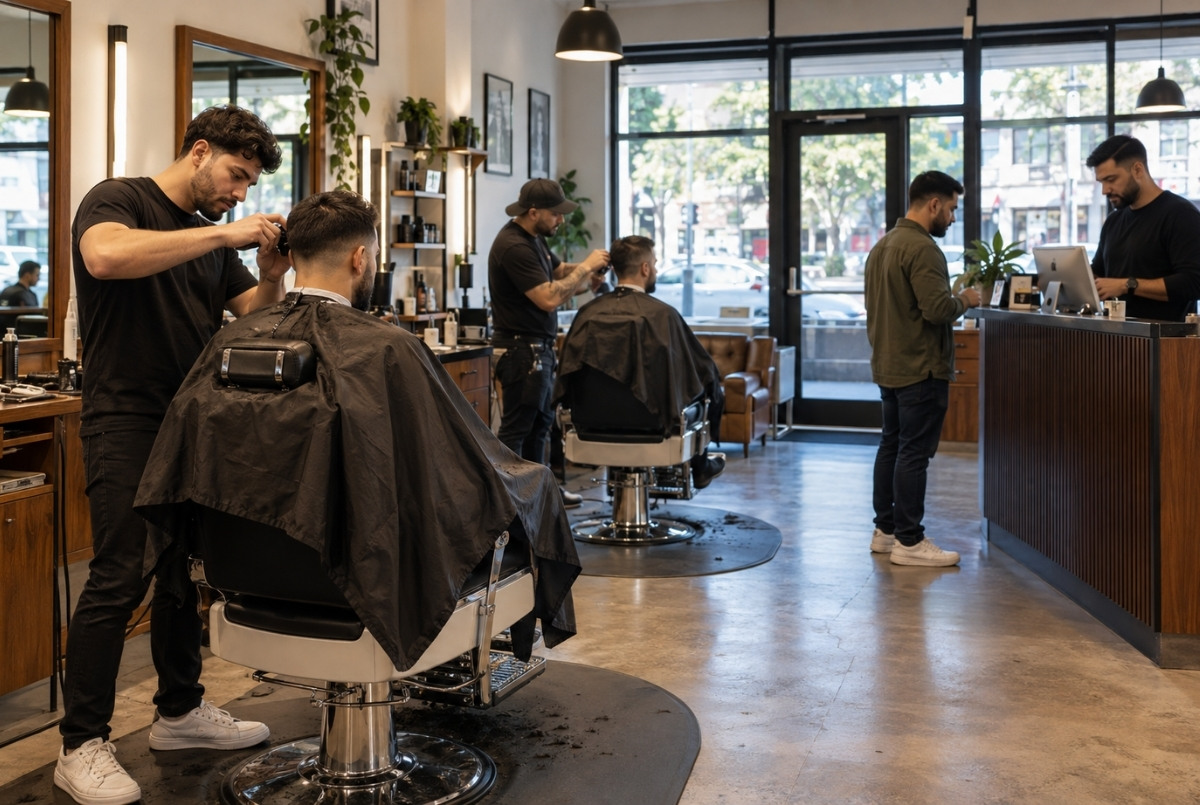
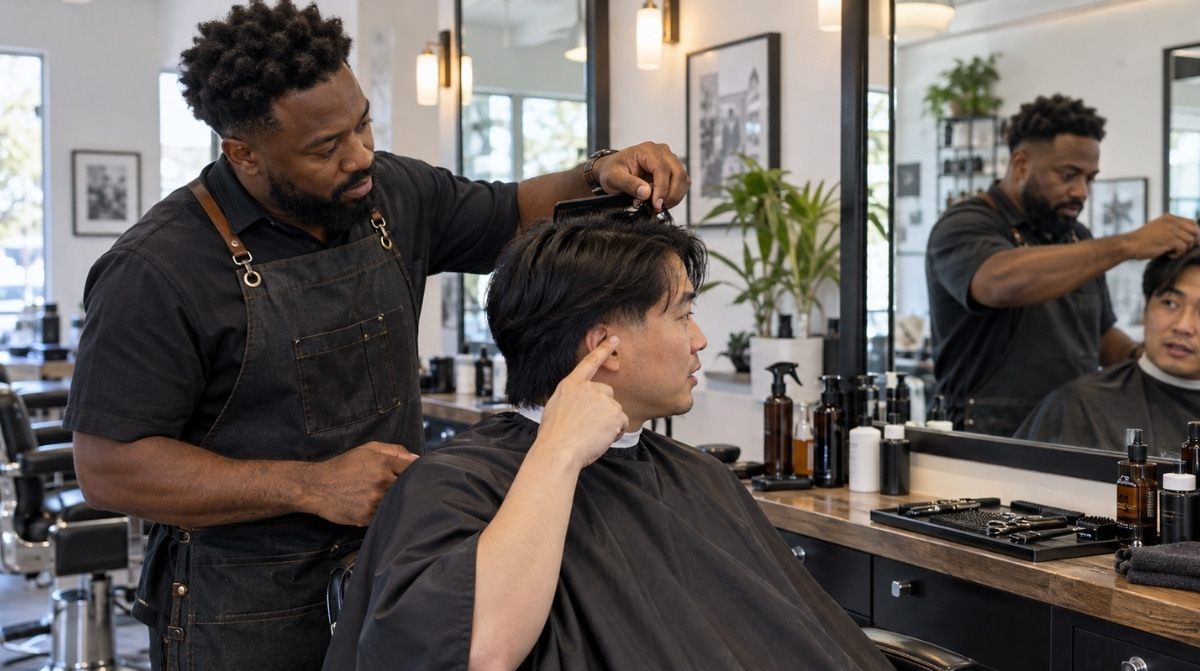
How to Talk to Your Barber About Haircut Lengths, Fades, and Styles

Sitting back in a barber chair can bring a little uncertainty once the cape is wrapped around your shoulders. You look into the mirror, and suddenly all those haircut terms you thought you knew seem harder to explain. An unsatisfying haircut does not always mean the barber lacks technical skill. Sometimes, the client pictures one result while the barber understands something else. Knowing how clipper guard numbers work, describing your preferred fade, and bringing useful reference photos can make your next appointment much easier to navigate.

Key Takeaways

  • Understanding Clipper Lengths: Most standard guard attachments increase in increments of 1/8 inch. A #1 guard leaves roughly 1/8 of an inch, a #2 leaves 1/4 of an inch, and so on, although the exact cutting length can vary by clipper, blade, and lever position.
  • Breaking Down Your Fade Request: To communicate the blend you want, explain three essentials: your preferred starting length, the height of the fade, and how much contrast you want between the shortest and longest sections.
  • The 3-Photo Strategy: Bring an image of your ideal haircut, another featuring a similar natural hair texture, and a third showing a style or detail you want to avoid.
  • Clear First-Visit Conversations: Discussing your daily routine, styling preferences, hair characteristics, and previous haircut experiences can help you and your barber establish realistic expectations.
  • Regulated Industry Standards: State-approved beauty and barbering programs follow regulated curricula that address haircutting, hair and scalp knowledge, sanitation, and other skills needed for professional practice.

Understanding Barber Clipper Guard Sizes
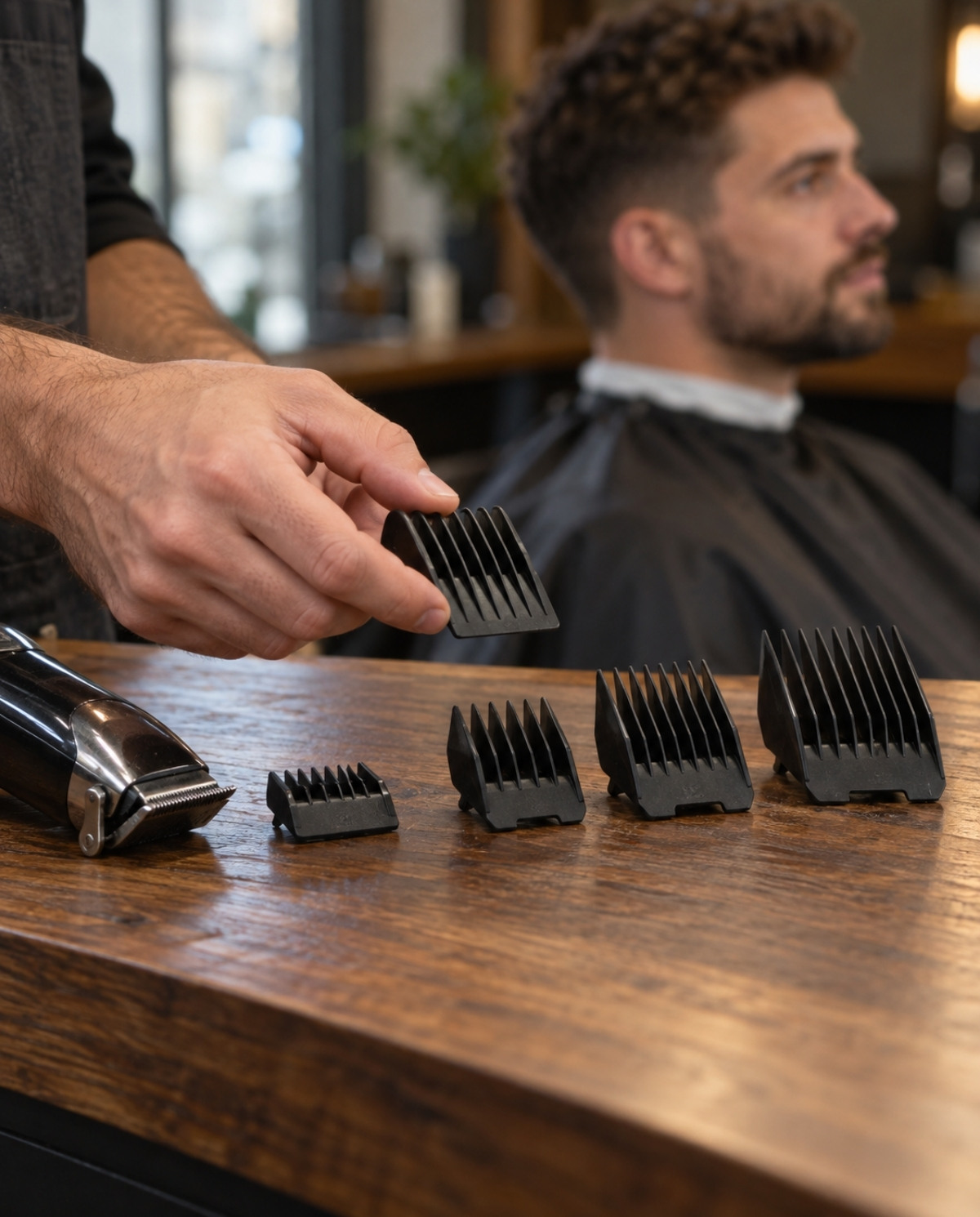
A barber lifts a black clipper guard above a wooden workstation displaying several guide combs with progressively deeper teeth.

A lot of people guess their preferred side length without really knowing how barber hair length numbers work in everyday practice. Most standard clipper guards follow a simple sizing convention: every whole-number increase generally adds about an eighth of an inch to the cutting length. As explained in the Fade Buzz Cut Length Index and Wahl’s official guide comb reference, clipper attachments help determine how much hair remains after cutting. These measurements are approximate, however, rather than identical across every clipper system.

Understanding barber haircut numbers takes some of the guesswork out of choosing a short hairstyle. On many clipper systems, a #0 guard leaves roughly 1/16 of an inch (1.5 mm), although #0 attachments and unguarded blade settings vary by manufacturer. Moving up to a #1 guard leaves approximately 1/8 of an inch (3 mm). If you have ever wondered what a 1 is at the barber, it generally means a close trim that leaves about 1/8 of an inch of hair. Your scalp may still be visible depending on your hair density, strand thickness, and the contrast between your hair and scalp.

A #2 guard leaves approximately 1/4 of an inch (6 mm), making it a common option for neatly trimmed sides. A #3 guard leaves around 3/8 of an inch (10 mm), creating a slightly softer finish. Moving up to a #4 guard leaves about 1/2 of an inch (13 mm), offering enough length for a fuller appearance or a gradual blend into longer hair on top.

One small detail many clients overlook is the adjustable lever found on many professional clippers. Closing the lever generally produces a shorter cut, while opening it leaves slightly more length without switching guards. As a result, two barbers using a #2 guard might achieve slightly different results depending on their clippers, blades, and lever settings. If you want to recreate a previous haircut, ask your barber to record both the guard size and lever position.

These barber cut numbers become more useful when you understand your natural hair characteristics. Hair density describes the number of individual strands growing within a particular area of the scalp, while strand thickness refers to the diameter of each strand. A person can have fine hair with high density or thicker individual strands with lower overall density. Both factors influence how much scalp becomes visible after a short haircut.

If you have fine strands or lower hair density, a #1 guard may reveal more scalp than you expect. Choosing a #2 or #3 guard can sometimes create a fuller appearance while reducing the visibility of natural bumps or uneven contours along the head. However, leaving hair longer does not necessarily conceal thinning, particularly when nearby sections have noticeably greater density.

Before choosing a guard, your barber should consider your hairline, crown growth direction, and any areas where hair is thinning. Cutting extremely close around a receding temple may emphasize the recession, whereas keeping additional length can sometimes produce a more balanced outline. Explaining your preferences beforehand helps your barber recommend a cut that works with your existing hair rather than against it.

Explaining Your Preferred Fade Without Confusion

When figuring out how to explain a fade to a barber, simply requesting a fade leaves plenty of room for interpretation. This haircut uses a gradual change in length, transitioning from shorter hair near the bottom toward longer sections higher on the head. To communicate the result you have in mind, focus on three important details.

Start by describing the shortest length you want at the bottom. A skin fade, sometimes called a bald fade, takes the lowest section down to exposed skin. Barbers may use a foil shaver or straight razor to achieve a particularly close finish. A shadow fade, on the other hand, keeps a small amount of visible hair at the base using a short clipper guard or blade setting. A #0.5 or #1 guard may create a softer shadow, depending on the tools used and your preferred appearance.

Next, explain how high you want the fade to extend. A low fade keeps its shortest section close to the ears and neckline, while a mid fade carries the transition farther up the sides. A high fade moves the shorter area considerably higher, sometimes approaching the parietal ridge, where the upper portion of the head begins curving into the sides.

These categories are helpful guides, but they are not standardized measurements. The same low fade can appear different on two people because of their head shape, temple height, and natural hair growth. Pointing out where you want the shorter section to reach often communicates your preference more effectively than relying on a haircut label alone.

Finally, decide how noticeable you want the difference between the shortest and longest sections to be. A high-contrast skin fade creates a stronger visual difference between exposed skin and longer hair, while a softer blend gives the haircut a more gradual appearance. Grooming trends highlighted by Men Zone’s 2026 Barbershop Trends reflect interest in natural-looking, lower-maintenance hairstyles with softer transitions.

A softer transition may also make growing hair less noticeable between appointments than a very sharp, high-contrast fade. Still, the ideal time between haircuts depends on how quickly your hair grows and how polished you want the outline to remain. Many clients return every three to five weeks, while people who prefer sharply defined skin fades may choose more frequent visits.

Another choice involves the shape of the fade around the back of your head. A level fade keeps the transition at a relatively consistent height, whereas a drop fade curves downward behind the ears toward the back. Depending on the placement and your head shape, this technique can preserve more length near the crown and produce a balanced silhouette. If you have a noticeable cowlick or an unusual crown growth pattern, discuss these features before your barber decides where to place the blend.

Choosing Haircut Photos That Actually Help Your Barber
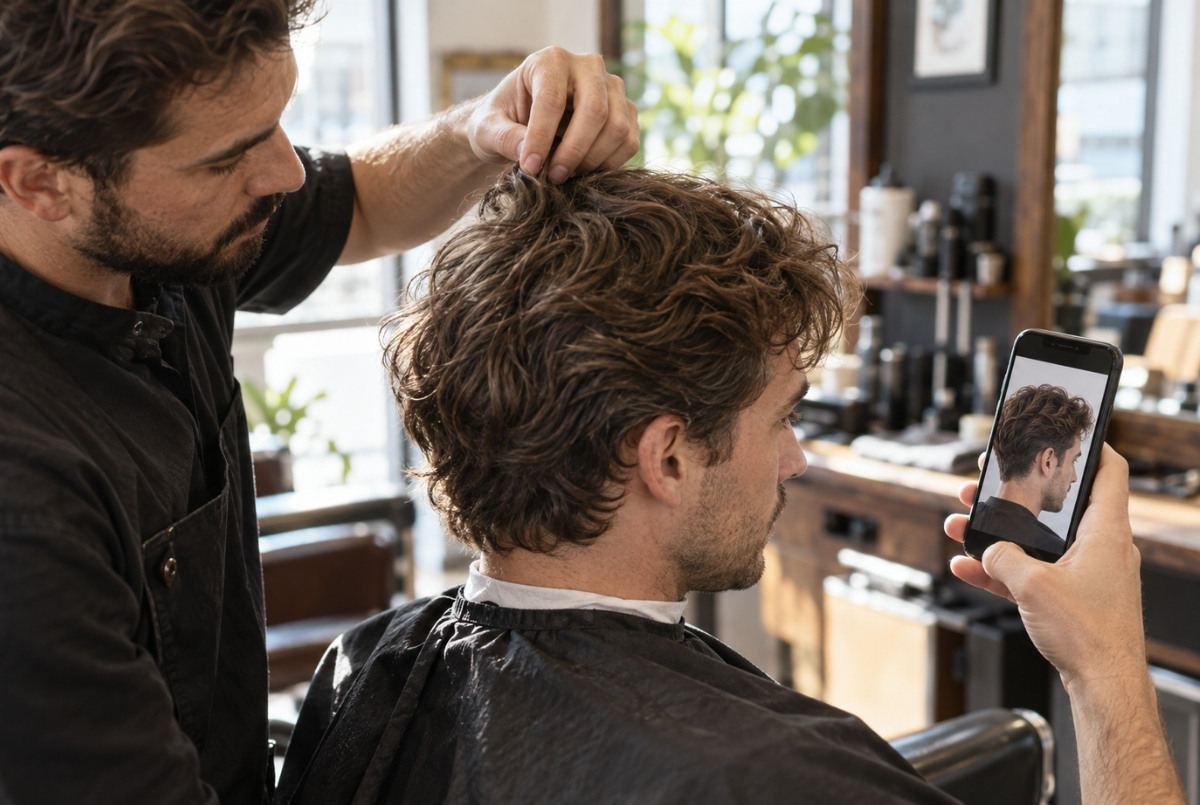
A barber lifts a section of a client’s wavy brown hair while the client holds a smartphone showing a shorter, similarly textured hairstyle.

Bringing pictures is one of the easiest ways to communicate when you want to talk to a barber about haircut ideas. However, showing only one celebrity photo does not always provide enough information. Even when a style looks perfect in a photograph, your head shape, hairline, density, and growth patterns may produce a different result.

To make your preferences easier to understand, prepare three different reference images:

  • Your Ideal Haircut: Choose a picture that captures the overall shape, top length, and styling direction you want.
  • A Similar Hair Texture: Find someone whose natural hair resembles yours, whether straight, wavy, curly, or coarse.
  • A Style You Want to Avoid: Include an example of a haircut, fade placement, or neckline finish you dislike so your barber understands your boundaries.

When selecting these pictures, pay attention to more than the finished hairstyle. Consider the model’s hairline, strand density, curl pattern, and the direction their hair naturally grows. A hairstyle photographed on someone with thick, straight hair may sit differently on finer or tightly curled strands, even when the cutting lengths are similar. Ask your barber which features of the reference are achievable with your hair and which might need adjustments.

It is equally important to understand how much styling the photographed haircut requires. Some looks depend on blow-drying, specialized tools, or products that create volume and hold. The same hairstyle may appear quite different after washing and air-drying. If you only spend a few minutes on your hair each morning, explaining that limitation allows your barber to recommend a more practical variation.

These conversations matter to barbershop businesses, too. According to Zenoti’s Salon and Barbershop Metrics Guide, first-to-second-visit retention is an important metric for tracking whether new customers return for another appointment. Although retention figures do not directly measure satisfaction or prove that consultations cause repeat visits, they illustrate why understanding and maintaining client relationships matters to a barbershop.

Students pursuing professional barbering education learn to examine hair characteristics, recognize unusual growth patterns, and recommend suitable services. This includes understanding cowlicks, which occur when hair grows in a direction that differs from surrounding strands, as well as considering how different cuts complement facial features. A useful consultation allows the barber to connect a client’s preferred appearance with the practical characteristics of their hair.

Simple Ways to Tell Your Barber What You Want
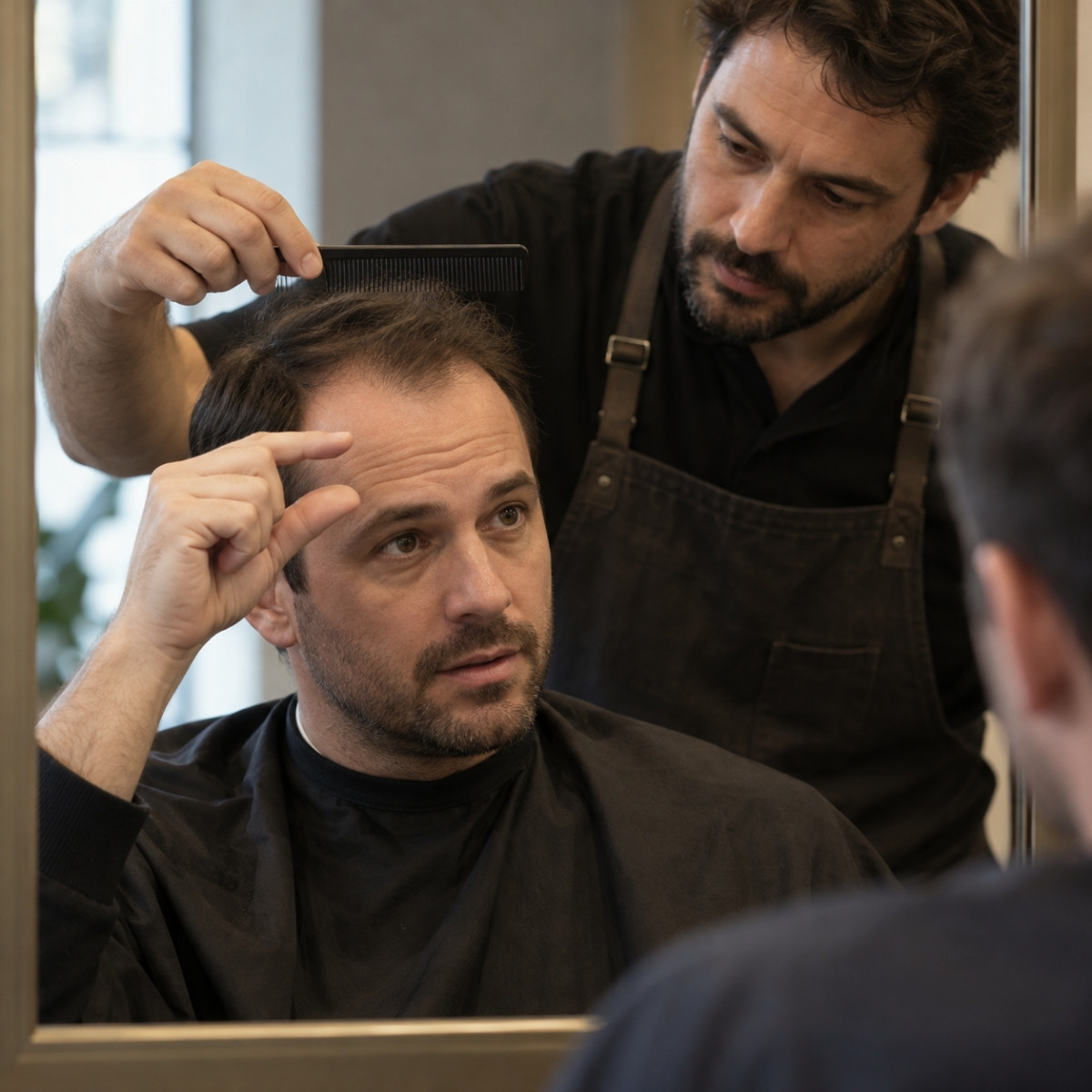
A client with a receding hairline holds his thumb and index finger apart while a barber positions a comb above his top hair.

If you sit down and struggle to figure out how to tell a barber to cut your hair, try organizing your request around three details: Top Length + Side Length or Fade Height + Neckline Finish.

For example, you might say, “I’d like to leave around two inches on top so I can brush it backward. For the sides, I’d prefer a mid fade beginning with a #2 guard, and I’d like the neckline to have a natural taper.” This gives the barber enough information to start discussing your preferences while allowing room for professional recommendations. Requests such as “just clean it up” or “make the sides shorter” are less helpful because they do not establish specific lengths or finishing details.

But what should you say to a barber when you do not know which haircut you want? You do not need to arrive with a specific style already chosen. Instead, describe your daily routine and the problems you would like your haircut to solve. You could ask for something that suits your head shape and takes no more than two minutes to style. You might also mention that your sides become bulky after a couple of weeks and ask which cut would grow out more comfortably.

Talking about previous haircut experiences can be especially useful. If the sides felt too puffy, the top required more styling than you expected, or the neckline appeared excessively sharp, tell your barber. These details help establish what you want to change without requiring you to memorize professional haircut terminology.

Client anxiety is another reason clear communication matters. As explained in Manhattan Barbershop’s guide to barbershop anxiety, some people feel uneasy during appointments because of clipper noise, close physical contact, or uncertainty about the process. Facing away from the mirror can also make it harder to follow what the barber is doing.

A considerate barber can reduce that uncertainty by explaining major steps, checking preferences before removing substantial length, and encouraging questions throughout the service. If something does not feel right, asking for a quick explanation or requesting a pause is perfectly reasonable. You should not have to remain silent while a haircut moves in a direction you did not expect.

Common Questions Before Your Next Barber Visit

How Is a Taper Different From a Fade?

Both styles involve gradually blending shorter and longer hair, but their typical placement differs. A fade often creates a broader transition across the sides and back, sometimes reaching very short lengths or exposed skin. A traditional taper generally retains more length around the sides and concentrates its shortest blending near the sideburns and neckline. Because barbers sometimes use these terms differently, bringing a reference image is a reliable way to clarify the finish you want.

Do You Need to Shampoo Before a Barber Appointment?

It helps to arrive with reasonably clean hair and without excessive styling product buildup. Heavy pomades, clays, or other products can make it harder for a barber to assess your hair’s natural movement, density, and growth direction. However, washing your hair immediately before your appointment is not always necessary, especially if your service already includes shampooing. For curly or textured hair, ask whether your barber prefers it detangled, in its natural state, or prepared in another specific way.

What if My Barber Has Not Cut Enough Hair?

Let your barber know as soon as you realize the length is not what you expected. In many cases, removing a little more hair is manageable, although the adjustment may require further blending or reshaping. If you think the haircut is becoming too short, raise your concern before the barber continues. Additional length can be removed, but hair that has already been cut cannot be immediately restored.

Building a Barbering Career Through Communication and Technical Skills

For aspiring hair professionals, learning to communicate with clients is just as important as becoming comfortable with shears, clippers, and other barbering tools. Building a long-term career involves understanding what customers expect, making practical recommendations, maintaining professional standards, and delivering services that encourage people to return.

Industry research offers a useful perspective on the value of existing customers. According to Zenoti’s 2026 Barbershop Trends report, new guest visits among barbershops in its North American benchmark dataset declined 17% in 2025 on a same-store basis, while existing guest visits increased 2%. These findings emphasize the business importance of serving returning clients, although the data do not establish that better communication or stronger relationships directly caused the increase.

Professional barbering education combines technical instruction with knowledge of sanitation, hair and scalp conditions, and service-related responsibilities. In Georgia, Rule 240-14-.02 outlines curriculum requirements for Master Barber students, including a minimum of 1,500 training hours. The curriculum requires 280 initial theory hours before students begin clinical services, with instruction addressing topics such as hair analysis, scalp treatments, shampooing, and conditioning. Students also complete practical training in haircutting and other barbering procedures.

Other states regulate barber training through their own licensing authorities. For example, the Arkansas State Board of Barber Examiners oversees barber education standards, licensing, examinations, and sanitation requirements. Although rules and required training hours vary between jurisdictions, state regulation helps establish the technical and public-health expectations associated with barbering.

Through structured instruction and hands-on practice, future barbers can develop a better understanding of hair growth patterns, scalp conditions, infection prevention, and customer service. This knowledge helps them explain haircut options, recognize practical limitations, and guide clients toward suitable choices rather than relying on assumptions.

Career prospects also deserve attention when considering barbering education. According to the U.S. Bureau of Labor Statistics, barbers earned a median hourly wage of $18.37 in May 2025, including tips. Barber employment is projected to increase 3% between 2025 and 2035. Actual earnings can differ considerably depending on geographic location, experience, clientele, employment arrangements, and whether a barber works independently or for an established business.

If you are deciding which direction to pursue, learning about the differences between barbering and cosmetology training and careers can help you compare educational requirements, professional responsibilities, and potential career opportunities.

Take the Next Step Toward a Barbering Career

Helping someone feel comfortable and understood during a haircut is an important part of working in the beauty industry. For individuals interested in becoming professional barbers, developing technical ability alongside consultation and customer service skills can provide a useful foundation for future career growth.

If you are considering professional beauty education, explore the available opportunities through the USA Beauty & Barber Academy enrollment page to learn more about beginning your training.

Have questions about available programs, enrollment requirements, or class schedules? Fill out the contact form below to speak with the admissions team and arrange a campus tour!

How Much Do Barbers Make? What the Numbers Really Tell You

Key Takeaways

  • Use wage figures as a starting point: BLS lists the median barber wage at $18.37 per hour for May 2025. At 2,080 hours annually, that translates to approximately $38,210. Employee tips and commissions are included, while self-employed earnings are excluded.
  • Focus on what remains after costs: Client payments are only the beginning of the calculation. Commission shares, chair rent, supplies, payment fees, and applicable taxes affect the money available for personal spending.
  • Compare rental with commission earnings: With a 60% barber commission and $400 in additional weekly rental costs, the two arrangements produce equal earnings at $1,000 in weekly service sales before personal taxes, assuming other conditions are equal. This is a comparison point, not the sales needed to earn zero profit.
  • Budget taxes against business profit: The standard self-employment tax rate is 15.3%, generally applied to 92.35% of net self-employment earnings after deductible expenses. Earnings limits and additional Medicare tax rules can affect the calculation.
  • Grow income without exhausting your schedule: Repeat customers, sensible pricing, profitable product sales, and controlled operating expenses can improve earnings without requiring a constant increase in appointments.

Reading Barber Wage Statistics in Context

Federal labor data offers a useful starting point when exploring how much do barbers make a year. The U.S. Bureau of Labor Statistics Occupational Outlook Handbook lists a median barber wage of $18.37 per hour in May 2025. Working 40 hours weekly for 52 weeks at that rate produces an annual equivalent of approximately $38,210.

That conversion assumes a full year of full-time work. It does not account for unpaid time away, reduced schedules, or differences between individual shops.

A median divides the workers represented into two equal groups: half earn above that amount and half below it. The mean, commonly called the arithmetic average, is calculated differently. Neither measure establishes the maximum a barber can earn.

The coverage of the survey is equally important. The BLS Occupational Employment and Wage Statistics methodology includes employee tips and commissions but does not cover self-employed workers or owners and partners in unincorporated firms. Self-employed barbers who rent chairs are therefore outside these employee wage estimates.

A renter’s client receipts cannot be compared directly with an employee’s wages. The renter still has to pay the costs of running the business, while employee compensation represents the amount paid to the worker under the shop’s compensation arrangement.

The exclusion of self-employed earnings also does not prove that barbers generally earn a particular percentage above the published median. For a useful personal estimate, start with the wage benchmark and then calculate expected income under the arrangement you intend to pursue.

Turning Appointments into an Earnings Estimate

Your service revenue depends on completed visits and the amount collected per visit. To understand what those visits contribute to your income, you also need to consider service duration, business expenses, and unpaid working time.

What Each Service Contributes

When asking how much do barbers make per cut, distinguish the customer’s bill from the barber’s compensation. A $35 haircut creates $35 in service sales. A commission barber receives an agreed share, while a self-employed renter pays business expenses from the receipts.

Local prices depend on the type of service, neighborhood, and market positioning of the shop. Comparing nearby businesses with similar offerings gives you a more practical pricing reference than assuming one national price applies everywhere.

Additional services can raise the amount spent during a visit. A hypothetical $30 haircut and $15 beard trim produce a $45 service ticket. The financial benefit depends on how much extra time and material the beard service requires.

For example, a $30 haircut taking 30 minutes produces $60 per service hour before expenses. A $45 haircut-and-beard service taking 45 minutes also produces $60 per service hour. The second appointment brings in more per customer, but the hourly service revenue remains unchanged.

Evaluate service combinations by their contribution after costs and the time needed to complete them safely. A higher bill is useful only when the service remains worthwhile to deliver.

How Many Visits Fit into a Working Day

There is no universal answer to how many cuts does a barber do a day. Detailed cuts, consultations, disinfection, breaks, and administrative duties all affect appointment capacity.

As an illustration, an eight-hour shift with one hour allocated to non-appointment duties leaves seven hours for client visits. If each appointment occupies 45 minutes, nine complete appointments fit into that period.

Actual paid visits may fall below available capacity. Empty slots, cancellations, and no-shows reduce sales even when the barber remains at work.

Build your forecast around the number of appointments you reasonably expect to complete. A fully booked schedule can be a goal, but it should not automatically become the assumption behind your income budget.

Daily Collections Versus Hourly Take-Home Pay

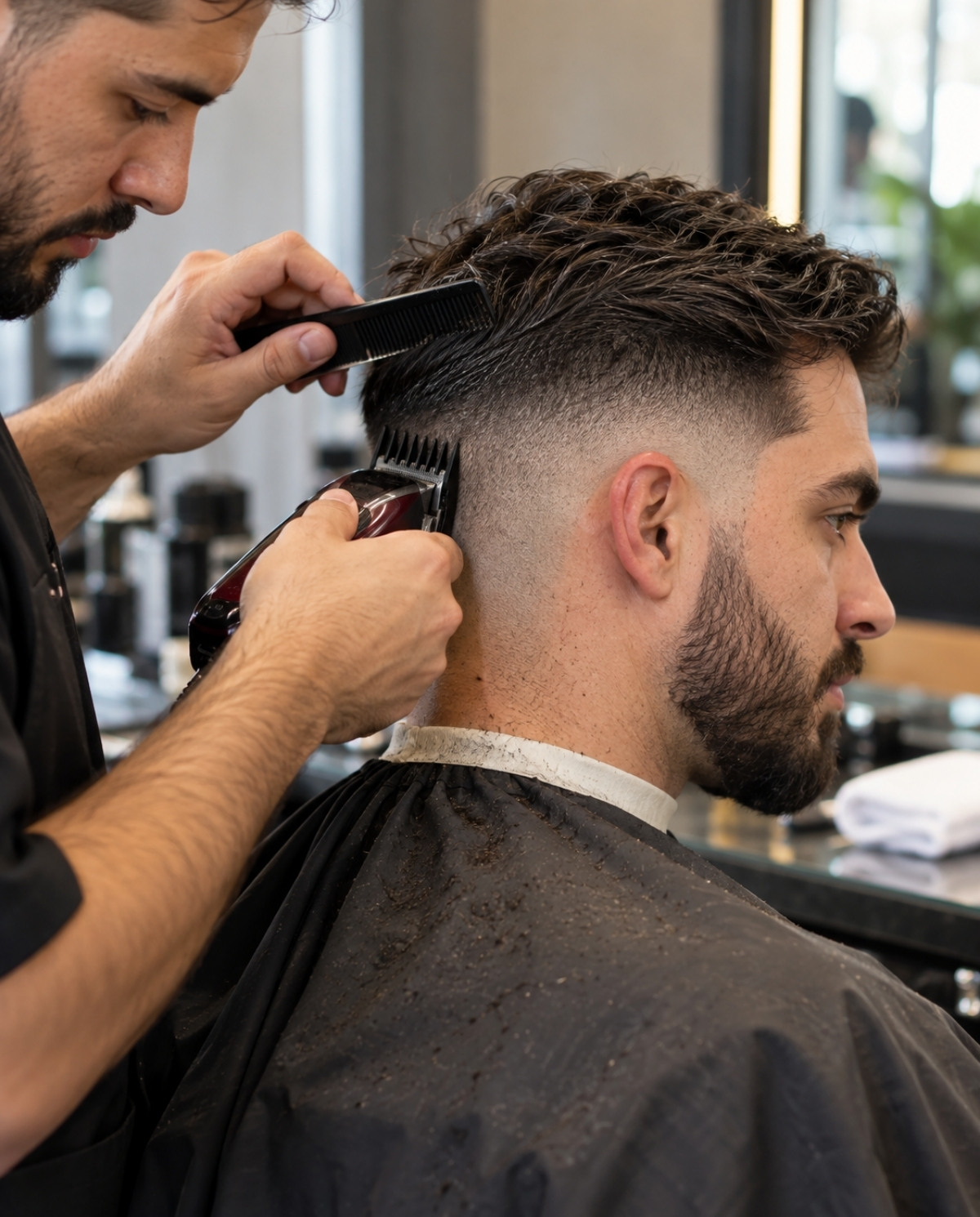
Close view of a barber using guarded clippers and a comb to refine a client’s fade, with small hair clippings on the cape.

To estimate how much does a barber make a day, consider ten completed visits with an average service ticket of $35. Those appointments generate $350 in service revenue.

If tips total an illustrative 15% to 20% of service sales, they contribute another $52.50 to $70. Combined daily receipts would be $402.50 to $420 before commission deductions, business expenses, and taxes. This example does not establish a standard tipping rate for every client.

For how much do barbers make an hour, divide by the entire working day rather than only the minutes spent cutting hair. Over eight hours, the example produces approximately $50.31 to $52.50 in gross receipts per working hour.

That amount is not an hourly take-home wage. Recording appointment volume, average spending, expenses, and total hours allows you to calculate a more meaningful return on your work.

Following the Money from Client Payment to Personal Income

Service and product sales bring money into a business, but only part of that money becomes available for personal use.

For a self-employed barber, income records begin with service payments, tips, and retail receipts. Deductible business costs may include rent, supplies, processing charges, booking software, insurance, and equipment expenses. The balance is business profit before personal taxes.

An employee begins with the compensation received from the shop, such as wages or commissions and applicable tips. The full amount charged to the customer belongs to the shop’s revenue calculation, not automatically to the employee’s earnings.

Comparing these financial measures consistently matters. A renter can collect more money from clients yet retain less after expenses than an employee working with reliable shop-generated demand.

How Commission and Chair Rental Allocate Costs

Commission compensation and chair rental are common arrangements, although hourly pay, salaries, and blended structures also exist.

  1. Commission arrangement: With an illustrative 60% barber share, every $100 in service sales provides $60 to the barber and $40 to the shop. The agreement should identify how tips are handled and which costs the shop pays, such as products, towels, booking support, or marketing.
  2. Chair rental arrangement: A self-employed renter pays for workspace and retains service receipts and tips. Responsibility for supplies, card processing, booking systems, advertising, insurance, and other expenses depends on the rental agreement; some packages include certain services or materials.

Receiving commission does not, by itself, determine employment status. The IRS guidance on employees and independent contractors evaluates behavioral control, financial control, and the type of relationship between the parties.

That third category extends beyond the written contract. Benefits, the expected duration of the relationship, and whether the work is central to the business can also matter.

Before accepting an offer, establish who controls pricing and scheduling, which expenses are covered, how tips are distributed, and what responsibilities you will carry.

Finding the Crossover Between the Two Arrangements

Rental introduces expenses that continue even when appointment volume drops. Whether it improves your earnings depends on your dependable sales and the costs you take on.

For a simplified comparison, suppose the barber receives 60% of service sales under commission. Renting allows the barber to retain the remaining 40% but introduces additional weekly expenses.

Divide those additional costs by 0.40 to find the service-sales level at which the two arrangements leave the same amount before personal taxes.

With $400 in additional weekly rental costs:

$400 ÷ 0.40 = $1,000 in weekly service sales.

At $600 in service sales, rental leaves $200 after the assumed $400 in costs. The commission arrangement pays $360.

At $1,500 in service sales, rental leaves $1,100, while commission pays $900.

At the $1,000 crossover, both leave $600 under these assumptions. The calculation identifies equal earnings between the arrangements, rather than a zero-profit business break-even point.

This comparison assumes identical tips and that the $400 represents the full difference in weekly expenses. If supplies or processing charges rise with sales, include those variable costs rather than treating every expense as fixed.

Benefits, differences in tax treatment, and access to customers supplied by the shop can also influence the result. Use ordinary weeks and realistic client demand when deciding whether rental is financially sustainable.

Keeping Tax Obligations and Equipment Costs in View

Barber holding a receipt and using a calculator between two stacks of paperwork, with a tool case and clipper guards nearby.

Self-employed barbers generally owe self-employment tax when net self-employment earnings reach $400, along with any applicable federal and state income taxes.

The IRS explanation of self-employment tax states that the taxable amount is generally 92.35% of net earnings after ordinary and necessary business expenses.

The standard rate is 15.3%, combining Social Security and Medicare taxes. However, the Social Security portion is subject to an annual earnings limit, and additional Medicare tax may apply above specified thresholds. The IRS breakdown of Social Security and Medicare taxes for self-employed workers explains these qualifications and the deduction generally available for the employer-equivalent portion.

Maintain separate records for receipts and expenses. Cash service payments and cash tips must also be recorded; receiving cash does not make the income exempt from reporting.

The IRS industry guide for cosmetology and barbering provides further information on rental arrangements, tips, and business records.

Allowing for taxes and future equipment replacement throughout the year gives you a clearer view of the money you can safely use for personal expenses.

Growing Revenue Beyond Another Haircut

More appointments are only one route to higher earnings. Suitable product recommendations, specialty services priced for their costs, and a location with workable expenses can also strengthen your financial results.

Measuring the Return from Product Recommendations

Pomades, shampoos, and beard oils can help customers maintain their results at home. Retail sales may also provide additional income without requiring a separate service appointment.

The amount sold is not necessarily the amount earned. Four products priced at $20 generate $80 in sales. Under a hypothetical 10% retail commission, the barber receives $8.

Repeating that sales level across 20 working days produces $160 in commission income.

If you buy and resell inventory yourself, calculate the remaining profit after wholesale prices, payment fees, and selling expenses. Stock that remains unsold or becomes damaged also affects the result.

The Grand View Research report on men’s grooming products forecasts a global market worth $506.7 billion by 2033. Its coverage spans multiple product categories and distribution channels; it does not measure barbershop service sales or forecast the earnings of an individual barber.

For your own business, the relevant measures are customer suitability, product costs or commission rates, and the income each recommendation actually produces.

Assessing a Location by Profit Potential

Higher haircut prices do not automatically make a market more profitable. Rent, customer demand, competition, and the cost of operating in that area all influence what remains after expenses.

The Best Cosmetology Programs barber salary guide lists May 2025 median annual employee wages of $61,150 in Washington, $30,750 in Georgia, and $25,640 in Arkansas. These are employee wage figures, not estimates of a renter’s revenue or business profit.

When making regional comparisons, consult the BLS state and metropolitan wage tables and match the occupation, reporting year, and wage measure. State-level figures cannot predict the earnings of a particular shop or newly licensed professional.

Consider the following before choosing where to work:

  • Comparable service rates: What nearby shops charge for services similar to yours.
  • Likely appointment demand: The paid visits you can reasonably expect after allowing for cancellations and slower periods.
  • Total operating expenses: Rental charges, supplies, payment fees, insurance, and any booking or marketing costs.
  • Customer convenience: Whether current clients can reach the location easily and continue booking with you.

A strong reputation and specialized ability may support higher prices. The useful financial target, however, is a reliable profit after costs.

Preparing for the Technical and Business Sides of Barbering

Professional training provides a foundation for consistent service. Cutting accuracy, sanitation, communication, and dependable work habits all contribute to the customer experience.

When comparing schools, look beyond exam preparation alone. Ask how students practice consultations, organize appointments, and learn about responsibilities in a working shop.

Our guide to barbering school costs, schedules, and enrollment can help you begin researching the educational commitment. Confirm current program details and admission requirements directly with the school before making your plans.

Useful areas to investigate include:

  • Reliable service delivery: Cutting technique, safe tool use, and an organized routine that allows enough time for consultations and disinfection.
  • Repeat-customer skills: Understanding preferences, producing consistent results, and discussing an appropriate return schedule.
  • Practical business knowledge: Pricing, compensation arrangements, expense records, retail sales, and the services permitted under your license.

Training requirements and permitted services depend on the state and license category. The Georgia barber curriculum regulations, for example, provide separate curricula for Master Barber and Barber II programs. Master Barber training includes chemical services.

For a broader look at entering the profession, explore our article on the steps involved in becoming a barber and our guide to barber licensing requirements and exam preparation.

Education supports your starting skills. Your earnings over time will also reflect experience, customer loyalty, local demand, and the way you manage expenses.

Common Questions About Barber Earnings and Career Planning

Adult trainee sectioning a mannequin’s brown hair with a comb while an instructor demonstrates comb positioning beside the training counter.

How much can tips add to a barber’s income?

The contribution varies between customers and appointments. As an illustration, a 15% to 20% gratuity on a $30 haircut equals $4.50 to $6. Ten visits would add $45 to $60 if every customer tipped within that range.

Record tips separately so you can understand their contribution without assuming the same amount will arrive every day. Published BLS employee wage estimates already include tips, so adding another tip percentage to those figures would double-count that component.

What client base is needed for a busy schedule?

There is no dependable number of months in which every beginner develops a full appointment book. Availability, local demand, service quality, and return frequency all affect progress.

You can, however, estimate the roster needed for a target workload. Ten visits daily over five days require 50 appointments each week. If every regular customer returns once every two weeks, approximately 100 active clients would support that volume. With four weeks between visits, approximately 200 would be needed.

Those examples assume appointments are evenly distributed and no visits are missed. Your actual rebooking and repeat-visit records provide a better measure of progress than a fixed timeline.

What physical demands should future barbers expect?

Long periods of standing and repeated hand, wrist, and arm movements are part of the work. The BLS career profile identifies physical stamina as an important quality because workers spend much of their shifts on their feet.

Suitable chair height, comfortable tools, changes in posture, and breaks can help manage strain. Ongoing pain or numbness should be assessed by a healthcare professional.

How do barbering and cosmetology licenses differ?

Barber education commonly concentrates on haircuts, shaving, and facial hair services. Cosmetology generally includes a wider combination of hair, skin, and nail services, although legal permissions depend on the state and license type.

Georgia’s Master Barber curriculum includes coloring, relaxing, permanent waving, and other chemical applications. Barber II has a separate curriculum.

Consult the Georgia State Board of Cosmetology and Barbers, or the licensing authority where you plan to work, before choosing a program or introducing a new service.

Explore Barber Training at USA Beauty and Barber Academy

USA Beauty and Barber Academy’s Master Barber program combines classroom instruction with practical training in haircutting, shaving, styling, chemical services, and sanitation. The school also identifies salon business and client retention among its training areas.

A visit to the Peachtree Corners campus gives you an opportunity to meet the team, explore the learning environment, and ask about program requirements and state board preparation.

Visit our Enrollment page to review the next steps and request a campus tour. You can also use the contact form below to ask questions and discuss your training goals.

Opening a Barbershop? Check These Costs and Licensing Rules First

What to Know Before Opening Your Shop

  • Business Ownership Does Not Authorize Barbering: Many states allow investors to own a barbershop without a personal barber license. The premises must still have the required establishment license, practitioners must hold appropriate credentials, and any professional management requirements must be satisfied.
  • Assess the Budget Before Taking on Rent: A former salon or barbershop may require less construction than an unfinished storefront. Inspect the infrastructure, obtain local estimates, and determine the revenue needed to cover expenses before committing.
  • Check the Rules for Your State: Georgia requires salon/shop owners to complete an approved health, safety, and sanitation course. Arkansas requires a registered barber to personally supervise and manage the barbershop.
  • A Contract Alone Does Not Establish Independence: Chair renters should run their own businesses. Setting their prices, requiring particular shifts, or directing their working methods can create worker-classification problems.
  • Measure the Value of Booking Software: Digital scheduling, appointment reminders, and payment policies can support daily operations. Use your own booking and revenue records to determine whether these tools deliver results.

Starting a business in the grooming industry is an exciting venture, but jumping into a commercial lease without a clear strategy can quickly lead to expensive setbacks. A lot of prospective owners assume they must be licensed hair professionals just to get started. In reality, states like New York and Georgia distinguish the shop’s operating license from an individual’s authorization to provide barbering services. If you are also interested in working behind the chair while managing your investment, learning about the steps to becoming a barber gives you a clear roadmap of the required training and professional milestones in this field.

Can You Own a Barbershop Without Cutting Hair?

Having no haircutting experience does not necessarily prevent you from investing in a barbershop. Business ownership and licensed service delivery carry different responsibilities, however. Before moving forward, establish which credentials your state requires for the premises, the people serving clients, and anyone providing professional supervision.

Separate the Business License From the Right to Provide Services

A compliant shop starts with understanding two types of authorization: the establishment license and the individual practitioner license.

The establishment license permits the business to operate under applicable state requirements. A practitioner credential permits its holder to deliver the services covered by that credential’s scope of practice.

These permissions are easy to confuse when researching how to set up a barbering shop. The New York State Division of Licensing Services makes the distinction explicit: a Barber Shop Owner license does not authorize its holder to practice barbering. People providing barbering services need the appropriate operator credential. New York also prohibits apprentice barbers from owning a shop or renting space in one.

An owner who does not serve clients may concentrate on financial planning, advertising, brand development, and administration. That role still includes ensuring the establishment is properly licensed, maintaining compliant facilities, and arranging any professional management or supervision required by law.

If you plan to own a barbershop without being a barber, leave regulated services such as haircutting, shaving, and line-ups to appropriately credentialed practitioners unless you obtain the required credential yourself. What matters legally is the service being performed, rather than simply whether someone handles a tool. Knowing the permitted scope of each credential helps you keep business responsibilities separate from licensed practice.

For a closer look at how future employees qualify, our article on barber license requirements covers training, state board examinations, and the licensing process.

Compare Georgia’s and Arkansas’s Operating Rules

Requirements differ across state lines. These two examples illustrate why owners need to investigate the rules for their actual location:

  • Opening in Georgia: The establishment application rules permit a person or persons to apply to operate a salon/shop without stating that every owner needs a practitioner credential. Georgia Board Rule 240-12-.01 requires the salon/shop owner to complete a board-approved health, safety, and sanitation course. It also requires the business name to include “Salon” or “Shop” and the establishment to be licensed before business begins.
  • Opening in Arkansas: Arkansas Code §17-20-301, published by the State Board of Barber Examiners, requires a barbershop to operate under a registered barber’s personal supervision and management. It also prohibits an unlicensed person from serving as a barber manager. An investor without a barber credential must therefore distinguish ownership of the business from its required professional management.

Before taking on a lease, find out whether your state requires a designated licensed manager, which license qualifies, and how supervision must be provided. Neither the title “master barber” nor a particular staffing arrangement should be treated as a nationwide requirement.

Evaluate the Space and Its Financial Demands

Rent becomes an obligation before your customer base has had time to develop. Compare potential premises early, including former salons or barbershops and unfinished retail units. For each option, assess whether the layout can meet licensing and building requirements, what alterations are necessary, and how the resulting expenses affect the business.

A suitable location needs to work from three perspectives: construction, ongoing profitability, and the terms of the lease.

Account for More Than Furniture and Décor

Mirrors, chairs, and paint are visible expenses, but a storefront conversion may also require extensive plumbing, electrical, and mechanical work. Water-heating capacity, drainage, and equipment power requirements deserve attention before you finalize the budget.

New water lines or drainage beneath a concrete floor can substantially increase construction costs. Because layouts and service plans vary, a universal plumbing percentage is not a dependable budgeting method. Request estimates for the work your shop actually needs.

For a preliminary reference, Menubly’s barbershop startup-cost guide estimates full build-out expenses at $15,000 to $50,000 or more, with barber chairs and station equipment budgeted separately. These are commercial-guide estimates, so use them as an initial reference rather than a national benchmark or replacement for contractor quotes.

Previously occupied salons and barbershops, often called second-generation spaces, may offer usable plumbing and electrical systems. Menubly suggests those existing systems could save $10,000 to $20,000. Whether you achieve any such savings depends on their condition and suitability for your operation.

You could also investigate a former pet-grooming unit, but its sinks and drains do not establish that it meets requirements for human grooming services. Have the premises assessed before including potential savings in your calculations.

Prepare separate allowances for construction, lease deposits, establishment licensing, equipment, supplies, signage, insurance, and initial marketing. Alongside the startup budget, forecast the cash required to pay ongoing bills while appointments are still building.

Work Out Your Required Sales Volume

Electrician reviews clipboard notes with a prospective owner beside a closed electrical panel and an existing barber station.

An inexpensive renovation does not guarantee affordable monthly operations. Calculate how much business the shop must generate before deciding that a location fits your budget.

The U.S. Small Business Administration’s break-even calculator provides the basis for this calculation:

Monthly services needed to break even = monthly fixed expenses ÷ contribution from each service

In a shop staffed by employees, the contribution from a service is its selling price less the variable expenses associated with delivering it. Your compensation model will affect those expenses, which may include commissions, consumable products, and card-processing charges.

Suppose monthly fixed expenses are $6,000 and each completed service contributes $20 toward them. The shop would need 300 services a month to reach break-even. With 25 operating days, that works out to 12 services per day. This example illustrates the calculation; it does not represent typical industry performance.

Check whether your staffed chairs, service durations, operating hours, and anticipated demand can support that target. Your broader cash-flow forecast should also address owner compensation and financing obligations. Tips collected for employees should not be treated as shop revenue.

For a chair-rental operation, calculate whether rent from realistically occupied stations will cover overhead. Include a scenario in which a station sits empty or a renter leaves. Weekly rental payments are predictable only when tenants remain in place and pay as agreed.

Investigate the Premises Before Negotiating the Lease

Passing traffic is only one part of a location’s suitability. Review the following before accepting a long-term commitment:

  1. Infrastructure Condition: Ask qualified contractors to check drainage, water supply, hot-water capacity, and the electrical demand of your equipment. Previously installed connections may still require repairs or replacement.
  2. Permitted Use and Facility Compliance: Verify that barbering is an allowed use and that the proposed layout can meet building, accessibility, fire, and state board requirements. A former salon is not automatically approved for your new business.
  3. Convenient Customer Access: Assess parking, the entrance, and how easily your intended customers can reach the premises.
  4. Terms for Unsuccessful Approvals: Seek provisions covering required approvals, application deadlines, and the right to end the lease if approval cannot be obtained. Address deposits and prepaid rent explicitly instead of assuming they will be returned.
  5. Responsibility for Costs and Alterations: Establish who pays for code upgrades, whether the landlord contributes to construction, when rent begins, and how maintenance and common-area charges work. Review restrictions affecting subleasing or chair rental.

In Georgia, the Board’s facility rules address matters such as separation from other spaces, equipment condition, running hot and cold water, restroom access, and displays of licenses and inspection reports.

Checking these requirements before signing helps prevent an apparently affordable space from becoming an expensive compliance project.

Decide How Barbers Will Work in Your Business

Your staffing arrangement determines how the shop earns money and how much responsibility you assume for management, payroll, and taxes. Independent chair renters pay for space while operating their own businesses. Employees work for the shop and receive hourly pay, commissions, or a combination.

Assess each arrangement against its expected revenue and expenses. Neither provides an automatic path to higher profit.

Understand the Chair-Rental Arrangement

An independent renter typically pays a weekly or monthly fee for a chair or defined area. Signs of a separate business include setting prices, managing appointments, buying products, and paying its own business expenses.

The IRS guide for the cosmetology and barber industry discusses these characteristics in its treatment of booth renters. The classification examples offer useful context, although current filing requirements should be verified separately.

Rental income can simplify forecasting and reduce payroll administration for the owner. It does not give the owner the same authority over a renter’s schedule, prices, or service methods that an employer has over employees. Sanitation duties and reasonable premises rules still require attention.

Document the rented space, payment terms, included services or supplies, access arrangements, insurance responsibilities, and termination conditions. Then make sure daily operations reflect the independence described in the agreement.

Recognize the Obligations That Come With Employees

With employees, the business can set service prices, schedule shifts, establish lawful workplace policies, take customer payments, and administer the agreed compensation system.

That control supports a consistent customer experience, but it also brings employment taxes, payroll administration, recordkeeping, and wage-compliance duties. A shop collecting more service revenue may still earn less profit after labor and other expenses.

Paying commissions does not, by itself, eliminate minimum-wage or overtime requirements. The U.S. Department of Labor’s guidance on commissioned retail and service employees explains the conditions required for the federal retail-service overtime exemption. Applicable state rules must also be considered.

Keep accurate time records and review the complete pay arrangement before treating an employee as exempt from overtime.

Match Worker Status to the Actual Arrangement

Two barbers cut clients’ hair at separate stations while another customer completes checkout with the owner at reception.

Some shops accommodate both employees and independent renters. Each relationship must be evaluated on its own facts, particularly when the business exercises control over someone described as a contractor.

The IRS worker-classification guidance considers behavioral control, financial control, and the nature of the relationship. It evaluates the full arrangement rather than relying on a single deciding factor.

Requiring particular shifts, setting a renter’s customer prices, or directing how services are delivered can point toward employment. A rental contract or the label “1099 contractor” does not resolve classification by itself.

Incorrect classification can result in employment-tax liability and additional obligations under wage, unemployment, or workers’ compensation laws. Chair rental also does not automatically require the owner to issue a contractor-payment tax form to the renter; reporting depends on the payment flows and the actual arrangement.

Create an Operating Environment Your Team Can Rely On

Owners without technical barbering experience can still contribute substantially by establishing dependable business systems. Understand your operational responsibilities and make sure any legally required professional supervision is covered.

Well-maintained premises, clear agreements, and suitable software help practitioners work effectively and support a consistent business.

Concentrate on the Responsibilities of Ownership

If you will manage the business without providing services, identify the practical problems you can solve for the people working there:

  • Define Who Provides Supplies: Stock the sanitation products, towels, neck strips, and other items your business supplies to employees. For renters, document which items are included and which they purchase for their own businesses.
  • Keep the Premises Functional: Arrange cleaning and maintenance, care for equipment and building systems, and respond promptly when something needs repair.
  • Help Customers Find the Shop: Maintain accurate business listings and develop local marketing and community connections. Arrange shared promotions with renters in accordance with their agreements and independent business status.
  • Maintain Required Professional Management: Where licensed supervision is mandatory, establish acceptable coverage and a plan for the designated professional’s absence or departure.

Adapt these systems to the staffing arrangement you choose. Shared scheduling and supplies may suit an employee-based business, whereas independent renters may handle appointments and purchase products themselves.

Connect Appointment Software With Clear Payment Policies

Digital booking and payment systems can organize appointments, transactions, and business records. Upmetrics’ barber-business trends article discusses online scheduling, cashless payments, reminders, and management software. These trends do not demonstrate a guaranteed increase in occupancy or profit.

Select features that fit your operation. A business employing barbers may benefit from shared schedules and commission reports. A rental-based shop needs to consider whether shared software respects each renter’s independent arrangements.

Understand the payment options before relying on cancellation protection. Square’s cancellation and prepayment documentation distinguishes full prepayment from holding a card for no-show protection. It also explains that a business chooses whether to enforce and charge its cancellation fee.

Communicate cancellation deadlines and charges clearly, check how customers receive the policy, and learn how refunds and declined cards are handled. Holding a card is different from collecting a deposit, and neither ensures that every canceled appointment produces recoverable income.

Review completed appointments, no-shows, late cancellations, booked hours, and revenue per available barber hour. Your records will show whether the system is improving the way your shop operates.

Develop the Knowledge Needed to Run the Shop

Barbershop owner studies an appointment calendar on a laptop at reception with an empty chair and prepared workstation behind him.

Successful ownership requires an understanding of regulation, financial planning, and the working environment your practitioners need.

Barbers must develop technical skills, while owners also need competence in budgeting, agreements, marketing, and administration. Training can introduce you to the trade, but it cannot replace a financial plan for your location or confirmation of establishment requirements.

The Fortune Business Insights salon-services report identifies interest in men’s grooming as one factor supporting market demand. Use that broader context to explore service possibilities, then test them against local customers, competition, and realistic prices.

If you or a prospective team member is considering formal education, our guide to starting barbering school in 2026 discusses costs, program length, and enrollment requirements. Ask the school directly about attendance options and instruction in sanitation, licensing preparation, client communication, and business topics.

Common Questions From Future Shop Owners

Must a non-barber owner hire someone with a master barber license?

There is no universal requirement to employ someone with the title “master barber.” The qualifying credential and supervision rules depend on the state. Arkansas, for example, requires a registered barber to personally supervise and manage the shop. Verify the professional management requirements that apply to your location.

How much time should I allow before opening?

The process can take several months as you negotiate the lease, complete construction, obtain permits and establishment licensing, and recruit staff. A previously fitted space needing minor changes may move faster than an unfinished unit requiring new drainage or electrical work. Set the opening schedule around the approvals and construction your premises require.

Is it possible to study barbering while managing a shop?

It may be possible if the school’s attendance schedule fits your business responsibilities. Ask whether part-time study is available, how training hours are completed, and how long the program will take under that schedule. Arrange sufficient management coverage during classes, and remember that being enrolled does not authorize you to provide regulated services.

Which insurance policies should a new owner consider?

General liability, business property, and professional liability are common coverage categories. General liability generally covers qualifying third-party injury and property-damage claims, while professional liability addresses qualifying claims connected with services. The actual protection depends on policy terms and exclusions.

The Wexford Insurance overview of barbershop licensing and insurance can help you begin a coverage discussion. Check your lease as well, since landlords may specify insurance requirements.

Workers’ compensation obligations vary by state and workforce size. The Georgia State Board of Workers’ Compensation states that most employers with three or more regular full-time, part-time, or seasonal employees must carry coverage. Corporate officers and LLC members count toward that threshold even if they exempt themselves from coverage.

Take the Next Step Toward Your Barbering Goals

Before investing in a lease, establish how the shop will be licensed, whether the finances are workable, and how practitioners will operate within the business. That preparation gives you a firmer basis for deciding when and where to open.

To learn about training at USA Beauty and Barber Academy, visit our Enrollment section. You can also use the inquiry form at the end of this article to contact our team and discuss your next steps.

How to Get Into Mortuary Cosmetology and Prepare for Your First Opportunity

Essential Points Before Entering Mortuary Beauty Work

  • Check the Rules for Your Services: Beauty training can support hair, makeup, and nail care for the deceased, but holding a cosmetology license does not authorize every preparation-room task. Ask both the beauty board and funeral-service regulator about your intended duties.
  • Education Routes Differ: Georgia offers a 1,500-hour cosmetology school route and an apprenticeship route requiring at least 3,000 hours over 18 months. Arkansas also specifies 1,500 hours for cosmetologist training.
  • Working Arrangements Vary: Funeral establishments may assign cosmetic care to employees or outside specialists. Discuss scheduling, expected case volume, responsibilities, and payment before accepting an arrangement.
  • Choose Coverage Individually: Mortuary products range from translucent to opaque. Skin condition and the correction needed should guide your selection; heavy, wax-based makeup is not necessary in every case.
  • Local Conversations Provide Useful Insight: Funeral directors can explain their staffing needs, credential expectations, supervision requirements, and preparation-room procedures.

Stepping onto a less conventional career path in the beauty world can feel intimidating. Desairology, or cosmetic care for people who have died, offers a way to apply beauty skills in a setting centered on remembrance. Helping recreate a loved one’s familiar appearance can be a meaningful contribution during a family’s difficult transition.

Working inside a funeral home also brings responsibilities beyond classic salon services. Exploring this specialty requires a realistic understanding of state regulations, workplace hazards, specialized products, and the opportunities available in your local area.

The Services Involved in Caring for a Person’s Final Appearance

Mortuary cosmetic care centers on dignity, respect, and the individual’s preferences. The desired result might be understated or more expressive, depending on how the person usually presented themselves and what the family requests.

Your responsibilities will depend on your authorized scope, the condition of the remains, and the funeral establishment’s instructions. They may include:

  • Hair Styling and Grooming: Trimming or arranging hair to reflect a familiar style, with beard grooming where permitted and appropriate.
  • Makeup Application: Matching complexion tones, reducing the appearance of discoloration, and applying foundation, lip color, or other requested cosmetics.
  • Nail Services: Cleaning, shaping, or polishing nails when requested and within your permitted responsibilities.

Family photographs offer useful guidance, but they cannot answer every question about the desired result. Someone who rarely wore cosmetics may call for a restrained approach, while another person’s recognizable appearance might include a particular lipstick shade or hairstyle. Ask the funeral director which photograph should guide the work and whether personal, cultural, or religious preferences need to be followed.

Funeral-home cosmetic care is among the specialized possibilities discussed in our guide to careers available with a cosmetology license, including offline and remote options. Foundational beauty skills remain useful, but this setting also calls for additional instruction and an understanding of the requirements governing your role.

Researching the Credentials Your Intended Role Requires

Offering hair or makeup services in a funeral setting does not automatically mean you need a four-year mortuary science degree. Equally, a general beauty license should not be treated as unrestricted permission to carry out preparation tasks.

The answer depends on the state and the exact services involved. For example, Florida’s Department of Business and Professional Regulation explains that makeup application and hair arranging on a deceased person in a funeral home are not regulated by that department. It directs further questions to the Division of Funeral, Cemetery & Consumer Services. This guidance addresses those particular services; it does not establish authorization for other preparation work.

Before selecting a training route, describe your proposed duties to your state beauty board and funeral-service regulator. Ask whether you need an individual license, must work under supervision, or face establishment-specific restrictions. Also identify any procedures reserved for licensed funeral-service professionals. Written clarification can help you plan with greater confidence.

Developing Relevant Skills Through Beauty Education

A state-approved cosmetology program can introduce techniques in hair design, makeup, nail services, color theory, and sanitation that may support later specialized learning.

Georgia’s school curriculum requires 1,500 training hours across a minimum of nine months. Arkansas lists a 1,500-hour training requirement for cosmetologists. Georgia also recognizes an apprenticeship option requiring at least 18 months and 3,000 hours.

These requirements concern general cosmetology education, not a separate mortuary beauty credential. Our overview of state cosmetology licensing hours, examinations, and renewal requirements can help you prepare questions for the board responsible for your license.

School accreditation and state approval serve different purposes. When evaluating a program for licensure, confirm that the relevant licensing board accepts its training.

Separating Cosmetic Services from Embalming and Reconstruction

Makeup application and embalming involve different responsibilities. A cosmetology or barber license does not authorize embalming, and working on the body’s exterior does not automatically place a procedure within your permitted scope.

  • Beauty Professionals: Cosmetologists and barbers may contribute services that their applicable authorization and the establishment’s policies permit. Their licenses cover different activities, so neither should be treated as interchangeable permission for every hair, skin, or nail service.
  • Embalming Professionals: Embalmers must meet the licensing requirements in their jurisdiction. Depending on the state, these can include approved funeral-service education, supervised experience, and examinations.
  • Supplementary Training: Relevant courses may teach specialized product use, presentation techniques, and preparation-room practices. Completing a private course does not replace a license or other authorization required to perform the services.

Georgia’s funeral-service licensing rules illustrate the distinction. Embalmer applicants must provide proof of graduation from an ABFSE-accredited funeral-service college or another college specifically approved by the Board, complete 3,120 apprenticeship hours, and document assistance with embalming at least 50 bodies. The examination route also requires passing the Funeral Service Science Examination of the National Conference of Funeral Service Examining Boards.

The American Board of Funeral Service Education directory identifies accredited programs. FINE Mortuary College’s resources provide additional background on funeral-service licensing, although the relevant state board remains the authority for confirming current requirements.

Refer structural reconstruction, invasive preparation, or any other work outside your competence or authorization to the establishment’s appropriately qualified professional. Additional technical knowledge does not, by itself, expand your legal responsibilities.

Selecting Makeup for the Condition of the Skin

Preparation-room cosmetic work begins with assessment. The condition of the skin, visible discoloration, and requested appearance influence how much correction is appropriate and which products should be used.

It is inaccurate to characterize all post-mortem skin as non-porous or assume that liquid cosmetics cannot be used. Mortuary product lines include several formulations, and an opaque finish is not necessary for every person.

For example, Dodge’s instructions for Aquachrome cosmetics describe a water-based, translucent formulation intended for normal skin. The manufacturer explains that translucent coverage preserves the underlying skin tone and is not designed to conceal discoloration.

When learning these techniques, pay attention to the following distinctions:

  1. Coverage Level: Translucent formulas can maintain a natural appearance where concealment is unnecessary. Opaque products may be appropriate for visible discoloration. Select coverage according to the case rather than routinely choosing the heaviest foundation.
  2. Application Requirements: Products differ in formulation and intended use. Follow their instructions and obtain supervised guidance before working with unfamiliar materials. Airbrushing may be an option, but it is not required for every assignment.
  3. Correction Versus Reconstruction: Concealing a color difference is distinct from rebuilding a feature with restorative materials. Experience applying foundation does not establish competence or authorization to perform structural restoration.
  4. Viewing Environment: Check the completed appearance under the lighting that will be used for the viewing. Refer to the requested look and family photographs rather than assuming every venue calls for identical color adjustments.

The Career Trend article on entering mortuary makeup work discusses specialized product knowledge and sanitation training. For individual product decisions, manufacturer guidance and supervised instruction offer more specific direction than a general career overview.

Color theory remains valuable, but careful restraint matters too. Apply only the correction needed to achieve the agreed appearance.

Understanding Hazards Before Entering the Preparation Room

A calm setting can still contain workplace risks. Depending on your duties and where you work, you may encounter blood or other potentially infectious materials, contaminated tools, or preparation-room chemicals.

OSHA’s funeral-home guidance explains that bloodborne-pathogen requirements depend on reasonably anticipated occupational exposure. Its separate formaldehyde interpretation addresses occupational exposure associated with embalming in funeral homes.

Discuss these matters with the establishment before beginning an assignment:

  • Training for Your Duties: Identify the hazards connected to your services and the instruction required before you start.
  • Protective Equipment: Confirm what protection is appropriate and who supplies it.
  • Chemical Handling: Locate safety data sheets and learn the relevant ventilation and handling procedures.
  • Decontamination and Disposal: Understand how tools, work surfaces, contaminated items, and waste must be managed.
  • Exposure Procedures: Know whom to notify and what action to take if an incident occurs.

Applicable obligations depend on the employment arrangement and exposure circumstances. Learn the establishment’s procedures before entering its preparation area; salon sanitation experience alone does not address every hazard in this environment.

Assessing Earnings and Contract Terms Realistically

Financial planning is an important part of exploring mortuary beauty work. Some establishments use employees, while others engage independent specialists. The services needed and frequency of assignments vary locally.

The Indeed guide to becoming a mortuary cosmetologist describes employment and independent-contracting possibilities. These arrangements should be evaluated separately because an employee salary estimate does not establish an appropriate freelance case fee.

As of October 5, 2026, ZipRecruiter’s Mortuary Cosmetologist category displayed an estimated national average of $43,287 annually, or approximately $20.81 per hour. Its separate Mortuary Cosmetology category displayed $45,943 annually, equivalent to approximately $22.09 per hour.

These are estimates for two differently named categories. They do not establish a standard hourly range, verified entry-level wages, contractor rates, or guaranteed earnings.

Before accepting work, clarify the payment arrangement:

  • Employee Positions: Ask which duties are included, whether hours are guaranteed, and how availability or work outside the regular schedule is handled.
  • Contract Assignments: Define the services covered by the fee, responsibility for supplies, and any additional charges for travel, urgent requests, or extra work.
  • Combined Funeral-Service Positions: Jobs that include embalming, funeral directing, or broader preparation duties involve different credentials and responsibilities. Their earnings are not a direct benchmark for hair and makeup services alone.

A contractor’s case fee is gross revenue. Travel, setup, cleanup, consumables, administration, insurance, and applicable taxes can reduce the amount retained.

Combining this specialty with salon services may offer flexibility, but it does not guarantee stable income. Before depending on mortuary work as your main source of earnings, ask local establishments about expected case volume and how they currently allocate cosmetic assignments.

Introducing Your Services to Funeral Establishments

Professional outreach can complement job-board searches. A conversation with a funeral director may reveal whether the establishment works with outside specialists, which services it needs, and what training or credentials it expects.

You can continue checking advertised positions while using direct contact to understand local working arrangements.

Consider the following steps as you explore opportunities:

  1. Identify Your Authorized Services: Confirm the rules for the work you intend to offer. Use that information to decide whether cosmetology education, funeral-service training, or additional supervised instruction fits your goals.
  2. Prepare Suitable Portfolio Examples: Use mannequins or living models to demonstrate natural makeup, complexion matching, restrained corrective techniques, and varied hairstyles. Show that you can follow individual preferences. Photographs of deceased people should not be used without appropriate authorization and compliance with applicable rules and establishment policies.
  3. Arrange a Professional Introduction: Request a short meeting with a funeral director. Explain your training, permitted services, availability, and interest in learning the establishment’s procedures.
  4. Discuss Practical Expectations: Ask who currently performs cosmetic preparation, whether contractors are engaged, and how supervision, supplies, scheduling, and payment are managed.
  5. Gain Appropriate Supervised Experience: Obtain instruction relevant to your role before accepting unfamiliar cases. Follow the establishment’s restrictions on observation and preparation-room access.
  6. Show Reliability and Discretion: Keep agreed appointments, follow safety procedures, safeguard sensitive information, and communicate promptly when a request exceeds your competence or authorization.

Professional trust grows when your work consistently reflects the family’s preferences and the establishment’s expectations. Technical skill matters alongside sound judgment, privacy, and a clear understanding of your responsibilities.

For additional guidance on licensing and early career decisions, explore the next steps after cosmetology school, from licensing to career opportunities.

Common Questions About This Specialty

How can I decide whether I am comfortable with the environment?

Working around death and grieving families can be emotionally challenging. Speak with experienced professionals about the setting and, where available, consider an authorized observation opportunity. Reflect on your personal boundaries and the support you would seek if an assignment affected you deeply.

What services might a barber provide?

Haircuts, beard grooming, or shaving may be possible when state requirements and establishment policies permit them. Confirm the rules for each proposed service. A barber license should not be treated as authorization for every makeup, skin, or nail procedure.

Should I purchase a dedicated equipment kit?

A separate kit can help organize supplies and support the establishment’s contamination-control procedures. First ask which products and tools the funeral home supplies and what you must bring. Airbrush equipment is not universally necessary, and unfamiliar materials require appropriate instruction.

What does a private mortuary beauty certificate establish?

It documents completion of the issuing provider’s course. It does not replace a required state license, authorization, or employer requirement. Investigate the rules for your intended services before selecting training, then check the course’s admission requirements and practical relevance.

How do I calculate a fee for an individual assignment?

Define the requested services and estimate the full time commitment, including travel, preparation, and cleanup. Add supply costs and relevant overhead, discuss expectations with prospective funeral-home clients, and record the agreed terms in writing. National salary estimates do not establish a standard per-case price.

Explore Your Next Step in Beauty Education

Specialized career interests begin with understanding the work and choosing education that fits your goals. Skills in hair design, skin care, color theory, and infection control can provide a foundation for further learning, while additional training and authorization depend on the role you intend to pursue.

Visit our Enrollment page to learn about admission requirements, available programs, and campus tours.

Use the inquiry form on that page to connect with the USA Beauty & Barber Academy team and discuss your training options.