Become a Cosmetology Instructor: What Happens After the Salon Chair?

What to Know Before Becoming a Beauty Educator

  • Career Change: Teaching offers a way to share your salon experience while spending less time performing services. Pay, benefits, and schedules depend on the employer.
  • Georgia Requirements: Applicants for a cosmetology instructor license need a current license at the appropriate level, one year of licensed work experience, and completion of the required instructor training. Georgia’s cosmetology instructor curriculum totals 750 hours.
  • Training Format: Ask each school which activities must take place on campus and whether any coursework can be completed online.
  • Exam Preparation: Georgia requires applicants to pass written and practical instructor examinations. Practice both subject knowledge and teaching delivery.

Years of salon appointments can be physically demanding. If you enjoy helping newer professionals develop their skills, instructor training may offer a path into education that builds on what you already know. This guide covers licensing, training formats, potential careers, and exam preparation, with Georgia requirements highlighted for readers considering USA Beauty & Barber Academy.

Check Your Eligibility for Instructor Training

Instructor licensing rules vary by state and by the subject you intend to teach. Before choosing a program, check the requirements for the license you want and the state where you plan to work.

License and Work Experience

In Georgia, an applicant for an instructor license must provide a current Georgia license at the appropriate level, proof of one year of work experience as a licensee, a high school diploma or GED, and documentation of the required instructor training. The state also requires passing written and practical examinations. Review the Georgia instructor licensing rule for the complete application requirements.

Work behind the chair can help you bring client communication, sanitation practices, and technical judgment into your teaching. The instructor program then focuses on how to explain, demonstrate, supervise, and evaluate those skills.

Instructor Training Hours

Training requirements differ across states. Arkansas, for example, requires an instructor training course lasting at least four months and totaling at least 600 hours under its cosmetology school rule. Georgia’s cosmetology instructor curriculum totals 750 hours and must be completed within one year.

If you may move after training, our guide to cosmetology license requirements by state can help you identify questions to ask about training hours, exams, renewals, and license transfers. Confirm the rules for your intended destination with its licensing board before relying on a credential earned elsewhere.

Instructor training goes beyond performing beauty services. Georgia’s curriculum includes teaching principles, curriculum development, lesson plans, classroom management, demonstrations, evaluation methods, and supervised practice teaching. Trainees must work under the direct supervision of a licensed instructor.

Your scope of practice also matters. The license you hold determines which services you may perform and which subjects you may be qualified to teach. Confirm the appropriate instructor license before enrolling in a program.

Your completion date will depend on the required hours, the school’s schedule, your attendance, and any time you continue working in a salon. Ask the school for its current full-time and part-time schedules rather than assuming a particular number of months.

Explore Training Formats That Fit Your Schedule

Leaving a salon schedule to attend instructor training can affect your income and your existing clients. Review the attendance requirements and weekly timetable before deciding how you will balance school and work.

Ask What Can Be Done Online

Some schools may use digital materials for reading, lectures, or lesson planning. The availability of online coursework does not establish that a particular instructor program is hybrid or that its online work counts toward licensing hours.

If you are considering USA Beauty & Barber Academy, ask its admissions team whether its Instructor Training program offers any online coursework, which activities require campus attendance, and what schedules are currently available. Georgia’s cosmetology instructor curriculum includes supervised practice teaching, so you should also ask how the school arranges that portion of training.

Consider Pay and Career Options

Instructor jobs can provide a different income structure from salon commission or chair rental. Actual pay, hours, health coverage, paid leave, and retirement benefits vary by school, position, and employment status. Review a specific job offer before treating any of these as guaranteed.

Compare the Full Employment Offer

When evaluating an instructor position, look beyond its advertised salary. Ask about weekly teaching hours, evening or weekend duties, paid preparation time, benefits eligibility, and expectations for supervising students on the clinic floor. These details will give you a clearer picture of how the role fits your finances and daily routine.

Look Beyond Your First Teaching Role

Teaching is one of several career paths you can explore with a cosmetology license. With relevant experience and qualifications, an educator might later pursue curriculum development, staff training, school administration, or education roles with beauty brands.

Those positions have different responsibilities and hiring requirements. A school director, for example, may oversee staff and regulatory compliance, while a curriculum developer plans instructional materials and assessments. If a particular role interests you, review current job postings to see which credentials and experience employers request.

Prepare for Georgia’s Instructor Exams

Finishing the required training hours is one part of the licensing process. Georgia’s instructor licensing rule also requires proof of passing written and practical examinations.

Practice Knowledge and Teaching Skills

Use your program’s current exam guidance to prepare for the written examination. For the practical portion, practice explaining a subject clearly, organizing a lesson, demonstrating safely, and responding to the evaluation criteria provided for your exam.

Build lesson plans and rehearse presentations throughout training. Mock exams can help you identify areas that need work, although they cannot guarantee a passing result. Check the current candidate information for your specific license before test day so you know what to bring and how the exam is administered.

If you are helping students prepare for their own move into the profession, our guide to what comes after cosmetology school covers licensing and early career steps they can explore.

Frequently Asked Questions

Can an esthetician or nail technician become an instructor?

Potentially, yes. Instructor license categories and teaching permissions depend on state rules and the practitioner license you hold. In Georgia, the instructor application requirements refer to a current license at the appropriate level. Check the requirements for the specific subject you want to teach before enrolling.

Is a college degree required to teach at a beauty school?

Georgia’s listed instructor-license application requirements include a high school diploma or GED, along with the applicable professional license, work experience, training, and examinations. An individual employer or a teaching position in another educational setting may have additional hiring requirements.

How does an instructor’s job differ from salon management?

A salon manager typically handles business operations, scheduling, inventory, and staff supervision. An instructor plans lessons, teaches theory and practical skills, supervises student work, and evaluates progress toward training objectives.

What will instructor training cost?

Costs depend on the school and program. Ask for the current tuition, fees, required supplies, payment options, and any available financial aid information before enrolling. USA Beauty & Barber Academy’s Enrollment page says applicants can discuss available financial aid options with an admissions coordinator.

Explore Instructor Training at USA Beauty & Barber Academy

If you want to turn your professional experience into a teaching career, explore USA Beauty & Barber Academy’s Instructor Training program. You can use its Enrollment page to request information and book a campus tour. An admissions representative can discuss the program, answer your scheduling questions, and help you understand the next steps.

Nail Technician Business Branding: Name Ideas, Instagram Tips, and Client Marketing

What You Should Know

  • A Distinct Identity Makes Your Specialty Clear: A recognizable business name and the correct professional designation help potential clients understand your services. Creative titles may enhance your marketing, but they cannot replace the occupational title recognized by your licensing authority.
  • Simple Scheduling Can Increase Confirmed Appointments: A Zenoti survey found that more than 83% of frequent nail-salon clients had abandoned a booking because they could not reach the business or the online process was too difficult. An accessible, mobile-friendly system can reduce these barriers.
  • Legal Requirements Depend on the State: Georgia generally requires 525 hours in an approved nail-care school program, whereas Arkansas requires a 600-hour manicure program. Future professionals must also fulfill the current application, examination, and licensing conditions in their state.
  • Responsible Practices Protect Clients and Professionals: Keeping uncured products away from skin, using compatible systems and curing equipment, managing filing dust, and complying with sanitation rules can help prevent avoidable injuries, infections, and acrylate sensitization.

Entering the beauty industry can be incredibly rewarding, but creating a recognizable career requires more than artistic ability. Many new professionals want to know how to attract nail clients, manage self-doubt, or create an Instagram profile that produces actual appointments. This guide explains how to shape a credible identity, develop an effective online presence, reach local clients, prioritize safety, and build a financially sustainable nail business.

Shape an Identity Clients Can Recognize

Nail technician comparing coordinated nail-tip displays, fabric swatches, and blank appointment cards while developing a consistent visual identity.

Your professional identity influences how potential clients interpret your work before they ever sit at your station. Before ordering printed materials or publishing a website, determine what you want the public to associate with your services. The name and title you select should make that positioning easy to understand.

Licensing terminology differs across jurisdictions. A licensed professional may be identified as a nail technician, manicurist, nail specialist, or nail care professional, depending on the state. The appropriate regulatory board—not the title written in a social media profile—defines the individual’s lawful scope of practice.

Creative descriptions such as nail artist, nail sculptor, and nail care specialist may support a brand when they accurately represent the services offered. Someone known for intricate hand-painted designs might use nail artist, while a professional specializing in custom extensions might choose nail sculptor. These descriptions ordinarily serve a marketing purpose rather than representing separate state-issued credentials.

Only describe yourself as certified when you have earned an authentic certification and can identify the organization that awarded it. A private product or technique certificate may document additional education, but it does not substitute for a state license or authorize services beyond your legal scope.

When developing nail technician business name ideas, prioritize clarity, memorability, and ease of spelling. Complicated or unconventional spellings may prevent clients from finding your profile, recommending the business, or tagging it correctly.

Combining your name with your specialty, such as Elena Miller Nail Artistry or Claws by Chloe, reinforces that clients are reserving time with an individual professional. A descriptive or location-based option such as Midtown Gel Studio or The Natural Nail Lab can immediately communicate a specialty or service area. Those planning to operate a larger salon in the future may benefit from a broader name such as Luxe & Lacquer that can accommodate additional professionals and services.

Before adopting a business name, investigate:

  • Your state’s registered-business database
  • Federal and state trademark records
  • Available website domains
  • Social media usernames
  • Local assumed-name or DBA requirements
  • Restrictions involving words such as salon, academy, medical, or certified

A business name alone does not grant permission to provide services. Legal operation may require an individual license, business registration, insurance, local permits, establishment approval, and compliance with state-board regulations. Anyone planning to open a physical location should research whether someone can own a salon without holding a cosmetology license and determine which credentials apply to the owner, establishment, and service providers.

Nail services can support a meaningful long-term career. According to the U.S. Bureau of Labor Statistics occupational outlook for manicurists and pedicurists, employment in this occupation is projected to grow 9% from 2025 through 2035, compared with 3% across all occupations.

In May 2025, national median earnings were $35,760 annually, or $17.19 per hour. Approximately 201,800 manicurist and pedicurist jobs existed in 2025, and self-employed workers represented 23% of the occupation. However, BLS wage estimates exclude self-employed workers. Independent professionals must subtract supplies, rent, insurance, taxes, processing charges, and other operating expenses when calculating take-home income.

Some workers may also qualify for the temporary federal deduction for reported tips. Under the IRS guidance concerning the qualified-tip deduction, eligible taxpayers may deduct as much as $25,000 in qualified tips for tax years 2025 through 2028. Eligibility is subject to occupation, income, filing-status, and business-income limitations. The provision does not eliminate the obligation to report tips and does not necessarily remove payroll or self-employment taxes.

Beginning with an accurate and legally responsible identity creates a dependable base for future career and business development.

Design an Online Experience That Encourages Booking

Your digital presence often provides a prospective client’s first impression of your business. A visitor should be able to identify your location, specialties, approximate prices, qualifications, and booking method without searching through numerous posts.

An effective nail technician bio for Instagram communicates the essential information quickly. Include your name, appropriate professional designation, city or studio location, and primary specialty. Examples might include Japanese Gel Art, Structured Overlays, Natural Nail Care, or Custom Extensions. Conclude with a direct link or instruction explaining how to reserve an appointment.

Only state that you are licensed when the license is active and covers the services being promoted. Professionals working from a suite or independently operated station inside another establishment should clarify whether appointments are made directly with them or through the salon.

Other useful profile details include:

  • Typical operating hours
  • A complete service-menu link
  • Deposit and cancellation terms
  • Instructions for first-time clients
  • Removal and outside-product policies
  • Parking and building-access information
  • Available payment methods

Nail technician captions for Instagram can do more than accompany finished-service photos. Educational content allows you to demonstrate the reasoning behind your practices. The natural nail plate contains layers of keratinized cells, and aggressive filing or buffing can make it thinner and weaker. Lifting can have several causes, including contamination, inadequate preparation, incompatible systems, application problems, physical trauma, or incomplete curing.

Explaining your preparation process, why unnecessary filing is avoided, and how clients can maintain their services safely between visits demonstrates professional knowledge. With suitable client permission, content may also show how reusable implements are cleaned and disinfected according to product directions and state requirements.

Sanitation terminology should be used accurately. Cleaning, disinfection, and sterilization describe different processes. Nail establishments commonly clean suitable reusable, nonporous implements before disinfecting them with products and contact times accepted under state rules. An autoclave performs sterilization, but a business should only advertise autoclave use when it operates a properly maintained and validated device for compatible instruments.

Social media may introduce clients to your services, but a dedicated nail technician website gives you greater control over the complete customer journey. A mobile-responsive site can organize services by name, description, duration, starting price, and additional fees. Potential charges for removals, repairs, length, shape, and complex artwork should be disclosed clearly.

Eligibility and limitations should also be explained for relevant services. Avoid promises to cure nail diseases or medically restore damaged nails. A nail technician may notice visible concerns, refuse a service that appears unsafe, and encourage a client to consult a qualified healthcare professional. Diagnosing and medically treating a condition generally remain outside the technician’s legal role.

Use a high-resolution portfolio that displays your own work accurately and from multiple angles. The examples should represent services that clients can genuinely request. Pair the portfolio with a reservation system that allows visitors to view policies, check availability, and submit or confirm appointments outside ordinary operating hours.

The Research and Markets Global Nail Salon Report estimates that the worldwide nail-salon market will expand from $14.08 billion in 2026 to $19.34 billion in 2030. It identifies custom artwork, premium services, digital scheduling, and increased attention to hygiene and safety among notable market trends.

Convenience is particularly important in this growing market. A Zenoti survey involving more than 1,000 U.S. salon and spa clients reported that over 83% of frequent nail-salon clients had skipped an appointment because they could not reach the business or found its online booking process too difficult.

The survey also reported that 64% of nail-salon regulars always considered calling the easiest way to manage appointments. Online scheduling should therefore improve access without eliminating personal assistance. Providing visible phone, text, or email support can help clients who need repairs, cannot identify the correct service, or have questions before confirming an appointment.

Reducing friction between discovery and reservation allows independent professionals to compete through accessibility as well as technical ability.

Use Community Relationships to Expand Your Reach

Nail technician and hairstylist reviewing manicure and hairstyle photographs on a tablet while planning a cross-promotion in a shared studio.

Online promotion increases digital visibility, while local outreach helps a business become familiar within its surrounding community. Using both approaches creates additional opportunities for nearby clients to encounter and remember your services.

Choose durable cardstock and a straightforward layout when producing nail technician business cards. Include your name, accurate title, city, website, social media information, and a QR code leading to a service menu or booking page.

Test the QR code with several mobile devices before approving a large print order. Direct it to a stable webpage under your control rather than a short-term offer or temporary link that may eventually stop working.

With permission from the business owner, nail technician flyers may be displayed at organizations that serve a related audience. Possible partners include hair salons, bridal stores, clothing boutiques, photographers, wedding planners, fitness studios, and beauty retailers.

Referral arrangements should provide an identifiable benefit without obscuring normal prices. A complimentary basic accent, small cuticle-oil sample, or another modest first-appointment benefit may be appropriate. Clearly communicate eligibility conditions and expiration dates.

A confident professional introduction also influences how others perceive your work. Rather than minimizing your occupation with a statement such as “I just do nails,” prepare a brief description that identifies your license, location, specialty, and the clients you serve.

For example:

“I am a state-licensed nail technician serving the Midtown area, with a focus on structured gel overlays and detailed custom artwork. My approach emphasizes careful preparation, precise application, and responsible maintenance guidance.”

This type of introduction distinguishes your services without promising health outcomes or implying authority outside your licensed scope.

Create the Kind of Service Clients Return To

Successful nail technician promotion involves regular visibility, reliable service, sound technical practices, and a consistent client experience. A first reservation introduces someone to the business, but long-term retention helps create predictable demand.

During an initial consultation, ask about the client’s service history, existing products, daily activities, maintenance preferences, and known sensitivities. Observe the visible condition of the nails and surrounding skin without trying to identify or diagnose a disease.

Set practical maintenance expectations before beginning. Extensions and structured overlays usually need ongoing maintenance, but the correct interval varies according to nail growth, length, structure, product system, lifestyle, and manufacturer directions. No single three-week or four-week schedule is appropriate for every client.

When the service is complete, offer to reserve the next suitable maintenance visit. Advance scheduling simplifies the client’s routine while allowing the business to forecast upcoming demand more effectively.

Authentic reviews and accurate photographs provide valuable social proof. Obtain permission before photographing or publishing a client’s hands. Avoid editing an image so heavily that its actual color, shape, finish, or condition is misrepresented.

Monitor a practical selection of business indicators:

  • Percentage of clients who rebook
  • Repeat-client rate
  • Average transaction value
  • No-show and late-cancellation rate
  • Revenue generated per available booking hour
  • Referral conversion rate
  • Sources through which new clients found the business

These measurements help reveal whether a campaign is attracting suitable returning clients or merely producing short-term discounted appointments.

A mission statement can provide direction when making operational decisions. Useful mission statement examples for a nail technician generally explain whom the business serves, which value it provides, how the service is delivered, and how the client should feel afterward.

For example:

“I provide busy professionals with clean, durable nail services through precise preparation, responsible product use, and consistent sanitation standards, helping each client feel polished, confident, and valued.”

A mission should influence actual operations rather than function only as promotional copy. If the business promises attentive care and responsible service, its appointment duration, cleanliness, prices, consultations, and policies should reflect those commitments.

Set Prices That Support the Business

New professionals sometimes charge considerably less than nearby providers while developing their confidence and portfolio. A temporary introductory offer can serve a strategic purpose, but continued underpricing may prevent the business from paying its expenses or investing in equipment and additional education.

Research comparable services in the local market without automatically duplicating another provider’s menu. An employee, booth renter, suite operator, and home-based professional may face very different operating costs.

Pricing calculations should consider:

  • Consumable products used during each appointment
  • Service, setup, and cleanup time
  • Booth, suite, or facility expenses
  • Insurance and licensing costs
  • Scheduling and payment-processing fees
  • Disinfection products, laundry, and disposable supplies
  • Marketing and photography expenses
  • Taxes and unpaid administrative work
  • Education, repairs, and equipment replacement
  • The profit needed to maintain the operation

Time-intensive additions such as extreme length, detailed shaping, repairs, removals, charms, or hand-painted designs may need separate charges. Publish sufficient information for clients to anticipate the likely total before booking, even when design complexity affects the final amount.

Gross revenue should never be confused with personal earnings. The amount collected from clients must still cover operating expenses, taxes, and the continuing costs of running the business.

Turn Safe Practices Into a Professional Standard

Gloved nail technician wiping a manicure table beside sealed metal implements, disposable buffers, clean towels, and sanitation supplies.

Product knowledge and responsible workplace practices contribute directly to client trust and career longevity. Chemical safety affects application techniques, equipment selection, ventilation, cleanup procedures, and exposure for both the client and professional.

The European Union prohibited TPO, formally known as Trimethylbenzoyl Diphenylphosphine Oxide, in cosmetic products beginning September 1, 2025. Under Commission Regulation (EU) 2025/877, TPO was added to the prohibited-substances list after being classified as a Category 1B substance toxic to reproduction.

The EU prohibition does not automatically control cosmetic products in the United States or other jurisdictions. Professionals should comply with the regulations that govern their location and obtain properly labeled products from dependable professional suppliers.

Artificial-nail systems may contain acrylates and methacrylates capable of causing allergic contact dermatitis. According to DermNet’s information about nail-cosmetic allergies, associated ingredients include methacrylate compounds such as HEMA, or 2-hydroxyethyl methacrylate.

Repeated contact between the skin and uncured or inadequately cured material is a primary concern. Sensitization may persist once it develops, and a reaction can appear on the fingers, surrounding skin, eyelids, face, or other areas contacted by the hands.

Responsible salon practices include:

  • Preventing uncured gel, acrylic, and related products from touching the skin
  • Following the lamp specifications and curing schedule validated by the product manufacturer
  • Avoiding unapproved combinations of incompatible product systems
  • Replacing curing equipment that is damaged or no longer reliable
  • Capturing or controlling dust produced during filing
  • Maintaining appropriate workplace ventilation
  • Selecting suitable gloves and other protective measures when required
  • Reviewing labels and Safety Data Sheets before using products
  • Ending a service if burning, blistering, swelling, or another concerning response occurs

Curing compatibility cannot be determined by wattage alone. Different gel formulas may rely on particular photoinitiators and require defined wavelengths, exposure periods, or equipment designs. The complete system directions supplied by the manufacturer provide better guidance than the advertised power rating of a randomly selected lamp.

The U.S. Occupational Safety and Health Administration’s resources for nail salons address ventilation, chemical hazards, workplace practices, protective measures, and access to Safety Data Sheets. These recommendations have direct relevance to routine chemical handling in nail establishments.

The FDA Modernization of Cosmetics Regulation Act, commonly called MoCRA, primarily imposes obligations on cosmetic manufacturers, processors, and responsible persons whose names appear on product labels. The law may affect a nail business that produces, packages, distributes, or markets its own cosmetics, but it does not replace OSHA protections or cosmetology-board requirements governing salon operations.

Accurate safety education can strengthen professional credibility without relying on frightening claims or describing any nail product as completely allergy-free.

Prepare for a Career With Training and Legal Compliance

A lasting nail career requires more than online demonstrations and a collection of starter products. Structured education, supervised practice, accurate chemical knowledge, and compliance with the relevant licensing authority provide the foundation for working professionally.

Training and licensing requirements differ among states, affecting the required instructional hours, examinations, and steps that must be completed before providing paid services.

Georgia generally requires a minimum of 525 hours in an approved nail-care school program or 1,050 hours of approved apprentice training. Education includes nail-care theory and practical instruction involving product use, sanitation, infection control, and applicable laws. Applicants must also meet the examination, application, and licensing requirements established by the Georgia State Board of Cosmetology and Barbers.

This overview of Georgia nail technician requirements offers introductory information, but prospective students and applicants should confirm current requirements with the state board before making enrollment or licensing decisions.

Arkansas requires a 600-hour manicure program. Candidates must also complete the examinations, fees, applications, and other conditions currently required by the Arkansas Department of Health’s Cosmetology Section. Testing vendors and procedures may change, so the department’s current rules and candidate materials should serve as the final authority.

The Arkansas nail technician licensing overview provides useful background, but it should be considered alongside current information from the responsible state agency.

Those interested in performing a wider selection of beauty services should review whether a cosmetology license permits work as a barber, lash technician, esthetician, or nail technician under the laws of the relevant state.

A cosmetology credential does not automatically provide the same authority as every barbering, esthetics, or specialty license. The permitted services may be included, restricted, independently regulated, or excluded depending on the jurisdiction and credential.

Learning about career opportunities available with a cosmetology license in traditional and remote settings may also introduce paths involving education, product sales, brand representation, platform work, and other beauty-industry roles. Certain positions may require additional education, employer qualifications, or instructor credentials.

An approved nail technology or cosmetology program can introduce students to essential areas such as:

  • Nail Anatomy and Structure: Studying the nail plate, matrix, nail bed, surrounding skin, contraindications, and visible concerns that may require a service to be changed, refused, or referred to a healthcare professional.
  • Product Behavior and Chemistry: Learning how gels, acrylics, adhesives, primers, solvents, and curing systems function so they can be chosen and applied responsibly.
  • Hazard Communication: Understanding Safety Data Sheets, product labeling, safe storage, exposure reduction, manufacturer directions, and applicable OSHA requirements.
  • Tool Cleaning and Disinfection: Removing visible debris from reusable, nonporous implements before applying an appropriate EPA-registered disinfectant for its required contact time and discarding porous or single-use materials when required.
  • Infection-Control Procedures: Following applicable requirements for hand hygiene, blood exposure, surfaces, linens, waste, and pedicure equipment.
  • Professional Limits: Recognizing visible concerns and recommending medical evaluation without diagnosing diseases or claiming to treat infections and other medical conditions.
  • Client Consultations: Reviewing the visible condition of the nails, previous services, maintenance preferences, known sensitivities, and lifestyle factors before selecting an appropriate cosmetic service.
  • Business Fundamentals: Developing practical knowledge of scheduling, pricing, inventory, licensing, records, customer service, and retention.

Formal education helps aspiring professionals develop the technical foundation, legal standing, and judgment required to transform creative interests into a sustainable career.

Common Questions From Aspiring Nail Professionals

When can a new nail technician expect a stable client list?

There is no guaranteed timeframe. Some professionals establish a reliable group of returning clients within several months, while others may require a year or more. Location, availability, salon traffic, prices, demand, retention, referrals, technical ability, and an existing audience can all affect the result.

Regular promotion, straightforward scheduling, accurate service information, appropriate rebooking, and genuine local reviews may support growth. However, a busy calendar is only sustainable when the pricing and appointment duration allow the business to remain profitable.

How should beginners determine their service prices?

Extremely low prices may attract initial attention but can make it difficult to cover products, facility expenses, insurance, taxes, processing charges, sanitation materials, and working time.

Research comparable local services, calculate direct and indirect expenses, estimate realistic appointment durations, and include an appropriate profit margin. When offering a temporary introductory rate, disclose the standard value and the date on which the promotion ends.

Is a personalized website domain required?

A custom domain is beneficial but not compulsory. An address such as www.yourname-nails.com may be easier for clients to remember and provides more control than relying entirely on a social network or generic scheduling link.

Purchasing a domain does not automatically improve local search placement. Visibility also depends on factors such as an accurate Google Business Profile, consistent contact details, relevant location and service pages, appropriate business categories, legitimate reviews, and trustworthy local links.

What posting schedule should a nail professional follow?

No single schedule produces the same outcome for every profile. Consistent, useful content is generally more valuable than posting repeatedly without a clear purpose.

Three high-quality posts per week can serve as an initial schedule, with stories added when there are worthwhile availability notices, educational explanations, behind-the-scenes material, or client-approved results. Track profile visits, booking-link activity, inquiries, and completed appointments to determine which content contributes to business results.

Which details belong on an appointment page?

A useful appointment page explains each service, approximate duration, starting price, deposit requirements, cancellation terms, removal charges, repair rules, maintenance expectations, location, and instructions for new clients.

When the appropriate appointment length cannot be determined from the service name alone, ask the client to provide a current photograph or contact the business before booking. This can help prevent an unsuitable service or time slot from being selected.

May nail technicians work on damaged or infected nails?

Nail technicians may provide cosmetic services permitted under their state license. They can observe visible concerns, decline a service that appears unsafe, and encourage the client to obtain qualified medical advice.

They should not diagnose fungal infections, prescribe treatments, or claim that a cosmetic procedure cures disease. Unexplained discoloration, drainage, swelling, pain, broken skin, or suspected infection may justify postponing the appointment and recommending professional medical evaluation.

Start Building Your Future in Nail Care

Developing artistic talent into a professional career begins with structured education. At USA Beauty & Barber Academy, the Nail Technician program includes hands-on experience in manicures, pedicures, nail enhancements, and design techniques. Students can also develop skills involving client relations, salon business, customer retention, résumé preparation, and employment searches.

The school’s supportive learning environment is designed to help students strengthen their practical abilities, confidence, and professional foundation before pursuing opportunities in the nail industry.

To review the admissions process and available training, visit the USA Beauty & Barber Academy Enrollment page.

Complete the contact form below to request more information, arrange a campus tour, and speak with the admissions team.

Cosmetology School in High School Explained: Eligibility, Costs, and Training Hours

What Students Should Know First

  • Early Training Depends on the State: Some students can begin approved cosmetology education before graduating from high school, but age, education, examination, and licensing requirements differ by state.
  • High School Programs Are Not Always Free: CTE and concurrent-enrollment programs may reduce tuition or allow students to complete licensing hours earlier, but students can still be responsible for tuition, kits, books, uniforms, transportation, and examination fees.
  • Starting School Is Not the Same as Getting Licensed: A state may permit training at 16 while applying separate age, education, hour, and examination requirements to license applicants.
  • Cosmetology Includes Several Areas of Beauty: Programs usually concentrate on hair while also covering sanitation, safety, basic skin care, nail care, client relations, and salon practices. Students primarily interested in skin or nails should compare specialized programs before enrolling.

If you are still in high school but already spend your free time practicing hairstyles, learning about makeup, or following skincare techniques, you may be wondering whether you can begin professional beauty training before graduation. In some states, the answer is yes.

An approved high school, CTE, concurrent-enrollment, private-school, or apprenticeship pathway may allow you to begin earning recognized training hours early. However, eligibility depends on more than your age. You must also confirm that the program is recognized by the appropriate state board, that its hours can be used toward licensure, and that its schedule will not prevent you from completing your high school requirements.

How Age and Education Rules Work

People researching how old you must be to enter cosmetology school quickly discover that the United States does not have one nationwide admission standard. State boards establish licensing and training rules, while individual schools may apply additional admission requirements.

School admission, student registration, apprenticeship registration, examination eligibility, and professional licensing are separate steps. Reaching the minimum age for one step does not necessarily make you eligible for every other step.

For example, the South Carolina Board of Cosmetology requires cosmetologist applicants to be at least 16, possess at least a 10th-grade education or its equivalent, complete 1,500 hours at an approved cosmetology school, and pass the required written and practical examinations.

The Alabama Board of Cosmetology and Barbering similarly requires examination candidates to be at least 16. Candidates must document completion of the 10th grade or higher and complete the applicable school or apprenticeship requirements before applying for the examination.

California applies different requirements to its school and apprenticeship routes. According to the California Board of Barbering and Cosmetology, cosmetology examination applicants generally must be at least 17 and have completed the 10th grade. Its apprenticeship pathway may begin at age 16 after the applicant has completed the 10th grade or its equivalent.

Students can also review who can qualify for beauty school and how admission requirements work. State minimums and school admission policies should always be checked separately.

Arkansas provides another example of state-specific eligibility. A cosmetology student generally must be at least 16 and have completed two years of high school or its equivalent. Applicants should verify current procedures through the Arkansas Department of Health Cosmetology Section and the school they intend to attend.

Georgia also separates the age for learning cosmetology from the qualifications for obtaining a license. Georgia Code § 43-10-14 permits a person who is at least 16 to learn cosmetology under a qualified instructor at a cosmetology school or through a registered apprenticeship.

However, Georgia Code § 43-10-9 generally requires a master cosmetologist license applicant to be at least 17, possess a high school diploma, state-approved high school equivalency diploma, or postsecondary degree, complete the required training, and pass the necessary examinations.

Is Beauty School Available to Minors?

Teenager and parent organizing school records and preparing a cosmetology program application at their kitchen table.

A student under 18 may attend an approved cosmetology program when state law and the school’s admission policy permit it. Nevertheless, minors may face additional enrollment requirements.

Because minors generally cannot enter every enrollment or financial agreement independently, a school may require a parent or legal guardian to sign an enrollment contract, payment agreement, consent form, or other document. The requirements are not identical at every institution.

Schools may also request proof of age, identification, an official transcript, and evidence that the student has completed the required grade level. Some institutions require a diploma or recognized equivalent even when state law allows training to begin earlier.

Students must also separate permission to attend classes from eligibility to receive a license. Depending on the state, applicants may need to reach a particular age, complete an approved curriculum, earn all required hours, and pass a written examination, practical examination, or both.

California is one example of why current examination rules should be checked carefully. The state stopped requiring practical examinations for its license types on January 1, 2022, according to the California Board’s examination information. That California policy should not be assumed to apply in other states.

Ways to Begin Beauty Training During High School

High school students may find cosmetology education through several arrangements, including district-operated programs, regional Career and Technical Education centers, concurrent enrollment with a technical college, private state-approved beauty schools, and registered apprenticeships in states that authorize them.

In some programs, students complete regular academic courses during one part of the day and attend vocational training during another. This arrangement can help students continue working toward graduation while beginning approved beauty education.

The Technical College of the Rockies High School Cosmetology Program illustrates how one concurrent-enrollment model operates. Its program provides 1,211 hours through a half-day schedule completed across four semesters and two school years.

The program’s published cost for 2026–2027 is $10,255.99. It also states that federal financial aid is unavailable to participating high school students, although grants and scholarships may be available. This example demonstrates that a high school cosmetology program should not automatically be described as free.

Costs and funding arrangements differ by district, college, state, and partnership. Public funding may cover part of the expense in one program, while another may charge students for tuition, kits, textbooks, uniforms, transportation, registration, or licensing examinations. Families should request a written cost breakdown before making a commitment.

Private beauty academies may offer another route, but their minimum age, education, and scheduling requirements can be stricter than the state’s general rules. Evening, weekend, part-time, and year-round schedules are also not available at every school.

Students comparing different schedules can explore how many months cosmetology school may take under full-time and part-time plans.

Before selecting a high school training option, ask:

  • Is the institution and the specific program approved by the state cosmetology board?
  • Will all completed hours appear on an official, state-recognized transcript?
  • How many approved hours can be earned before high school graduation?
  • Which tuition, kit, book, uniform, transportation, and examination expenses are covered?
  • Can completed student hours be transferred if the student changes schools?
  • What happens to the hours if the student later moves to another state?
  • Will the class schedule leave enough time to complete high school graduation requirements?
  • How much additional cosmetology training will remain after high school?

What Teen Cosmetology Students Actually Study

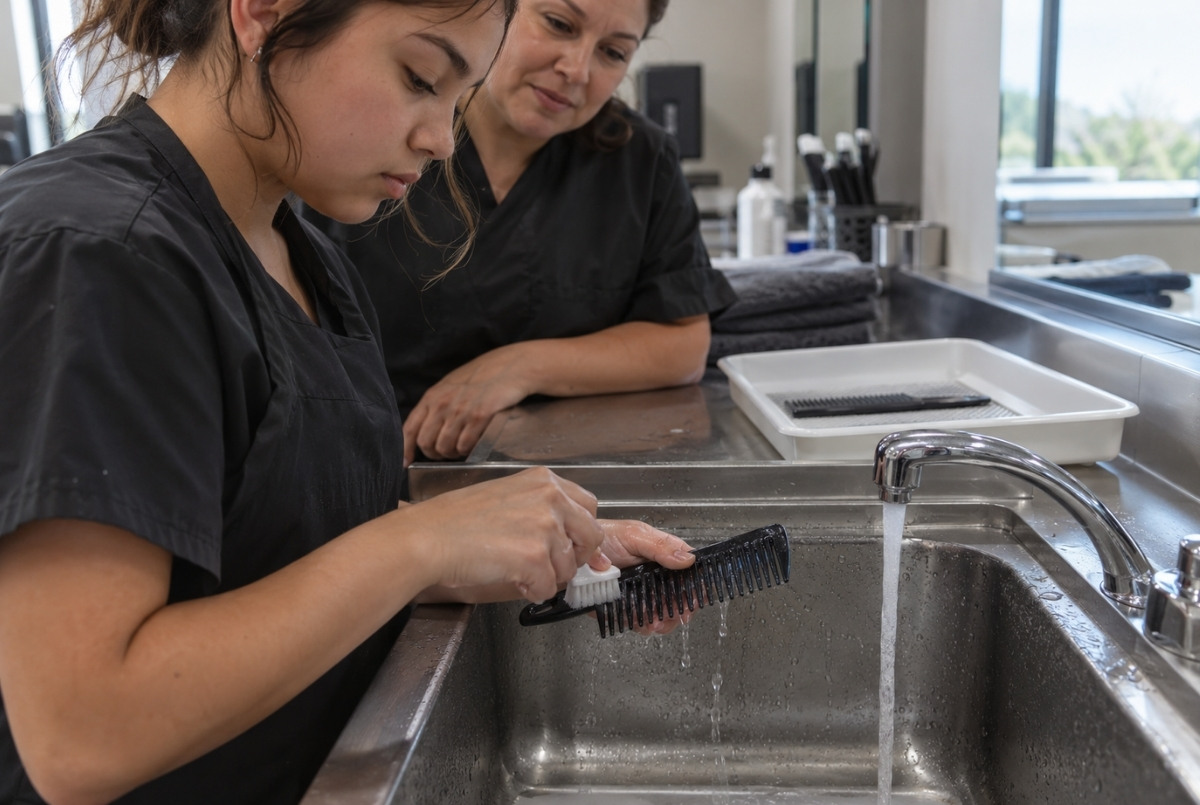
Teenage cosmetology student cleaning a reusable comb with a small brush at a utility sink while an instructor observes.

Current cosmetology education reaches beyond basic haircuts. Students commonly receive instruction in haircutting, hairstyling, chemical services, sanitation, infection control, client safety, and salon procedures. Programs may also introduce skin care, makeup, hair removal, manicuring, and pedicuring.

Georgia’s curriculum provides a useful example. Under the Georgia State Board’s cosmetology curriculum, a complete master cosmetology course contains 1,500 hours.

Students must complete 250 hours of Level 1 education before progressing to clinical services on clients. Those initial hours include 225 hours of theory and mannequin training, along with 15 hours of introductory skin care and 10 hours of introductory nail care.

Cosmetology introduces several beauty subjects, but it does not give every topic equal emphasis. Someone primarily interested in facials, advanced skin analysis, hair removal, makeup, or spa services should compare cosmetology with a dedicated esthetician program.

Georgia’s separate esthetician school curriculum, for example, requires 1,000 hours and provides more concentrated education in skin sciences, facials, body treatments, hair removal, makeup, client records, and spa or salon management.

Students mainly interested in manicures, pedicures, artificial nails, or other nail services should also compare the cosmetology curriculum with a dedicated nail technology program. General cosmetology includes nail education, but a specialty program devotes more attention to that field.

Completing a short class or receiving a specialty certificate does not automatically authorize a person to perform every service covered in the class. Advanced exfoliation, lasers, injections, medical devices, and medical treatments may fall outside a cosmetologist’s or esthetician’s legal scope. Authorization depends on the state, the procedure, and whether medical supervision or a separate professional license is required.

Beauty programs may also include client communication, appointment scheduling, retail sales, recordkeeping, marketing, professional conduct, and salon management. These subjects can prepare students for entry-level employment, but opening a salon or renting a private suite may involve additional establishment licenses, business registrations, insurance, permits, and local requirements.

The U.S. Bureau of Labor Statistics Skincare Specialist Report projects 9% employment growth for skincare specialists from 2025 to 2035, compared with 3% for all occupations. BLS also projects approximately 14,200 openings each year, on average, during that period.

Those annual openings should not be interpreted as 14,200 newly created jobs every year. Many are expected to result from workers transferring to other occupations or leaving the labor force.

Independent work also has a noticeable presence in the broader beauty industry. A 2022 policy submission from the American Association of Cosmetology Schools, using 2020 industry data, reported that 33% of workers in personal appearance occupations were self-employed, compared with 6% of the overall workforce.

Because that figure covers the broader personal appearance industry and relies on older data, it should not be treated as a current statistic specifically about teenagers, skincare specialists, or recent graduates. It also does not mean that a newly licensed professional is immediately prepared to operate an independent business.

How to Prepare Before Applying

High school student and parent comparing a cosmetology training cost breakdown with a calculator at a home desk.

A step-by-step review can help high school students avoid choosing a program whose hours, schedule, or admission policies do not meet their needs.

  1. Check every licensing stage: Review your state board’s requirements for beginning school, registering as an apprentice, taking examinations, and receiving a license.
  2. Research future moves: If you may relocate, review cosmetology license requirements by state. Transferring unfinished student hours is different from transferring an active license through endorsement or reciprocity.
  3. Meet with your school counselor: Ask about CTE courses, regional technical centers, concurrent enrollment, graduation credits, and schedule requirements.
  4. Contact prospective beauty schools: Verify minimum age, education requirements, approved programs, available schedules, tuition, supplies, and remaining training after graduation.
  5. Collect the required records: Depending on the institution, you may need an official transcript, government-issued identification, proof of age, and signed parent or guardian documents.
  6. Confirm program approval: Make sure both the school and the specific course are accepted by the state board responsible for recognizing your training hours.

State approval and institutional accreditation are separate matters. State-board approval determines whether the education can satisfy licensing requirements in that state. Accreditation may affect institutional oversight and eligibility for certain types of federal financial aid, but it does not guarantee that another state will accept completed training hours.

Questions Students and Parents Often Ask

Will my high school cosmetology hours follow me to another state?

Possibly, but unfinished student hours do not transfer automatically. The receiving board may examine the curriculum, require an official transcript, compare the completed education with its own standards, or require additional training. Contact both boards and ask specifically about transferring partial education rather than an active professional license.

Can a high school student receive federal financial aid for cosmetology classes?

Students who remain enrolled in high school generally cannot receive federal Title IV aid, including Pell Grants, for concurrent cosmetology-school enrollment. They may still qualify for district CTE funding, state or local dual-enrollment assistance, institutional scholarships, or private support. Students should obtain a written explanation of their eligibility and remaining expenses.

Could vocational beauty courses affect four-year college admission?

Not automatically. Students must still complete the courses required for high school graduation and admission to their intended colleges. Postsecondary cosmetology credits may be accepted only as electives or may not count toward a four-year degree. A guidance counselor can help determine how the courses will appear on the transcript and whether the schedule satisfies college-preparatory requirements.

What changes when an enrolled student turns 18?

After turning 18, a student can generally sign personal enrollment and scheduling documents without a parent or guardian. However, becoming an adult does not remove the state’s curriculum, hour, examination, or application requirements.

How should I evaluate a high school beauty program?

Compare the total expense, class schedule, number of board-recognized hours, graduation-credit arrangement, and amount of training that will remain after high school. A low-cost program may still be a poor choice if the state board does not recognize its hours or if students have to repeat the education later.

Plan Your Next Step Carefully

Beginning beauty education early can be valuable when the program is legitimate, the training hours are recognized, and the schedule fits your academic responsibilities. The best option is not necessarily the program that starts the soonest. It is the one that moves you toward graduation and professional licensing without creating unexpected costs or unusable training hours.

Although Georgia law may permit cosmetology training to begin earlier in certain approved settings, USA Beauty & Barber Academy currently requires applicants to be at least 18 years old and possess a high school diploma or GED. The academy also requires a photo ID and Social Security card under its published admission requirements.

To learn about available programs, current schedules, financial-aid options, or campus tours, visit the USA Beauty & Barber Academy enrollment page or submit the contact form at the end of this article.

Is Beauty School Required for a Cosmetology License? What State Laws Say

Main Points to Know

  • Licensing Depends on the State: The United States does not issue one national cosmetology license. Some states recognize regulated salon apprenticeships, while others require applicants to graduate from an approved school.
  • Apprenticeships Often Take More Hours: On-the-job training routes frequently require substantially more hours than beauty school. Georgia requires 3,000 apprentice hours instead of 1,500 school hours, while California requires 3,200 on-the-job hours plus 220 hours of related training instead of 1,000 school hours.
  • Exam Performance Is Not Consistent: In certain California reporting periods, cosmetology apprentices recorded lower written-exam pass rates than candidates educated in schools. These findings are not national averages and can change by year, examination, program, language, and candidate category.
  • Online Courses Cannot Replace Practical Training: Some approved programs provide theory instruction online, but students must still complete the hands-on training recognized by their state for initial licensure.
  • Moving a License Can Be Complicated: Completing an apprenticeship does not automatically prevent license transfer. However, the destination state may examine your training, testing history, professional experience, and current license status before approving you.

Building a career around hair, skin, and nail services can be rewarding for someone who enjoys creativity and helping clients feel more confident. However, traditional beauty programs can feel difficult to manage when tuition at some private schools exceeds $15,000 and training must be completed around work or family responsibilities.

That leads many future cosmetologists to consider workplace training instead of a conventional school program. This route is legally available in certain states, but it still involves regulated education, extensive supervised practice, and specific licensing requirements.

Is Beauty School Always Required for Licensure?

Each state establishes its own training hours, testing standards, approved educational formats, and licensing procedures. Because there is no nationwide cosmetology license, a training route accepted in one state might not qualify an applicant in another.

Before selecting a program, examine your state’s cosmetology requirements and confirm that the education you plan to complete will make you eligible for its licensing examination.

Graduating from a state-approved school remains the standard route in most states. Numerous jurisdictions also recognize formally organized apprenticeships supervised by licensed professionals. Availability, registration procedures, approved occupations, training hours, and supervision standards differ considerably.

Georgia and Arkansas illustrate how state policies can vary:

Learning how to obtain a cosmetology license without attending a conventional academy begins with reviewing the applicable state rules. Where apprenticeships are recognized, bypassing beauty school does not mean avoiding education. It means receiving that education through another regulated training system.

What Training as a Salon Apprentice Involves

A salon apprenticeship is one of the main alternatives to a school-based cosmetology course. Rather than spending most training hours in classrooms and student clinics, an apprentice develops skills under supervision inside an approved working salon.

This arrangement is not the same as accepting an ordinary entry-level salon position. The apprentice, trainer, establishment, and program sponsor may need to be registered or approved before training begins. Work completed before the appropriate authorization is issued might not count toward licensing requirements.

Apprentices must also complete more than practical client services. The California Board of Barbering and Cosmetology, for example, requires a minimum of 3,200 on-the-job training hours over two years. Cosmetology apprentices must additionally complete at least 220 hours of related training supplied by the program sponsor.

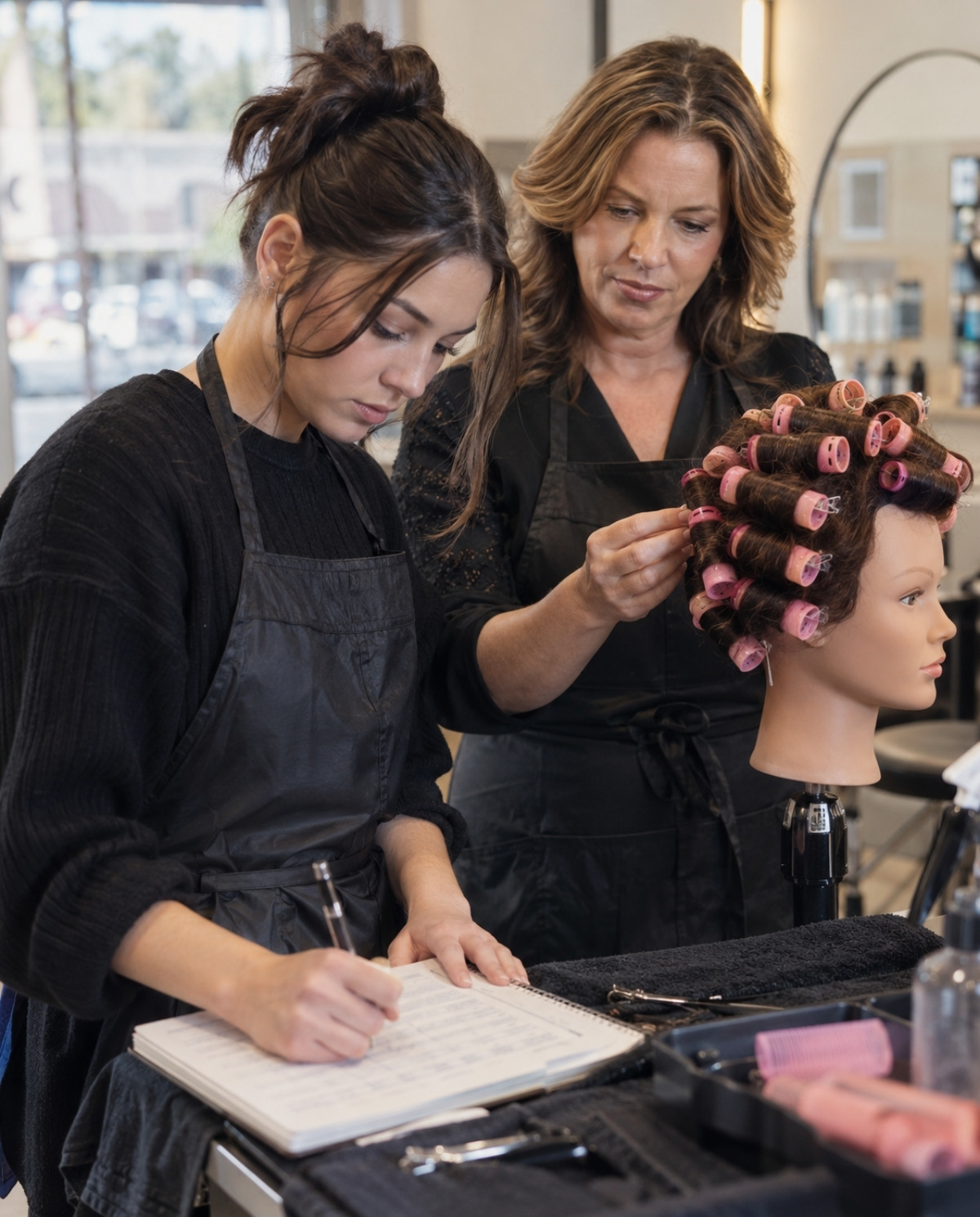
Cosmetology apprentice documenting completed training hours while a supervising professional examines a roller set on a mannequin.

Advantages of Training in an Active Salon

One significant benefit is regular exposure to the way a professional salon operates. Apprentices can learn how appointments are organized, consultations are conducted, products are discussed, and services are managed throughout a working day.

Interaction with paying clients may help apprentices strengthen their communication abilities and understand realistic service timing. Depending on the state and program, they may gradually perform approved services under the direct supervision of their assigned trainer.

A legitimate apprenticeship generally connects compensated employment with structured instruction and supervised experience. The U.S. Department of Labor describes apprenticeship as a model that combines paid on-the-job training with classroom instruction. Actual wages, schedules, benefits, and training expenses depend on the employer, program rules, and applicable employment laws.

For some learners, this structure reduces the need to leave the workforce completely while preparing for a license. It can also provide opportunities to develop professional relationships within the local beauty industry.

Possible Drawbacks and Training Gaps

The value of an apprenticeship depends greatly on its organization, sponsor, and supervising professional. Technical ability does not automatically make someone an effective instructor, and a busy salon may struggle to provide lessons as consistently as a school.

Apprentices also should not expect every salon duty to count toward approved training. Cleaning stations, preparing products, and watching services may be normal workplace responsibilities, but licensing authorities generally require documented education across particular subjects and practical operations.

Theory instruction is equally important. Cosmetologists must understand infection control, client safety, chemical services, product use, hair and scalp conditions, skin and nail fundamentals, and the laws regulating professional services.

Before entering a program, ask:

  • Must the apprentice and establishment receive approval before any hours are recorded?
  • Who maintains the hour records, and when are those records submitted?
  • What happens to completed training if the supervisor leaves or the establishment closes?
  • Can earned hours move to another approved salon or sponsor?
  • How will theory, sanitation, chemical safety, and state regulations be taught?
  • Are textbooks, formal classes, and examination-preparation resources included?
  • What wages, instructional charges, registration fees, equipment costs, and testing fees apply?
  • How much of the weekly schedule is assigned to recognized training activities?

These questions matter because state rules can restrict the way hours are transferred or combined. Georgia does not allow apprentice hours to be combined with school hours. The state also requires new paperwork whenever an apprentice changes the supervising professional or salon.

How to Interpret Apprentice Exam Statistics

Certain official reports indicate that apprentices can experience additional difficulty with written licensing examinations, but the data requires careful interpretation.

In a collection of California Board apprenticeship meeting materials, cosmetology apprenticeship candidates had lower written-exam pass rates than school-educated candidates during the periods reviewed. Results differed across reporting periods, license categories, examinations, programs, and languages.

The figures should not be presented as a permanent California rate or a national apprenticeship average. They document differences between candidate and training categories during particular reporting periods, but they do not establish why those differences occurred.

Prospective apprentices should request recent program-level results from the sponsor and ask whether the statistics cover first-time candidates or every examination attempt.

Can Online Classes Lead to a Cosmetology License?

Flexible education is especially attractive to people balancing training with employment or family responsibilities. Although online courses can make certain subjects more accessible, they should not be mistaken for a complete licensing route.

Cosmetology learner attending an online theory class while supervised haircutting practice takes place in an adjoining training area.

Subjects That May Be Available Remotely

Some state-approved schools operate hybrid programs that deliver a portion of the theory curriculum online. Depending on state regulations and program approval, these subjects might include anatomy, chemistry, infection control, product knowledge, business practices, and state law.

Distance education does not automatically count toward licensing requirements merely because a school offers it. The instruction must be part of a recognized program, and the institution may need to document attendance, assignments, examinations, participation, and completed hours.

Before enrolling, confirm directly with the school and licensing authority that:

  • The institution is approved by the appropriate state authority.
  • The particular cosmetology program makes graduates eligible for licensure.
  • The state allows the advertised theory hours to be completed remotely.
  • The course provides all required supervised practical training.
  • The curriculum satisfies the rules of the state where you intend to seek a license.

Training That Must Be Completed in Person

Cosmetology is a practical occupation requiring supervised experience with sanitation, client protection, tools, haircutting, styling, chemical applications, and other services included within the applicable state scope of practice.

An online certificate alone is therefore not equivalent to a cosmetology license or proof of completing an approved licensing program. Practical experience must come through a school, apprenticeship, or another pathway formally accepted by the state.

Online beauty courses are not automatically illegitimate. Many provide useful continuing education, business instruction, product training, or examination review. The concern arises when a provider suggests that an inexpensive digital certificate by itself authorizes someone to perform regulated services.

Before paying a provider, ask the state board whether that exact course qualifies applicants for initial licensure. Promotional terms such as “accredited,” “board-ready,” or “professionally certified” do not override licensing regulations.

Comparing the Time Required by Each Route

People searching for the fastest licensing option may assume apprenticeship is quicker because they can begin working in a salon immediately. Starting as a registered apprentice, however, is not equivalent to becoming an independently licensed cosmetologist.

Full-time school is frequently the shorter path because its schedule is organized around accumulating approved education hours. Depending on the state requirement and weekly attendance schedule, completion may take approximately 8 to 15 months. Part-time attendance, missed classes, holidays, closures, and administrative delays can extend that timeline.

For a closer look at the relationship between required hours and completion dates, review this guide explaining how long full-time and part-time cosmetology programs may take.

Apprenticeships frequently involve more training hours and may include a mandatory calendar period. Georgia requires 3,000 hours over at least 18 months. California requires 3,200 on-the-job hours over two years in addition to 220 hours of related training.

Individual circumstances can still affect which option finishes sooner. A person attending school part time might take longer than someone completing a demanding apprenticeship schedule. For students able to attend school full time, however, the school pathway is often the more direct route to examination eligibility.

To learn more about written tests, practical testing policies, and preparation, review our cosmetology state board examination guide.

Will Apprentice Training Be Accepted in Another State?

Relocating can complicate cosmetology licensing because states use terms such as reciprocity, endorsement, and transfer differently. There is no single nationwide process that guarantees recognition of an existing license.

Training through an apprenticeship does not automatically prevent a cosmetologist from qualifying in a different state. The destination authority may examine:

  • Whether the current license is active and free from disciplinary restrictions;
  • The amount and type of education or training completed;
  • Whether the applicant passed written or practical examinations;
  • The applicant’s length of licensed professional experience;
  • Whether the original licensing requirements are substantially equivalent;
  • Whether additional education or a state-law examination is required.

Some states emphasize post-licensure work experience, while others compare the original training directly with their own educational standards. Apprentices should preserve their registration documents, curricula, hour reports, related-training records, examination results, employment history, and original license.

For more information about differences between jurisdictions, see our overview of state cosmetology hours, examinations, renewals, and licensing rules.

The Cosmetology Licensure Compact is designed to simplify professional practice across participating jurisdictions. However, the official Compact website confirms that multistate licenses are not yet being issued.

Once applications become available, eligibility is expected to require applicants to live in a Compact member state and hold an active, unencumbered single-state cosmetology license issued by that home state. Applicants will also need to pay the applicable fees and satisfy the Compact’s application conditions.

The Compact does not establish a universal number of training hours. Each member state continues to determine the education, training, and competency examination required for its original single-state license.

Anyone expecting to relocate should investigate the destination state’s licensing rules before committing to either an apprenticeship or school program. Neither route guarantees automatic approval in every jurisdiction.

Comparing the Complete Financial Commitment

Aspiring cosmetologist comparing classroom and apprenticeship schedules beside a textbook and professional hairstyling tool roll.

Cost is one of the primary reasons people investigate alternatives to conventional beauty school. An apprenticeship can reduce tuition expenses and provide employment income during training, but it should not automatically be considered free.

Depending on the arrangement, apprentices may need to pay for:

  • State applications, registrations, and permits;
  • Required theory classes or related instruction;
  • Textbooks and digital learning materials;
  • Tools, products, uniforms, and safety equipment;
  • Examinations and initial licensing fees;
  • Transportation and childcare;
  • Extra education following a program change or relocation.

Before signing an agreement, request a complete written explanation of wages, fees, required supplies, weekly hours, educational responsibilities, and refund conditions. Confirm whether the arrangement treats the apprentice as an employee and how compensation will be determined.

Standalone salon apprenticeships generally do not provide Pell Grants or federal student loans in the same way as eligible college or career-school programs. An apprenticeship connected with an eligible educational institution or separate approved program may have different funding arrangements. Depending on the circumstances, apprentices may also qualify for employer assistance, state workforce funding, veterans’ benefits, scholarships, or other program-specific support.

Beauty schools have expenses of their own, including tuition, kits, registration charges, and living costs during training. Students attending eligible programs at participating institutions may qualify for federal student aid.

Accreditation alone does not guarantee access to Pell Grants or federal loans. The institution and program must satisfy federal eligibility requirements, the school must participate in the relevant aid programs, and the student must qualify individually.

Prospective students can use the official Federal Student Aid school search to look for a federal school code and review available information. They should also confirm program eligibility with the institution’s financial-aid office.

When comparing the two routes, consider:

  • Tuition or related-instruction charges;
  • Books, tools, uniforms, registrations, examinations, and license fees;
  • Expected earnings during apprenticeship training;
  • Transportation and childcare costs;
  • The estimated time required to qualify for a license;
  • Available grants, scholarships, workforce programs, and employer assistance;
  • Possible additional-training costs after relocating.

Deciding Which Option Fits Your Situation

School and apprenticeship training can both lead toward licensure where state law recognizes them, but neither option is automatically suitable for every student.

A state-approved school may suit learners who want an organized curriculum, scheduled theory classes, regular instructor access, examination preparation, and a potentially shorter full-time route.

An apprenticeship may suit someone whose state permits it, who has identified a reputable program and supervisor, who needs employment income, and who learns effectively in an active salon. Before choosing this route, understand the additional hours, reporting obligations, related education, and consequences of changing supervisors or moving.

Regardless of the option selected, verify the exact program with the state licensing authority before paying fees or beginning training.

Common Questions About Alternative Licensing Routes

May Applicants Use an ITIN on a License Application?

Requirements depend on the jurisdiction. The California Board of Barbering and Cosmetology, for example, accepts a valid Individual Taxpayer Identification Number instead of a Social Security Number on licensing applications.

An ITIN is issued for federal tax purposes. It does not grant immigration status or employment authorization. Applicants should separately confirm their legal authorization to work and their state board’s current identification requirements.

Will a Criminal Conviction Prevent Licensing?

Not automatically. The rules depend on the state, the offense, and the applicant’s circumstances. The Texas Department of Licensing and Regulation, for example, evaluates relevant criminal history individually rather than treating every conviction as an automatic disqualification.

Prospective Texas applicants may request a criminal history evaluation letter before investing in training. Applicants elsewhere should ask whether their licensing authority offers a comparable pre-application review.

Can an Apprenticeship-Based License Move Across State Lines?

Possibly. An apprenticeship does not automatically prevent a cosmetologist from becoming licensed elsewhere. The destination state may review the existing license, education and training records, examination history, professional experience, and disciplinary status.

If the qualifications are not considered equivalent, additional education, experience, or testing may be necessary.

Is Federal Student Aid Available to Salon Apprentices?

A standalone salon apprenticeship generally does not offer Pell Grants or federal loans in the same way as an eligible postsecondary program. Funding might still be available through an employer, workforce agency, veterans’ program, scholarship, or separate eligible educational provider.

Beauty-school students should also verify both institutional and program eligibility because not every school or program participates in federal student aid.

Are Apprentices Allowed to Provide Client Services?

Where cosmetology apprenticeships are permitted, registered apprentices may usually provide authorized services under the supervision specified by the state and program.

California allows apprentices to work on paying clients when the services are performed under the direct supervision of the designated trainer in the approved establishment named on the apprentice license. Apprentices cannot work independently or count unregistered employment toward future licensing requirements.

What Happens When an Apprentice Moves to Another Salon?

The process depends on the state’s regulations. Changing salons or trainers may require ending the existing arrangement, obtaining an official record of completed hours, registering the new supervisor or establishment, and receiving approval before earning additional credit.

Georgia specifically requires a new application each time an apprentice changes the supervising licensee or salon. Apprentices should contact the licensing authority and secure official training records before leaving the original arrangement.

Begin Your Professional Beauty Training

If you prefer organized theory instruction, supervised practical experience, and structured preparation for the licensing process, an approved beauty program may be a suitable next step.

USA Beauty and Barber Academy offers cosmetology among its listed training options. Prospective students can visit the academy’s Enrollment page to request information, learn about the enrollment process, arrange a campus tour, and discuss programs and scheduling.

For additional assistance, submit your information through the contact form at the end of this page.