

Cosmetology School in High School Explained: Eligibility, Costs, and Training Hours

What Students Should Know First
- Early Training Depends on the State: Some students can begin approved cosmetology education before graduating from high school, but age, education, examination, and licensing requirements differ by state.
- High School Programs Are Not Always Free: CTE and concurrent-enrollment programs may reduce tuition or allow students to complete licensing hours earlier, but students can still be responsible for tuition, kits, books, uniforms, transportation, and examination fees.
- Starting School Is Not the Same as Getting Licensed: A state may permit training at 16 while applying separate age, education, hour, and examination requirements to license applicants.
- Cosmetology Includes Several Areas of Beauty: Programs usually concentrate on hair while also covering sanitation, safety, basic skin care, nail care, client relations, and salon practices. Students primarily interested in skin or nails should compare specialized programs before enrolling.
If you are still in high school but already spend your free time practicing hairstyles, learning about makeup, or following skincare techniques, you may be wondering whether you can begin professional beauty training before graduation. In some states, the answer is yes.
An approved high school, CTE, concurrent-enrollment, private-school, or apprenticeship pathway may allow you to begin earning recognized training hours early. However, eligibility depends on more than your age. You must also confirm that the program is recognized by the appropriate state board, that its hours can be used toward licensure, and that its schedule will not prevent you from completing your high school requirements.
How Age and Education Rules Work
People researching how old you must be to enter cosmetology school quickly discover that the United States does not have one nationwide admission standard. State boards establish licensing and training rules, while individual schools may apply additional admission requirements.
School admission, student registration, apprenticeship registration, examination eligibility, and professional licensing are separate steps. Reaching the minimum age for one step does not necessarily make you eligible for every other step.
For example, the South Carolina Board of Cosmetology requires cosmetologist applicants to be at least 16, possess at least a 10th-grade education or its equivalent, complete 1,500 hours at an approved cosmetology school, and pass the required written and practical examinations.
The Alabama Board of Cosmetology and Barbering similarly requires examination candidates to be at least 16. Candidates must document completion of the 10th grade or higher and complete the applicable school or apprenticeship requirements before applying for the examination.
California applies different requirements to its school and apprenticeship routes. According to the California Board of Barbering and Cosmetology, cosmetology examination applicants generally must be at least 17 and have completed the 10th grade. Its apprenticeship pathway may begin at age 16 after the applicant has completed the 10th grade or its equivalent.
Students can also review who can qualify for beauty school and how admission requirements work. State minimums and school admission policies should always be checked separately.
Arkansas provides another example of state-specific eligibility. A cosmetology student generally must be at least 16 and have completed two years of high school or its equivalent. Applicants should verify current procedures through the Arkansas Department of Health Cosmetology Section and the school they intend to attend.
Georgia also separates the age for learning cosmetology from the qualifications for obtaining a license. Georgia Code § 43-10-14 permits a person who is at least 16 to learn cosmetology under a qualified instructor at a cosmetology school or through a registered apprenticeship.
However, Georgia Code § 43-10-9 generally requires a master cosmetologist license applicant to be at least 17, possess a high school diploma, state-approved high school equivalency diploma, or postsecondary degree, complete the required training, and pass the necessary examinations.
Is Beauty School Available to Minors?

A student under 18 may attend an approved cosmetology program when state law and the school's admission policy permit it. Nevertheless, minors may face additional enrollment requirements.
Because minors generally cannot enter every enrollment or financial agreement independently, a school may require a parent or legal guardian to sign an enrollment contract, payment agreement, consent form, or other document. The requirements are not identical at every institution.
Schools may also request proof of age, identification, an official transcript, and evidence that the student has completed the required grade level. Some institutions require a diploma or recognized equivalent even when state law allows training to begin earlier.
Students must also separate permission to attend classes from eligibility to receive a license. Depending on the state, applicants may need to reach a particular age, complete an approved curriculum, earn all required hours, and pass a written examination, practical examination, or both.
California is one example of why current examination rules should be checked carefully. The state stopped requiring practical examinations for its license types on January 1, 2022, according to the California Board's examination information. That California policy should not be assumed to apply in other states.
Ways to Begin Beauty Training During High School
High school students may find cosmetology education through several arrangements, including district-operated programs, regional Career and Technical Education centers, concurrent enrollment with a technical college, private state-approved beauty schools, and registered apprenticeships in states that authorize them.
In some programs, students complete regular academic courses during one part of the day and attend vocational training during another. This arrangement can help students continue working toward graduation while beginning approved beauty education.
The Technical College of the Rockies High School Cosmetology Program illustrates how one concurrent-enrollment model operates. Its program provides 1,211 hours through a half-day schedule completed across four semesters and two school years.
The program's published cost for 2026–2027 is $10,255.99. It also states that federal financial aid is unavailable to participating high school students, although grants and scholarships may be available. This example demonstrates that a high school cosmetology program should not automatically be described as free.
Costs and funding arrangements differ by district, college, state, and partnership. Public funding may cover part of the expense in one program, while another may charge students for tuition, kits, textbooks, uniforms, transportation, registration, or licensing examinations. Families should request a written cost breakdown before making a commitment.
Private beauty academies may offer another route, but their minimum age, education, and scheduling requirements can be stricter than the state's general rules. Evening, weekend, part-time, and year-round schedules are also not available at every school.
Students comparing different schedules can explore how many months cosmetology school may take under full-time and part-time plans.
Before selecting a high school training option, ask:
- Is the institution and the specific program approved by the state cosmetology board?
- Will all completed hours appear on an official, state-recognized transcript?
- How many approved hours can be earned before high school graduation?
- Which tuition, kit, book, uniform, transportation, and examination expenses are covered?
- Can completed student hours be transferred if the student changes schools?
- What happens to the hours if the student later moves to another state?
- Will the class schedule leave enough time to complete high school graduation requirements?
- How much additional cosmetology training will remain after high school?
What Teen Cosmetology Students Actually Study
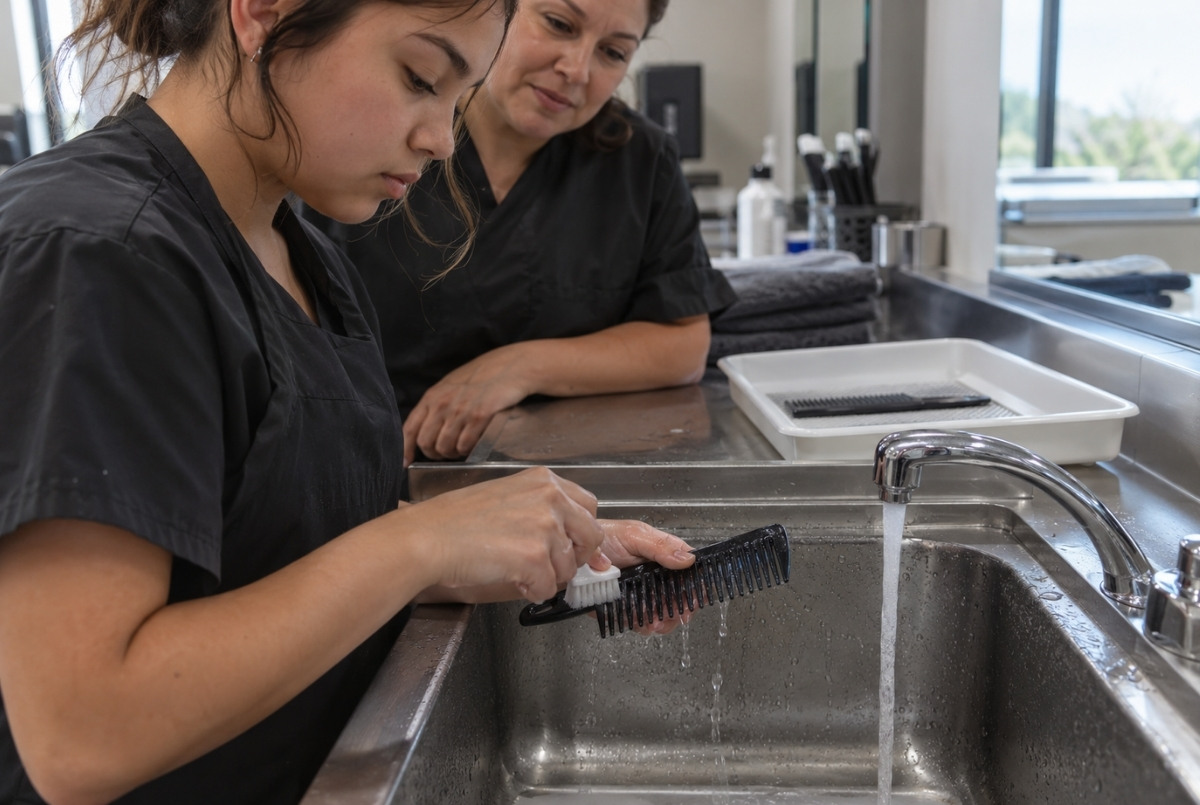
Current cosmetology education reaches beyond basic haircuts. Students commonly receive instruction in haircutting, hairstyling, chemical services, sanitation, infection control, client safety, and salon procedures. Programs may also introduce skin care, makeup, hair removal, manicuring, and pedicuring.
Georgia's curriculum provides a useful example. Under the Georgia State Board's cosmetology curriculum, a complete master cosmetology course contains 1,500 hours.
Students must complete 250 hours of Level 1 education before progressing to clinical services on clients. Those initial hours include 225 hours of theory and mannequin training, along with 15 hours of introductory skin care and 10 hours of introductory nail care.
Cosmetology introduces several beauty subjects, but it does not give every topic equal emphasis. Someone primarily interested in facials, advanced skin analysis, hair removal, makeup, or spa services should compare cosmetology with a dedicated esthetician program.
Georgia's separate esthetician school curriculum, for example, requires 1,000 hours and provides more concentrated education in skin sciences, facials, body treatments, hair removal, makeup, client records, and spa or salon management.
Students mainly interested in manicures, pedicures, artificial nails, or other nail services should also compare the cosmetology curriculum with a dedicated nail technology program. General cosmetology includes nail education, but a specialty program devotes more attention to that field.
Completing a short class or receiving a specialty certificate does not automatically authorize a person to perform every service covered in the class. Advanced exfoliation, lasers, injections, medical devices, and medical treatments may fall outside a cosmetologist's or esthetician's legal scope. Authorization depends on the state, the procedure, and whether medical supervision or a separate professional license is required.
Beauty programs may also include client communication, appointment scheduling, retail sales, recordkeeping, marketing, professional conduct, and salon management. These subjects can prepare students for entry-level employment, but opening a salon or renting a private suite may involve additional establishment licenses, business registrations, insurance, permits, and local requirements.
The U.S. Bureau of Labor Statistics Skincare Specialist Report projects 9% employment growth for skincare specialists from 2025 to 2035, compared with 3% for all occupations. BLS also projects approximately 14,200 openings each year, on average, during that period.
Those annual openings should not be interpreted as 14,200 newly created jobs every year. Many are expected to result from workers transferring to other occupations or leaving the labor force.
Independent work also has a noticeable presence in the broader beauty industry. A 2022 policy submission from the American Association of Cosmetology Schools, using 2020 industry data, reported that 33% of workers in personal appearance occupations were self-employed, compared with 6% of the overall workforce.
Because that figure covers the broader personal appearance industry and relies on older data, it should not be treated as a current statistic specifically about teenagers, skincare specialists, or recent graduates. It also does not mean that a newly licensed professional is immediately prepared to operate an independent business.
How to Prepare Before Applying

A step-by-step review can help high school students avoid choosing a program whose hours, schedule, or admission policies do not meet their needs.
- Check every licensing stage: Review your state board's requirements for beginning school, registering as an apprentice, taking examinations, and receiving a license.
- Research future moves: If you may relocate, review cosmetology license requirements by state. Transferring unfinished student hours is different from transferring an active license through endorsement or reciprocity.
- Meet with your school counselor: Ask about CTE courses, regional technical centers, concurrent enrollment, graduation credits, and schedule requirements.
- Contact prospective beauty schools: Verify minimum age, education requirements, approved programs, available schedules, tuition, supplies, and remaining training after graduation.
- Collect the required records: Depending on the institution, you may need an official transcript, government-issued identification, proof of age, and signed parent or guardian documents.
- Confirm program approval: Make sure both the school and the specific course are accepted by the state board responsible for recognizing your training hours.
State approval and institutional accreditation are separate matters. State-board approval determines whether the education can satisfy licensing requirements in that state. Accreditation may affect institutional oversight and eligibility for certain types of federal financial aid, but it does not guarantee that another state will accept completed training hours.
Questions Students and Parents Often Ask
Will my high school cosmetology hours follow me to another state?
Possibly, but unfinished student hours do not transfer automatically. The receiving board may examine the curriculum, require an official transcript, compare the completed education with its own standards, or require additional training. Contact both boards and ask specifically about transferring partial education rather than an active professional license.
Can a high school student receive federal financial aid for cosmetology classes?
Students who remain enrolled in high school generally cannot receive federal Title IV aid, including Pell Grants, for concurrent cosmetology-school enrollment. They may still qualify for district CTE funding, state or local dual-enrollment assistance, institutional scholarships, or private support. Students should obtain a written explanation of their eligibility and remaining expenses.
Could vocational beauty courses affect four-year college admission?
Not automatically. Students must still complete the courses required for high school graduation and admission to their intended colleges. Postsecondary cosmetology credits may be accepted only as electives or may not count toward a four-year degree. A guidance counselor can help determine how the courses will appear on the transcript and whether the schedule satisfies college-preparatory requirements.
What changes when an enrolled student turns 18?
After turning 18, a student can generally sign personal enrollment and scheduling documents without a parent or guardian. However, becoming an adult does not remove the state's curriculum, hour, examination, or application requirements.
How should I evaluate a high school beauty program?
Compare the total expense, class schedule, number of board-recognized hours, graduation-credit arrangement, and amount of training that will remain after high school. A low-cost program may still be a poor choice if the state board does not recognize its hours or if students have to repeat the education later.
Plan Your Next Step Carefully
Beginning beauty education early can be valuable when the program is legitimate, the training hours are recognized, and the schedule fits your academic responsibilities. The best option is not necessarily the program that starts the soonest. It is the one that moves you toward graduation and professional licensing without creating unexpected costs or unusable training hours.
Although Georgia law may permit cosmetology training to begin earlier in certain approved settings, USA Beauty & Barber Academy currently requires applicants to be at least 18 years old and possess a high school diploma or GED. The academy also requires a photo ID and Social Security card under its published admission requirements.
To learn about available programs, current schedules, financial-aid options, or campus tours, visit the USA Beauty & Barber Academy enrollment page or submit the contact form at the end of this article.