


How Much Do Barbers Make? What the Numbers Really Tell You

Key Takeaways
- Use wage figures as a starting point: BLS lists the median barber wage at $18.37 per hour for May 2025. At 2,080 hours annually, that translates to approximately $38,210. Employee tips and commissions are included, while self-employed earnings are excluded.
- Focus on what remains after costs: Client payments are only the beginning of the calculation. Commission shares, chair rent, supplies, payment fees, and applicable taxes affect the money available for personal spending.
- Compare rental with commission earnings: With a 60% barber commission and $400 in additional weekly rental costs, the two arrangements produce equal earnings at $1,000 in weekly service sales before personal taxes, assuming other conditions are equal. This is a comparison point, not the sales needed to earn zero profit.
- Budget taxes against business profit: The standard self-employment tax rate is 15.3%, generally applied to 92.35% of net self-employment earnings after deductible expenses. Earnings limits and additional Medicare tax rules can affect the calculation.
- Grow income without exhausting your schedule: Repeat customers, sensible pricing, profitable product sales, and controlled operating expenses can improve earnings without requiring a constant increase in appointments.
Reading Barber Wage Statistics in Context
Federal labor data offers a useful starting point when exploring how much do barbers make a year. The U.S. Bureau of Labor Statistics Occupational Outlook Handbook lists a median barber wage of $18.37 per hour in May 2025. Working 40 hours weekly for 52 weeks at that rate produces an annual equivalent of approximately $38,210.
That conversion assumes a full year of full-time work. It does not account for unpaid time away, reduced schedules, or differences between individual shops.
A median divides the workers represented into two equal groups: half earn above that amount and half below it. The mean, commonly called the arithmetic average, is calculated differently. Neither measure establishes the maximum a barber can earn.
The coverage of the survey is equally important. The BLS Occupational Employment and Wage Statistics methodology includes employee tips and commissions but does not cover self-employed workers or owners and partners in unincorporated firms. Self-employed barbers who rent chairs are therefore outside these employee wage estimates.
A renter's client receipts cannot be compared directly with an employee's wages. The renter still has to pay the costs of running the business, while employee compensation represents the amount paid to the worker under the shop's compensation arrangement.
The exclusion of self-employed earnings also does not prove that barbers generally earn a particular percentage above the published median. For a useful personal estimate, start with the wage benchmark and then calculate expected income under the arrangement you intend to pursue.
Turning Appointments into an Earnings Estimate
Your service revenue depends on completed visits and the amount collected per visit. To understand what those visits contribute to your income, you also need to consider service duration, business expenses, and unpaid working time.
What Each Service Contributes
When asking how much do barbers make per cut, distinguish the customer's bill from the barber's compensation. A $35 haircut creates $35 in service sales. A commission barber receives an agreed share, while a self-employed renter pays business expenses from the receipts.
Local prices depend on the type of service, neighborhood, and market positioning of the shop. Comparing nearby businesses with similar offerings gives you a more practical pricing reference than assuming one national price applies everywhere.
Additional services can raise the amount spent during a visit. A hypothetical $30 haircut and $15 beard trim produce a $45 service ticket. The financial benefit depends on how much extra time and material the beard service requires.
For example, a $30 haircut taking 30 minutes produces $60 per service hour before expenses. A $45 haircut-and-beard service taking 45 minutes also produces $60 per service hour. The second appointment brings in more per customer, but the hourly service revenue remains unchanged.
Evaluate service combinations by their contribution after costs and the time needed to complete them safely. A higher bill is useful only when the service remains worthwhile to deliver.
How Many Visits Fit into a Working Day
There is no universal answer to how many cuts does a barber do a day. Detailed cuts, consultations, disinfection, breaks, and administrative duties all affect appointment capacity.
As an illustration, an eight-hour shift with one hour allocated to non-appointment duties leaves seven hours for client visits. If each appointment occupies 45 minutes, nine complete appointments fit into that period.
Actual paid visits may fall below available capacity. Empty slots, cancellations, and no-shows reduce sales even when the barber remains at work.
Build your forecast around the number of appointments you reasonably expect to complete. A fully booked schedule can be a goal, but it should not automatically become the assumption behind your income budget.
Daily Collections Versus Hourly Take-Home Pay
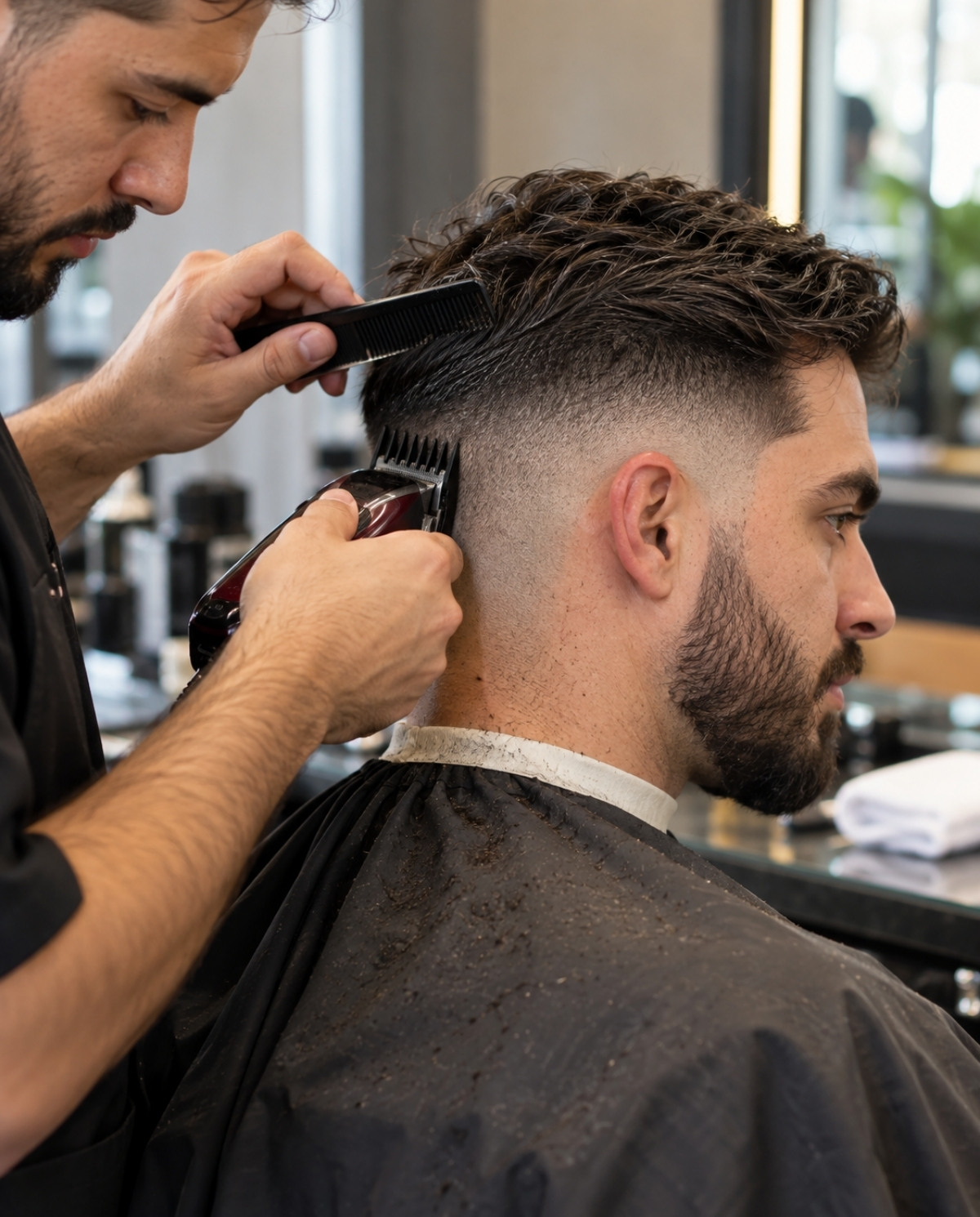
To estimate how much does a barber make a day, consider ten completed visits with an average service ticket of $35. Those appointments generate $350 in service revenue.
If tips total an illustrative 15% to 20% of service sales, they contribute another $52.50 to $70. Combined daily receipts would be $402.50 to $420 before commission deductions, business expenses, and taxes. This example does not establish a standard tipping rate for every client.
For how much do barbers make an hour, divide by the entire working day rather than only the minutes spent cutting hair. Over eight hours, the example produces approximately $50.31 to $52.50 in gross receipts per working hour.
That amount is not an hourly take-home wage. Recording appointment volume, average spending, expenses, and total hours allows you to calculate a more meaningful return on your work.
Following the Money from Client Payment to Personal Income
Service and product sales bring money into a business, but only part of that money becomes available for personal use.
For a self-employed barber, income records begin with service payments, tips, and retail receipts. Deductible business costs may include rent, supplies, processing charges, booking software, insurance, and equipment expenses. The balance is business profit before personal taxes.
An employee begins with the compensation received from the shop, such as wages or commissions and applicable tips. The full amount charged to the customer belongs to the shop's revenue calculation, not automatically to the employee's earnings.
Comparing these financial measures consistently matters. A renter can collect more money from clients yet retain less after expenses than an employee working with reliable shop-generated demand.
How Commission and Chair Rental Allocate Costs
Commission compensation and chair rental are common arrangements, although hourly pay, salaries, and blended structures also exist.
- Commission arrangement: With an illustrative 60% barber share, every $100 in service sales provides $60 to the barber and $40 to the shop. The agreement should identify how tips are handled and which costs the shop pays, such as products, towels, booking support, or marketing.
- Chair rental arrangement: A self-employed renter pays for workspace and retains service receipts and tips. Responsibility for supplies, card processing, booking systems, advertising, insurance, and other expenses depends on the rental agreement; some packages include certain services or materials.
Receiving commission does not, by itself, determine employment status. The IRS guidance on employees and independent contractors evaluates behavioral control, financial control, and the type of relationship between the parties.
That third category extends beyond the written contract. Benefits, the expected duration of the relationship, and whether the work is central to the business can also matter.
Before accepting an offer, establish who controls pricing and scheduling, which expenses are covered, how tips are distributed, and what responsibilities you will carry.
Finding the Crossover Between the Two Arrangements
Rental introduces expenses that continue even when appointment volume drops. Whether it improves your earnings depends on your dependable sales and the costs you take on.
For a simplified comparison, suppose the barber receives 60% of service sales under commission. Renting allows the barber to retain the remaining 40% but introduces additional weekly expenses.
Divide those additional costs by 0.40 to find the service-sales level at which the two arrangements leave the same amount before personal taxes.
With $400 in additional weekly rental costs:
$400 ÷ 0.40 = $1,000 in weekly service sales.
At $600 in service sales, rental leaves $200 after the assumed $400 in costs. The commission arrangement pays $360.
At $1,500 in service sales, rental leaves $1,100, while commission pays $900.
At the $1,000 crossover, both leave $600 under these assumptions. The calculation identifies equal earnings between the arrangements, rather than a zero-profit business break-even point.
This comparison assumes identical tips and that the $400 represents the full difference in weekly expenses. If supplies or processing charges rise with sales, include those variable costs rather than treating every expense as fixed.
Benefits, differences in tax treatment, and access to customers supplied by the shop can also influence the result. Use ordinary weeks and realistic client demand when deciding whether rental is financially sustainable.
Keeping Tax Obligations and Equipment Costs in View

Self-employed barbers generally owe self-employment tax when net self-employment earnings reach $400, along with any applicable federal and state income taxes.
The IRS explanation of self-employment tax states that the taxable amount is generally 92.35% of net earnings after ordinary and necessary business expenses.
The standard rate is 15.3%, combining Social Security and Medicare taxes. However, the Social Security portion is subject to an annual earnings limit, and additional Medicare tax may apply above specified thresholds. The IRS breakdown of Social Security and Medicare taxes for self-employed workers explains these qualifications and the deduction generally available for the employer-equivalent portion.
Maintain separate records for receipts and expenses. Cash service payments and cash tips must also be recorded; receiving cash does not make the income exempt from reporting.
The IRS industry guide for cosmetology and barbering provides further information on rental arrangements, tips, and business records.
Allowing for taxes and future equipment replacement throughout the year gives you a clearer view of the money you can safely use for personal expenses.
Growing Revenue Beyond Another Haircut
More appointments are only one route to higher earnings. Suitable product recommendations, specialty services priced for their costs, and a location with workable expenses can also strengthen your financial results.
Measuring the Return from Product Recommendations
Pomades, shampoos, and beard oils can help customers maintain their results at home. Retail sales may also provide additional income without requiring a separate service appointment.
The amount sold is not necessarily the amount earned. Four products priced at $20 generate $80 in sales. Under a hypothetical 10% retail commission, the barber receives $8.
Repeating that sales level across 20 working days produces $160 in commission income.
If you buy and resell inventory yourself, calculate the remaining profit after wholesale prices, payment fees, and selling expenses. Stock that remains unsold or becomes damaged also affects the result.
The Grand View Research report on men's grooming products forecasts a global market worth $506.7 billion by 2033. Its coverage spans multiple product categories and distribution channels; it does not measure barbershop service sales or forecast the earnings of an individual barber.
For your own business, the relevant measures are customer suitability, product costs or commission rates, and the income each recommendation actually produces.
Assessing a Location by Profit Potential
Higher haircut prices do not automatically make a market more profitable. Rent, customer demand, competition, and the cost of operating in that area all influence what remains after expenses.
The Best Cosmetology Programs barber salary guide lists May 2025 median annual employee wages of $61,150 in Washington, $30,750 in Georgia, and $25,640 in Arkansas. These are employee wage figures, not estimates of a renter's revenue or business profit.
When making regional comparisons, consult the BLS state and metropolitan wage tables and match the occupation, reporting year, and wage measure. State-level figures cannot predict the earnings of a particular shop or newly licensed professional.
Consider the following before choosing where to work:
- Comparable service rates: What nearby shops charge for services similar to yours.
- Likely appointment demand: The paid visits you can reasonably expect after allowing for cancellations and slower periods.
- Total operating expenses: Rental charges, supplies, payment fees, insurance, and any booking or marketing costs.
- Customer convenience: Whether current clients can reach the location easily and continue booking with you.
A strong reputation and specialized ability may support higher prices. The useful financial target, however, is a reliable profit after costs.
Preparing for the Technical and Business Sides of Barbering
Professional training provides a foundation for consistent service. Cutting accuracy, sanitation, communication, and dependable work habits all contribute to the customer experience.
When comparing schools, look beyond exam preparation alone. Ask how students practice consultations, organize appointments, and learn about responsibilities in a working shop.
Our guide to barbering school costs, schedules, and enrollment can help you begin researching the educational commitment. Confirm current program details and admission requirements directly with the school before making your plans.
Useful areas to investigate include:
- Reliable service delivery: Cutting technique, safe tool use, and an organized routine that allows enough time for consultations and disinfection.
- Repeat-customer skills: Understanding preferences, producing consistent results, and discussing an appropriate return schedule.
- Practical business knowledge: Pricing, compensation arrangements, expense records, retail sales, and the services permitted under your license.
Training requirements and permitted services depend on the state and license category. The Georgia barber curriculum regulations, for example, provide separate curricula for Master Barber and Barber II programs. Master Barber training includes chemical services.
For a broader look at entering the profession, explore our article on the steps involved in becoming a barber and our guide to barber licensing requirements and exam preparation.
Education supports your starting skills. Your earnings over time will also reflect experience, customer loyalty, local demand, and the way you manage expenses.
Common Questions About Barber Earnings and Career Planning

How much can tips add to a barber's income?
The contribution varies between customers and appointments. As an illustration, a 15% to 20% gratuity on a $30 haircut equals $4.50 to $6. Ten visits would add $45 to $60 if every customer tipped within that range.
Record tips separately so you can understand their contribution without assuming the same amount will arrive every day. Published BLS employee wage estimates already include tips, so adding another tip percentage to those figures would double-count that component.
What client base is needed for a busy schedule?
There is no dependable number of months in which every beginner develops a full appointment book. Availability, local demand, service quality, and return frequency all affect progress.
You can, however, estimate the roster needed for a target workload. Ten visits daily over five days require 50 appointments each week. If every regular customer returns once every two weeks, approximately 100 active clients would support that volume. With four weeks between visits, approximately 200 would be needed.
Those examples assume appointments are evenly distributed and no visits are missed. Your actual rebooking and repeat-visit records provide a better measure of progress than a fixed timeline.
What physical demands should future barbers expect?
Long periods of standing and repeated hand, wrist, and arm movements are part of the work. The BLS career profile identifies physical stamina as an important quality because workers spend much of their shifts on their feet.
Suitable chair height, comfortable tools, changes in posture, and breaks can help manage strain. Ongoing pain or numbness should be assessed by a healthcare professional.
How do barbering and cosmetology licenses differ?
Barber education commonly concentrates on haircuts, shaving, and facial hair services. Cosmetology generally includes a wider combination of hair, skin, and nail services, although legal permissions depend on the state and license type.
Georgia's Master Barber curriculum includes coloring, relaxing, permanent waving, and other chemical applications. Barber II has a separate curriculum.
Consult the Georgia State Board of Cosmetology and Barbers, or the licensing authority where you plan to work, before choosing a program or introducing a new service.
Explore Barber Training at USA Beauty and Barber Academy
USA Beauty and Barber Academy's Master Barber program combines classroom instruction with practical training in haircutting, shaving, styling, chemical services, and sanitation. The school also identifies salon business and client retention among its training areas.
A visit to the Peachtree Corners campus gives you an opportunity to meet the team, explore the learning environment, and ask about program requirements and state board preparation.
Visit our Enrollment page to review the next steps and request a campus tour. You can also use the contact form below to ask questions and discuss your training goals.