
What Independent Nail Professionals Need to Know
- Protecting Your Work: General liability may respond to third-party accidents, professional liability addresses covered allegations involving your services, and product liability may apply when a product causes an injury. Technicians who travel should separately verify how their portable equipment is insured away from their primary location.
- Handling Income and Tips: Payments and tips earned through your business must be reported. From 2025 through 2028, eligible workers can claim a federal deduction of up to $25,000 for qualified voluntary tips, but eligibility limits apply and payroll or self-employment taxes may still be owed.
- Operating Legally: An individual nail license is not the same as permission to operate a salon or home-based studio. Depending on the location and business model, additional establishment licensing, zoning clearance, local registration, and tax accounts may be required.
Creative talent can open the door to a rewarding nail career, but technical skill is only one part of becoming a successful professional. A practical introduction to manicuring and nail technology can help you understand the services, responsibilities, and client expectations connected to the field. Learning how insurance, taxes, and business licensing work can then help you build a career that is financially organized and legally compliant.
Creating an Insurance Safety Net for Your Services

Nail professionals regularly work with chemical systems, electric files, curing lamps, sharp implements, and products that may cause sensitivities in some clients. Even when proper procedures are followed, a customer could fall in the workspace, allege that a service caused nail damage, or experience a reaction to a product.
There is no single federal law that requires every nail technician in the United States to carry professional liability insurance. Nevertheless, coverage may be required by an employer, salon owner, booth-rental contract, commercial lease, client agreement, or state or local regulation. Independent technicians should also consider how a claim could affect their personal savings and business income.
Beauty-industry insurance packages commonly offer several forms of liability protection:
- General Liability: May cover qualifying third-party bodily injury or property-damage claims that are not caused directly by the nail service. A client falling near the reception area or tripping over an exposed cord are common examples.
- Professional Liability: May respond when a client alleges that a covered service was performed negligently or incorrectly. Claims could involve an accidental cut, chemical irritation, excessive natural-nail damage, or an infection allegedly connected to the appointment.
- Product Liability: May apply when a client claims that a product used or sold by the business caused an injury or reaction. Examples can include polish, primer, adhesive, cuticle oil, acrylic products, or gel systems.
These protections are not standardized across every policy. One insurer may combine all three, while another may exclude certain services, techniques, products, or business locations. Coverage limits, deductibles, reporting deadlines, and legal-defense provisions can also vary.
The membership policy provided by Associated Nail Professionals, for example, includes general, professional, and product liability for qualifying members. It also provides legal defense for covered losses, permits qualifying additional-insured endorsements, and is written on an occurrence basis.
An occurrence-form policy generally considers when the covered incident happened. This can allow a later claim to be considered even after the original policy period has ended, provided the incident occurred while the policy was active and all other terms are satisfied.
A claims-made policy generally requires the claim to be made while qualifying coverage is active. Retroactive dates, renewal history, and extended reporting coverage may also affect protection. Because these details matter, technicians should compare more than the annual premium.
Before purchasing a policy, confirm that the covered-services list matches your actual work. Depending on your practice, that could include:
- Natural manicures and pedicures.
- Gel polish and structured-gel services.
- Acrylic or other enhancement systems.
- Electric-file procedures.
- Product retailing.
- Booth-rental work.
- Appointments performed away from the salon.
You should also determine:
- Whether professional and product liability are included with general liability.
- Whether the policy follows you into clients’ homes or temporary work locations.
- Whether your booth-rental arrangement is an approved business setup.
- Whether a salon owner or landlord may be listed as an additional insured.
- Whether legal expenses are paid inside or outside the liability limit.
- Whether the coverage is occurrence-form or claims-made.
- Whether specific products, advanced techniques, or services are excluded.
Estimating Premiums and Covering Portable Tools
Insurance premiums vary based on factors such as location, annual revenue, payroll, claims history, services performed, property value, policy limits, and deductibles. A solo booth renter will not necessarily receive the same quote as a salon owner with employees and a large inventory.
Based on policies purchased by nail technicians through Insureon, the reported median costs are approximately:
- General Liability: $48 per month or $579 per year.
- Professional Liability: $47 per month or $567 per year.
- Business Owner’s Policy: $91 per month or $1,086 per year.
These amounts represent policies purchased through Insureon rather than guaranteed prices for every nail business. Association plans or policies with narrower protection may cost less, while salons with more employees, higher revenue, expanded services, or valuable equipment may receive higher quotes.
A Business Owner’s Policy, or BOP, generally packages commercial property insurance with general liability. It may cover insured furniture, computers, inventory, lamps, and other property at the scheduled business location.
A BOP should not automatically be treated as a complete insurance package. Professional liability, workers’ compensation, commercial auto, cyber coverage, and off-site equipment protection may require separate policies or endorsements.
Traveling technicians face an additional issue: insuring the equipment they own. Liability insurance primarily addresses covered claims made by other people. It should not be assumed to replace your own lamp, electric file, product case, or other tools after theft or physical damage.
Traditional commercial property coverage commonly focuses on property at the address listed in the policy. Inland marine insurance, also known in some policies as tools-and-equipment coverage or an equipment floater, is designed for qualifying movable business property transported over land or kept temporarily away from the main premises.
Whether a specific loss is covered still depends on the policy. Before relying on an equipment floater, ask whether your listed property is protected:
- During transportation to an appointment.
- At a temporary service location.
- Inside a client’s residence.
- While temporarily stored in a vehicle.
- After theft, vandalism, fire, or accidental physical damage.
Vehicle-storage exclusions, unattended-vehicle conditions, deductibles, valuation methods, and maximum limits may affect reimbursement.
Commercial auto insurance serves a different purpose. It may insure a qualifying vehicle used for business, subject to its terms, but it should not be assumed to cover every professional item carried inside. A mobile technician should review vehicle and equipment coverage separately with a licensed insurance professional.
Organizing Business Income and Deductible Expenses
Self-employment changes how income, expenses, and taxes are reported. Instead of waiting until tax season to reconstruct a year of appointments, independent technicians should maintain records throughout the year.
Under the IRS rules for reporting tips, a self-employed professional generally includes service revenue and tips in gross business receipts. These amounts are normally reported with other business activity on Schedule C.
Depending on the technician’s location and household situation, the resulting profit may be subject to:
- Federal income tax.
- Self-employment tax.
- State income tax.
- Applicable city, county, or local taxes.
Some technicians initially transfer 25% to 30% of weekly net profit into a tax savings account. That range may be useful as an early budgeting estimate, but it is not an official IRS rate and does not guarantee that enough money has been reserved.
Your actual obligation depends on business profit, deductions, tax credits, filing status, other household income, state taxes, and additional federal tax rules. Review the IRS estimated-tax guidance or consult a qualified tax professional when calculating quarterly payments.
Ordinary and necessary expenses related to an existing nail business may reduce taxable business profit when properly documented. Potential nail-business deductions can include:
- Service Products and Supplies: Gel products, acrylic liquids and powders, nail tips, forms, gloves, wipes, disposable files, drill bits, disinfectants, and similar consumable supplies.
- Tools and Equipment: Electric files, curing lamps, dust collectors, manicure tables, pedicure equipment, storage units, and business computers. Some purchases may be deducted immediately, while others may be depreciated or handled through another permitted cost-recovery method.
- Workspace and Operating Costs: Booth rent, qualifying utility expenses, business insurance, payment-processing charges, and professional license-renewal fees.
- Advertising and Administration: Booking platforms, website hosting, business cards, photography, business-use phone expenses, and paid social-media advertising.
- Continuing Education: Under the IRS work-related education rules, training may qualify when it maintains or improves skills used in an existing business. Education that satisfies the minimum requirements for entering a profession or qualifies the taxpayer for a new trade or business is generally treated differently.
- Business-Related Travel: Travel to a qualifying convention, trade show, or educational event may be deductible when it meets the IRS business-travel requirements. Personal travel and ordinary commuting are not treated the same way.
Maintain receipts, invoices, bank records, payment-processor reports, appointment records, mileage logs, and daily tip records. A deduction lowers the amount of income used in a tax calculation; it does not provide a dollar-for-dollar refund of every business purchase.
How the 2025–2028 Qualified-Tip Deduction Works
The federal tip deduction discussed by Paul Mitchell Schools and Aveda Arts may benefit eligible salon professionals. The current IRS explanation of the qualified-tip deduction states that eligible employees and self-employed individuals may deduct as much as $25,000 in qualified tips for tax years 2025 through 2028.
The official IRS list of qualifying tipped occupations includes manicurists and pedicurists, including nail technicians.
The deduction is subject to several conditions:
- The payment must be a qualified voluntary tip rather than a mandatory service charge.
- Tips must still be properly reported as income.
- The maximum deduction is $25,000 per federal return.
- For a self-employed worker, the deduction cannot exceed net income from the trade or business in which the tips were received.
- The deduction begins to phase out when modified adjusted gross income exceeds $150,000, or $300,000 for taxpayers filing jointly.
- A married taxpayer must file a joint return to claim the deduction.
- The taxpayer must have a valid Social Security number.
- The deduction may be claimed by an eligible taxpayer who itemizes or takes the standard deduction.
The phrase “no tax on tips” does not mean tips disappear from the tax return or become exempt from every form of tax. Employee tips generally remain subject to applicable Social Security and Medicare payroll taxes. Tips earned through self-employment generally remain part of the income used to calculate self-employment tax.
The standard self-employment tax rate is 15.3%, consisting of 12.4% for Social Security and 2.9% for Medicare. Under the IRS self-employment tax rules, the tax generally applies when net self-employment earnings reach at least $400, and the calculation normally uses 92.35% of net earnings.
The Social Security component is limited by the applicable annual wage base, while Medicare tax may continue beyond that amount. An additional Medicare tax can apply when income exceeds the relevant threshold. Self-employed taxpayers can generally deduct the employer-equivalent portion of self-employment tax when calculating adjusted gross income.
Separating Your Personal License From Business Approval

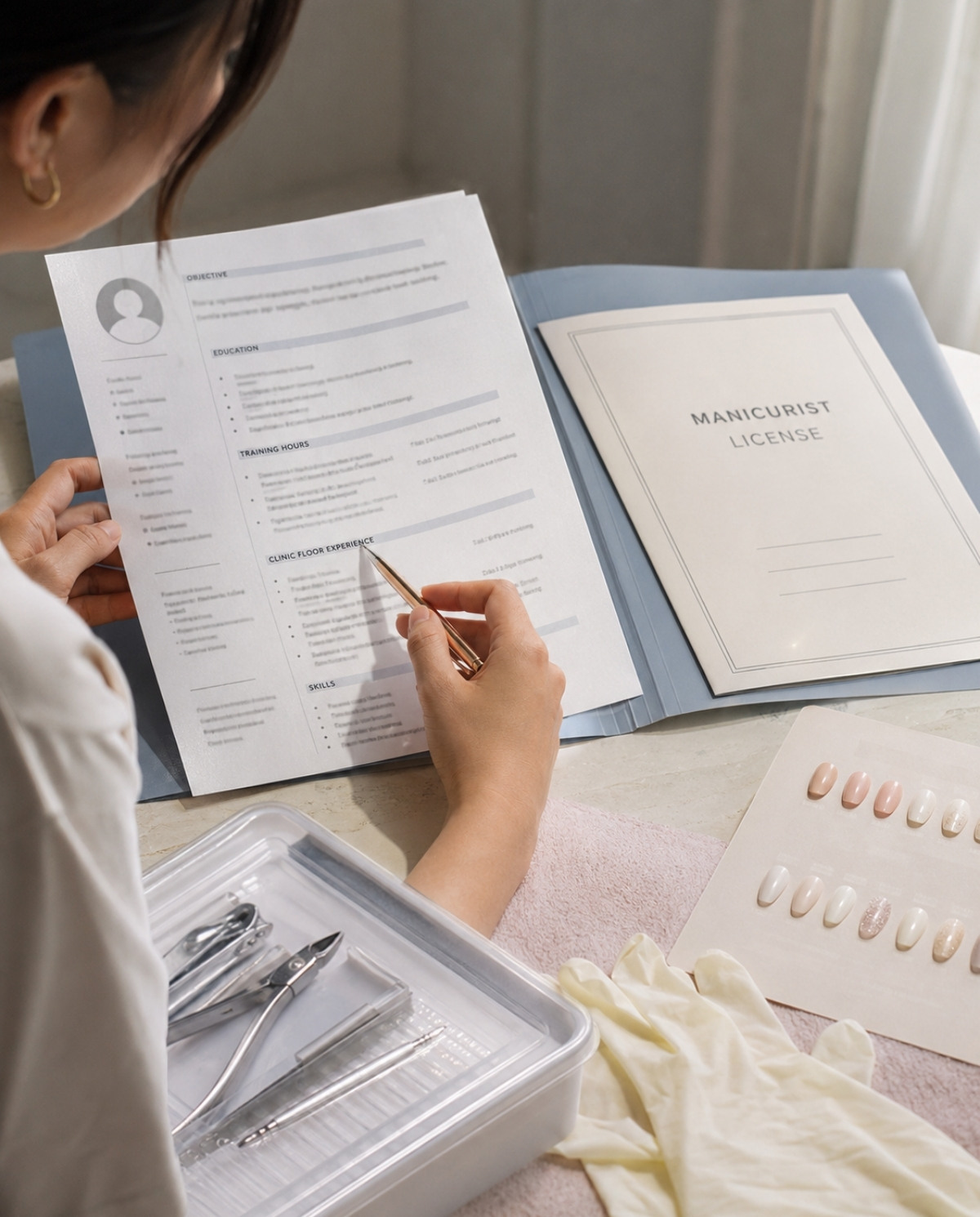
A nail practitioner license and authorization to operate a business are not interchangeable. The individual credential permits a qualified person to perform regulated services, while establishment licenses, business registrations, zoning decisions, and tax accounts govern other parts of the operation.
A person may qualify for a practitioner license through an approved school program or, in states that permit it, an apprenticeship. The person may also need to pass written, practical, or other examinations required by the licensing authority. Because pathways differ, holding a license does not necessarily prove that every practitioner completed a traditional school program.
The SBA guide to licenses and permits explains that requirements depend on the activity, business location, and applicable government rules.
A nail business may need more than one type of approval:
- Individual Practitioner License: Authorizes the named person to provide services within the license scope.
- Salon or Establishment License: Applies to a regulated salon, suite, home studio, or qualifying mobile facility.
- City or County Registration: May take the form of a business license, occupational tax certificate, or similar local approval.
- Zoning or Occupancy Clearance: May determine whether clients can legally visit a residential or commercial property.
- Tax Registration: May be required for business taxes or the collection of sales tax on taxable retail products.
- Entity or Trade-Name Filing: May apply when forming an LLC, corporation, partnership, or operating under an assumed business name.
An employee normally works under the establishment license held by the salon owner rather than obtaining that establishment license personally. A booth renter may also work inside an existing licensed salon without owning the salon license. However, the renter may still be responsible for an individual license, tax reporting, local registration, insurance, and other independent-business obligations.
A state-focused overview of nail licensing, schooling, and costs can provide useful background, but official state-board rules should be used to confirm current legal requirements.
Examples of state differences include:
- In Georgia, the official nail-care school curriculum requires 525 training hours completed over a course lasting at least four months. Georgia also permits a nail-technician apprenticeship requiring 1,050 hours over at least eight months.
- A person opening a Georgia salon must receive the salon or shop license before beginning operations. The Georgia Board FAQ also explains that the state establishment license is separate from the city or county business license.
- Georgia allows salons in private homes when all applicable requirements are satisfied. Under the state’s facility regulations, salon space cannot be used for domestic activities and cannot be connected to domestic space by a doorway or opening. Floor-to-ceiling separation is generally required.
- Georgia does not license a cart, kiosk, trailer, mobile home, motor home, or similar unit as a roaming salon. Such a unit must meet Board requirements and remain anchored at a permanent operating location.
- In Arkansas, the official cosmetology regulations establish a 600-hour manicure curriculum. Anyone planning to operate a salon or mobile salon should confirm the current application, facility, inspection, sanitation, equipment, and permit requirements directly with the Arkansas Department of Health before opening.
Home-based and mobile operations often involve both state-board rules and local property restrictions. Confirm zoning and facility requirements before remodeling a home, signing a lease, purchasing a mobile unit, or scheduling clients at a new address.
A general preparation sequence can include:
- Complete an approved educational program or a permitted apprenticeship.
- Meet the examination requirements established by the state.
- Apply for and maintain the required individual license.
- Select a legal business structure and register a trade name when necessary.
- Set up applicable federal, state, and local tax accounts.
- Verify local business-license, zoning, and occupancy requirements.
- Obtain establishment approval before operating a salon, suite, or home studio when required.
- Purchase insurance appropriate for the services, property, and locations involved.
This list is a planning framework rather than a universal legal order. States use different license titles, application processes, examinations, apprenticeship options, and rules for home or mobile services.
A simple business plan can help turn these requirements into a realistic operating budget. Estimate:
- Booth rent, studio rent, or home-studio expenses.
- Insurance and renewal fees.
- Product and disposable costs for each service.
- Booking-platform and payment-processing charges.
- Advertising expenses.
- Available appointments per week.
- Deposit, cancellation, refund, and late-arrival policies.
- Weekly and monthly revenue goals.
- Funds reserved for taxes, slow seasons, and equipment replacement.
Providing regulated services without the required individual or establishment license can result in citations, fines, disciplinary action, or an order to stop operating. An insurance carrier may also dispute a claim involving excluded services, an undisclosed location, or activity outside the insured scope. The actual result depends on state law, the circumstances, and the insurance contract.
Prepare for More Than the Technical Exam

A sustainable beauty career requires technical ability, sanitation knowledge, client communication, and an understanding of professional responsibilities. USA Beauty and Barber Academy offers hands-on nail training designed to introduce students to manicures, pedicures, nail enhancements, and design techniques.
Visit the Enrollment page to review the admission process, request more information, or arrange a campus tour.
You can also submit the contact form at the bottom of the page to connect with the admissions team and discuss available training options.
Questions New Nail Business Owners Often Ask
Does selling press-on nail sets from home require a salon license?
Selling completed press-on sets without applying them to customers may be treated as a product-based business rather than the operation of an in-person nail salon. In many locations, that distinction may mean a cosmetology establishment license is not required.
The outcome depends on the jurisdiction and the activities performed. Local business registration, sales-tax registration, home-occupation approval, lease restrictions, or homeowners association rules may apply, but none of these requirements should be assumed to exist in every case.
Businesses that manufacture, package, relabel, or include nail glue, polish, gel products, or other cosmetics should review the FDA guidance for nail-care products along with applicable labeling and state consumer-product requirements.
Confirm the business model with the state cosmetology board, state tax agency, and local licensing or zoning authority before beginning sales.
Can a first-year business owner be penalized for missing estimated-tax payments?
Yes. Starting a business for the first time does not automatically remove the obligation to pay tax during the year. An underpayment penalty may apply when required payments or withholding are insufficient or paid late.
Under the IRS estimated-tax penalty rules, many taxpayers avoid the penalty when:
- The amount owed after subtracting applicable withholding and refundable credits is less than $1,000.
- At least 90% of the current year’s tax was paid on time.
- At least 100% of the prior year’s tax was paid on time, when that safe harbor applies.
Certain higher-income taxpayers must use 110% of the prior year’s tax instead of 100%. A taxpayer who had no tax liability for the previous full tax year may not be required to make estimated payments when all applicable IRS conditions are met.
Federal estimated-tax installments are generally due April 15, June 15, September 15, and January 15 of the following year. A due date that falls on a weekend or legal holiday generally moves to the next business day.
Is a dedicated bank account mandatory for a sole proprietor?
Federal law does not generally require a sole proprietor to open a separate account solely because the business is operated as a sole proprietorship. However, local bank policies or other circumstances may affect how payments are handled.
Keeping business funds separate is still a strong recordkeeping practice. It makes it easier to compare appointments with deposits, document expenses, prepare tax returns, review payment-processing reports, and measure actual profit.
The SBA business-banking guide recommends opening an account once a business begins receiving or spending money.
Financial separation becomes particularly important when operating through an LLC or corporation because accurate records help support the distinction between business and personal activity.
Build a Career With a Stronger Business Foundation
Insurance, taxes, and licensing may not be the most artistic parts of nail technology, but they directly affect whether a business can remain stable. Clear financial records, appropriate coverage, and verified operating approvals make it easier to protect revenue and serve clients professionally.
Formal nail training can also introduce more than product application. Students may study sanitation, infection control, client consultation, state regulations, service procedures, professional conduct, and salon operations.
Those deciding between a specialized nail pathway and a wider beauty curriculum can compare cosmetology and nail technology career paths before selecting a program.
Choosing a training route that matches your state requirements and career goals can help you enter the industry with stronger technical preparation and a clearer understanding of how professional beauty businesses operate.