

How to Apply for Nail Technician Jobs When You’re Just Starting Out
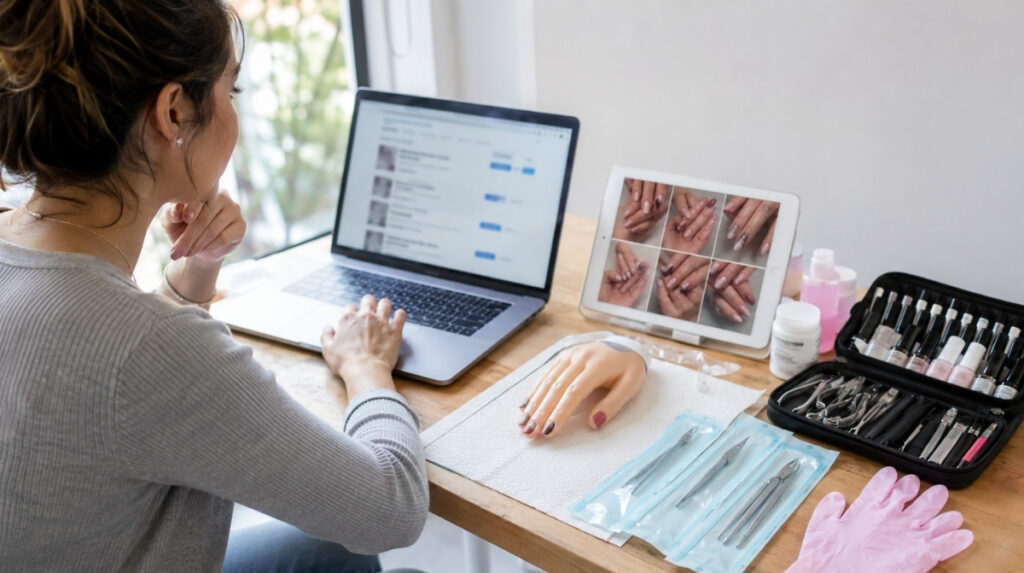
The classic career paradox can feel incredibly frustrating. Scrolling through job boards only to see salon owners asking for years of professional experience can make anyone feel stuck, especially when you cannot actually get that experience until someone gives you a chance. Sitting at home with a brand-new license and a nervous hand often brings on a wave of imposter syndrome. It is completely normal to wonder if managers will even look at your application when you have only worked on your beauty school classmates or close friends.
Every top-tier artist in our industry started exactly where you are standing right now. Shifting how you present your current value is the real secret to landing that first role. Salon owners look for safety, enthusiasm, reliability, and great customer service alongside basic technical skills. This guide lays out a clear, actionable roadmap to help you master how to apply for a nail technician job, grab the attention of local owners, and clear your first interview with total confidence.
Key Takeaways for New Nail Technicians
- The Market is Expanding: The U.S. Bureau of Labor Statistics projects 7% employment growth for manicurists and pedicurists from 2024 to 2034, with about 24,800 openings projected each year on average.
- Prioritize Your Real Skills: Past work in retail, restaurants, hospitality, or office support can translate directly into the client communication, scheduling, and time management skills owners need.
- Safety Leads the Way: Showing that you understand chemical safety, proper disinfection, product labels, ventilation, and Safety Data Sheets makes you stand out as a highly responsible beginner.
- Local Rules Matter: Every state sets its own training hour requirements, licensing pathways, apprenticeship rules, and salon-safety guidelines, so keeping up with your local board is vital for long-term compliance.
Building an Entry-Level Resume That Still Feels Strong
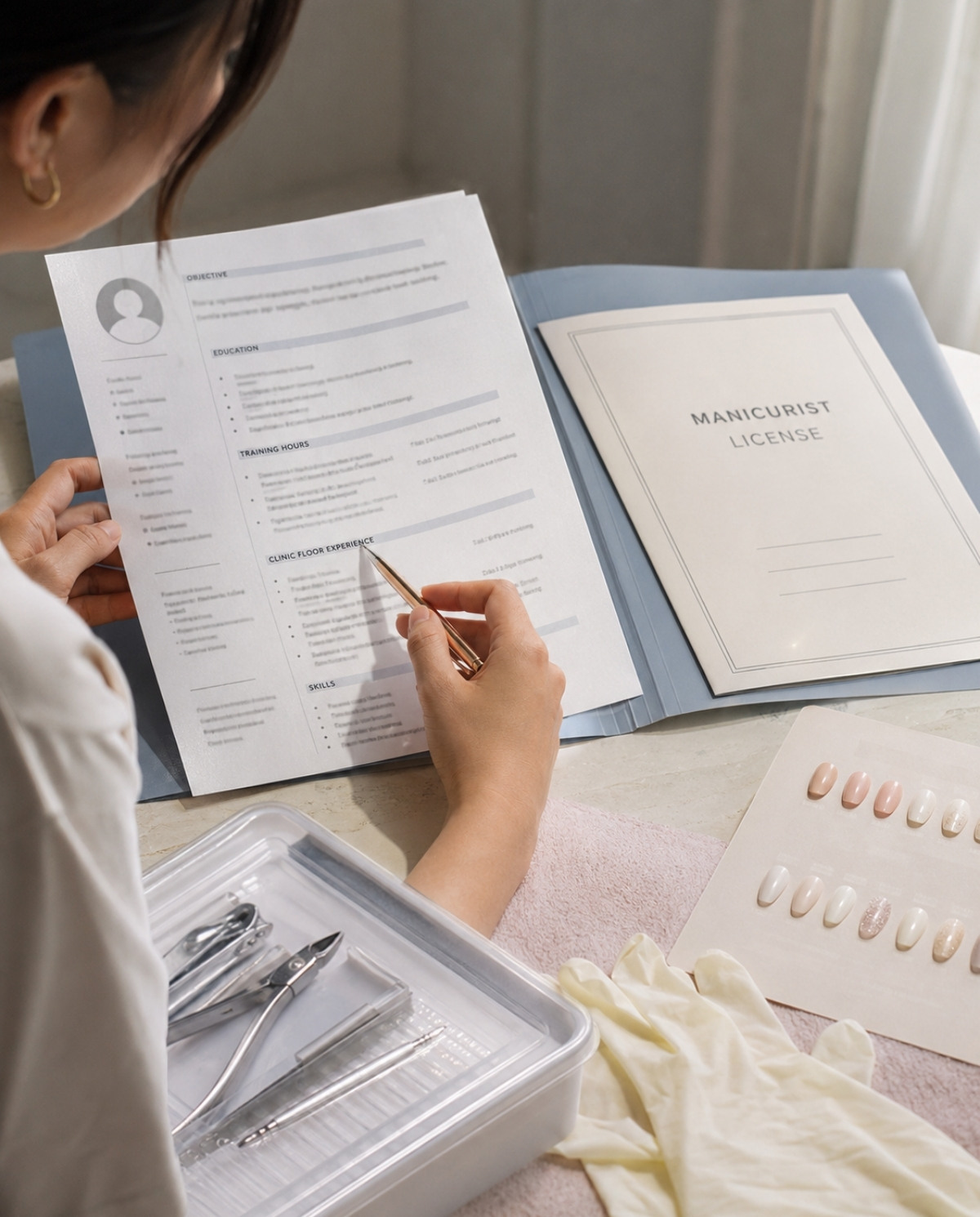
When you lack a traditional salon history, your resume should never look like a blank page. Instead, treat it as a personal marketing tool that highlights your technical potential and foundational training. Building a clean CV for a nail technician without experience requires you to focus heavily on your educational milestones.
A strong nail technician CV with no experience proves that entering the field with limited commercial hours is not a barrier. If you completed your training hours at a solid academy, those hours hold real weight. You should explicitly list your school hours, license status, salon floor practice, sanitation training, and any specialized workshops you took, such as e-file safety, structured gel application, acrylic fundamentals, or client consultation practice. To help you structure these details clearly, you can review this guide on building your career with a professional starter kit and nail tech skills checklist for 2026 to match your resume with the operational skills owners actually look for.
Your resume must also include a clear link to your visual work, even if it is still small. A clean digital page, Google Drive folder, or dedicated professional social media account can easily show your understanding of nail shaping, prep work, polish control, and clean setups. For a beginner, a small but organized nail technician portfolio is much more persuasive than a long document filled with unrelated filler.
Turning Past Jobs Into Salon-Ready Experience
If you worked in customer service, retail, hospitality, food service, or office administration before this, you already have skills that salons need. Owners want to know that you understand how to talk to clients, manage a schedule, recommend products, handle payments, and stay calm during busy hours.
For instance, if you were a barista, you can explain that you managed high-volume customer orders under tight time constraints while maintaining strict health protocols. If you worked in retail sales, highlight your experience helping customers find the right products, answering questions, processing transactions, and handling customer concerns professionally. These examples show that you understand the business side of service, which makes you a much lower risk to hire.
When you write the introductory profile at the top of your page, crafting a strong objective for a nail technician is crucial. Your nail technician objective statement needs to highlight your dedication to client safety and your desire to grow within a structured team environment. A strong entry-level example can focus on bringing strong sanitation habits, modern gel system knowledge, and client-first hospitality to a growing salon team.
Why Beginners Still Have Room in the Nail Industry
Many beginners assume they are competing for a tiny handful of slots against veteran techs. However, recent data from the U.S. Bureau of Labor Statistics shows that employment for manicurists and pedicurists is projected to grow 7% from 2024 to 2034, which is much faster than the average for all occupations.
According to the BLS, this growth results in roughly 24,800 open positions each year on average over the decade. Many of those openings are expected to come from workers who transfer into other occupations or leave the labor force, including retirements. That means the market continues to create steady opportunities for properly trained, licensed applicants who can show professionalism from day one.
The BLS also lists the median hourly wage for manicurists and pedicurists at $16.66 in May 2024. Actual income can vary widely depending on location, tips, commission structure, booth rental costs, client volume, and whether the technician is an employee or self-employed. For a beginner, this makes the first job valuable not only for pay, but also for building speed, confidence, repeat clients, and professional credibility.
Writing a Cover Letter That Feels Personal
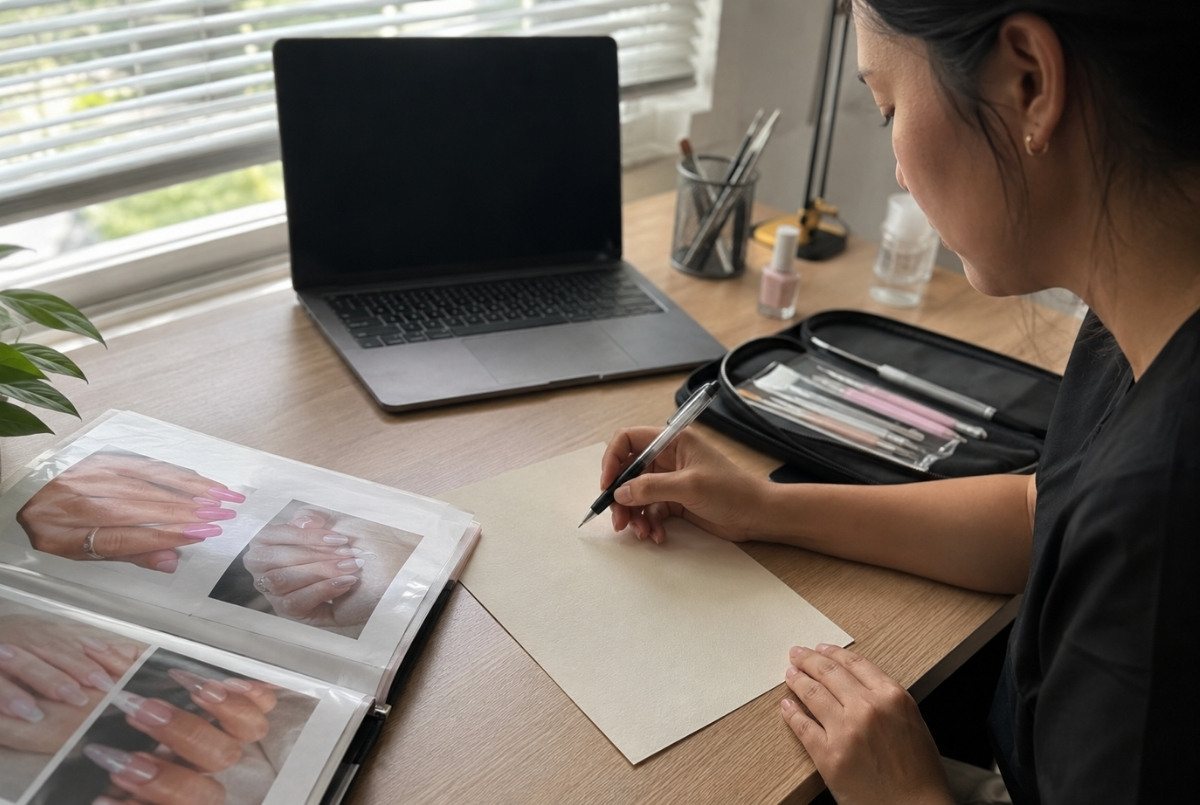
Your resume shows what you can do, but your cover letter tells owners who you are. When you sit down to write a personalized cover letter for a nail technician position, your primary goal is to show genuine enthusiasm for the specific salon you want to join. Managers see generic templates every single day, and they get tired of them.
An authentic cover letter for a nail technician with no experience should focus heavily on your teachability. Many salon owners actually like hiring eager beginners because they can train you to fit their exact brand standards, timing expectations, client-service style, and specific service protocols without having to break old habits.
What to Include in Your Opening Message
Address the salon manager or owner by name whenever you can find it. Explain exactly why you want to work at their specific location. Maybe you love their focus on intricate nail art, their reputation for spotless clean stations, their luxury pedicure menu, or their commitment to natural nail health.
Next, show that you understand your legal boundaries and scope of practice. Let them know you understand the difference between professional cosmetic exfoliation and invasive skin removal, and that you only perform services on intact, healthy skin and nails within your training and state rules. This commitment to safety is a huge selling point. Showing that you understand why professional nail salon hygiene and aftercare advice for nail technology are game changers in 2026 before you even get an interview sets you apart as an informed professional.
This compliance is particularly critical if you plan to practice in states with detailed regulatory boards. For instance, the Georgia Board of Cosmetology and Barbers states that cosmetology services should only be performed on intact, healthy scalp, skin, and nails, and Georgia explicitly prohibits razor-like implements such as credo blades and razor-type callus shavers. Arkansas also enforces detailed rules around personal cleanliness, pedicure-spa disinfection, labeled containers, disinfectant use, and storage of cleaned items in dry, covered containers through the Arkansas cosmetology rules. Wrap up your letter by stating your willingness to complete a practical technical test on a live model or a practice hand to prove your current skills.
Using Product-Safety Knowledge to Stand Out
Salons operate in a world where client safety, worker safety, state rules, and cosmetic product responsibilities all matter. According to the U.S. Food and Drug Administration, the Modernization of Cosmetics Regulation Act, known as MoCRA, expanded FDA authority over cosmetics and includes requirements such as serious adverse event reporting and safety substantiation for cosmetic products.
You do not need to be a chemical scientist, but showing that you understand the safety environment around products matters. The FDA's cosmetic registration and product listing guidance states that a responsible person must list each marketed cosmetic product with FDA, including product ingredients, and provide updates annually. That kind of product visibility makes it more important for salons to buy from reputable suppliers, read product labels, keep Safety Data Sheets accessible, and take client reactions seriously.
Knowing how to spot ingredient warnings also shows immense professionalism. For example, the FDA has warned that several cosmetic products marketed as gel nail polish removers were found to contain methylene chloride, also known as dichloromethane or methyl bichloride. FDA states that methylene chloride is prohibited in cosmetics at any level. Mentioning your habit of checking labels, avoiding suspicious imported removers, asking for Safety Data Sheets, and buying from reputable suppliers tells a salon owner that you are an asset who will help protect their clients and their business.
Creating a Beginner Nail Portfolio With Real Proof
In the beauty world, visual proof of your talent carries a lot more weight than words on a page. You do not need a massive list of paying clients to build something beautiful.
New graduates can build their initial collections using beauty school practice hands, classmates, family members, and friends. The goal is to showcase clean, consistent, and precise work rather than incredibly complex but messy art.
Choosing the Right Photos for Your Portfolio
When you take photos of your sets, avoid using heavy filters or busy backgrounds. Use a simple, neutral background and bright, natural light or a clean ring light. Make sure to crop out messy towels, open bottles, used files, or cluttered product containers in the background.
Your showcase should exhibit a good variety of classic shapes, like almond, square, and coffin. Focus on showing clean polish application that does not flood into the lateral nail folds or surrounding skin. Include close-up shots of high-quality basic manicures alongside your best designs. This proves you have mastered the foundational mechanics of nail care before trying to master wild trends.
For every photo, add a brief caption explaining the service type, the product system used, the prep method, and whether the work was done on a practice hand or live model. A beginner portfolio becomes much stronger when it explains the professional thinking behind the finished result.
Showing You Understand Nail Product Safety
A sophisticated presentation does not just show pretty colors, it demonstrates an understanding of product systems and client safety. As highlighted in a market trends analysis by Booksy Biz, modern salon conversations increasingly focus on cleaner positioning, ingredient awareness, and more specific product claims instead of vague marketing language.
This is where accuracy matters. HEMA-free and TPO-free products are often marketed as ways to reduce exposure to specific ingredients of concern, but they do not automatically make a service risk-free. The FDA's nail care product guidance explains that many nail products contain potentially harmful ingredients but may be safe when used according to directions. The British Association of Dermatologists has also warned about allergic reactions connected to methacrylate chemicals used in acrylic nails, gel nails, and gel polish.
Adding brief text captions that explain how you follow the manufacturer's lamp, cure-time, product-thickness, and application instructions proves you are an educated specialist. Avoid claiming that any product is completely allergy-proof. Instead, show that you understand the real safety habits: avoid skin contact with uncured gel, cure correctly, do not casually mix incompatible lamps and gel systems, keep containers closed, and follow product instructions.
Preparing for the Salon Interview and Skill Test
Walking into a salon for an interview can make anyone nervous, but thorough preparation is the best way to beat anxiety. When you prepare for your meeting, practice common nail technician interview questions and answers before you arrive.
Studying structured interview questions for a nail technician allows you to organize your thoughts so you do not freeze under pressure. Reviewing common interview questions and answers for a nail technician with a friend helps you steer the conversation back to your core training, your clean safety habits, and your genuine passion for the industry. Knowing how to answer common interview questions for a nail technician with answers prepared for a live panel gives you an instant boost of confidence.
How to Talk About Limited Salon Experience
A manager will likely ask how you plan to handle a fast-paced environment since you have not worked in a commercial salon before.
Skip the apologies for being new. Instead, answer confidently by explaining that during your beauty school clinic hours, you worked under specific time limits to mirror a real salon environment. You learned how to manage your station setup, consult with clients smoothly, complete a clean service, and maintain strict sanitation protocols under a schedule. Explain that you know you will need to build up your speed for their specific menu, but you already know how to stay organized, safe, and highly coachable under pressure.
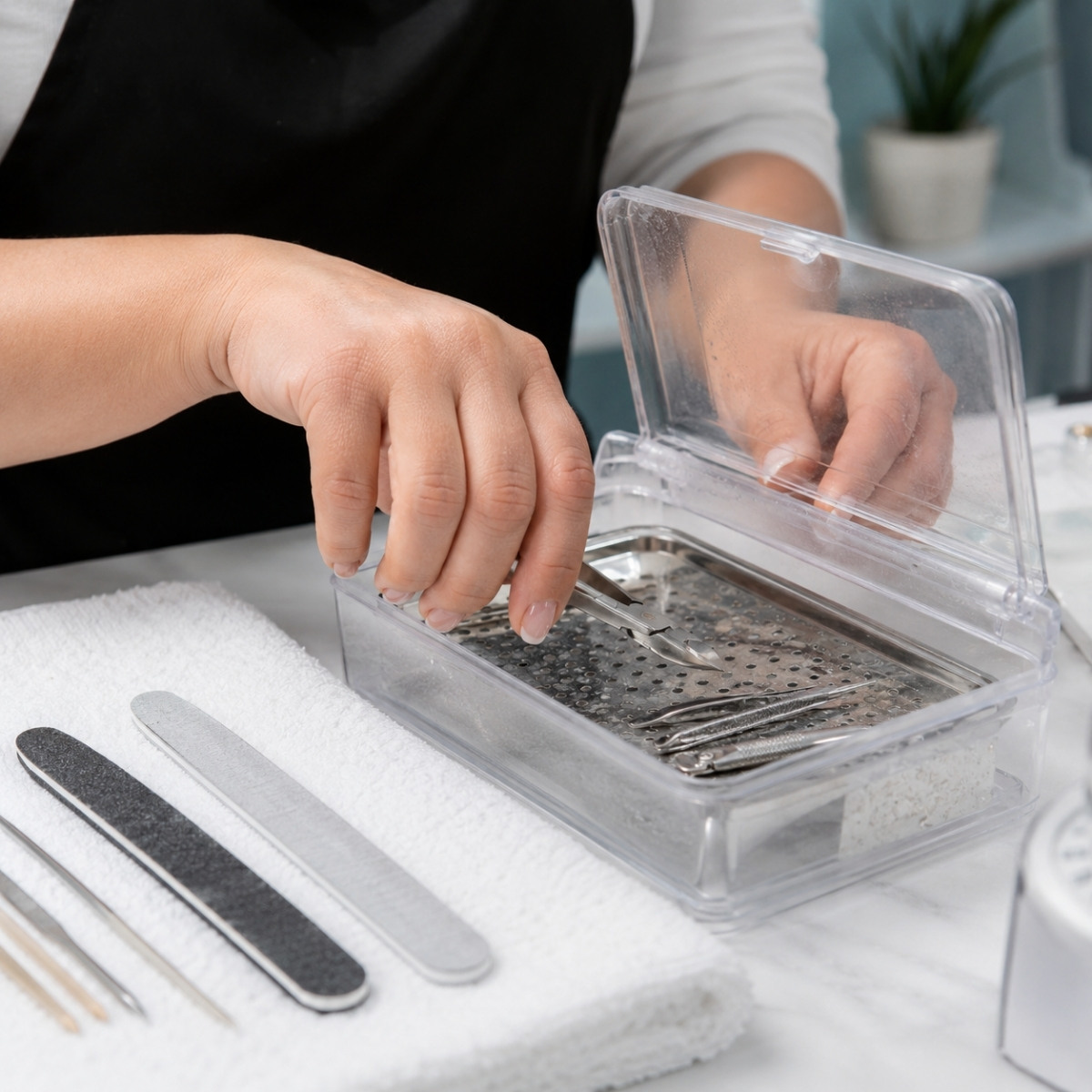
If they ask you to perform a practical audition on a model or practice hand, clarify what tools you need to bring ahead of time. If you bring your own kit, make sure every reusable implement is completely cleaned, disinfected, dry, and stored in a clean, covered container according to state-board rules. Keep your clean tools separate from used ones, and do not reuse porous single-use items such as certain wooden sticks, files, buffers, toe separators, or other disposable items unless your state rules and product instructions clearly allow proper disinfection. Throughout the audition, walk your evaluator through your steps out loud, explaining how you protect the natural nail plate, avoid overfiling, prevent cross-contamination, and maintain a clean station.
Cleaner Air, Safer Stations, and Better Work Habits
Occupational safety is a major topic in modern salons. Regular exposure to dust, chemical vapors, and fine particles requires smart workstation habits. The Occupational Safety and Health Administration advises salon workers and employers to choose safer products, read product information, use appropriate gloves, avoid surgical masks for chemical protection, and rely on good ventilation and work practices to reduce exposure.
Ventilation standards can also appear in building-code requirements. The International Code Council explains that the International Mechanical Code requires source-capture systems at manicure and pedicure stations, with a minimum exhaust rate of 50 CFM at each station and exhaust inlets located close to the point of chemical application when factory-installed inlets are not provided. Exact requirements can vary by jurisdiction and build-out, so it is safest to treat ventilation as both a worker-safety issue and a local-code issue.
Showing immediate respect for downdraft tables, keeping product containers closed when not in use, using clean waste-handling habits, and understanding basic ventilation maintenance signals to an owner that you view this career as a serious, professional trade.
Start Your Nail Career With USA Beauty & Barber Academy
Building a long-term, rewarding career starts with a modern education that salon owners trust. If you are ready to turn your passion into professional credibility, USA Beauty & Barber Academy offers a Nail Technician pathway designed to help students build the technical skills, sanitation habits, and salon-readiness needed for the beauty industry.
You can find out more about how to begin your journey in our Enrollment section. We love meeting future beauty professionals, and we invite you to fill out the contact form at the bottom of this page to connect with our team, ask questions, and take your next big step forward.
Frequently Asked Questions
Do I absolutely need a state license to get hired at a professional salon?
Yes, in almost every state, you must hold a valid, active state license or a state-recognized apprentice credential where that pathway is allowed before performing nail services for compensation. The U.S. Bureau of Labor Statistics explains that manicurists and pedicurists must complete a state-approved cosmetology or nail technician program and pass a state exam for licensure.
However, state pathways can vary. Some states also recognize regulated apprenticeship options. For example, under the Georgia apprentice rules, nail technician apprentice training requires 8 months and 1,050 hours, and apprentice hours cannot be combined with school hours. Requirements vary by location, but attending a structured beauty school is one of the most direct ways to get the necessary hours, sanitation knowledge, and technical preparation to pass your state exams.
What kind of pay structure should an entry-level nail technician expect?
New technicians usually start on an hourly base pay plus tips, a commission split, or a booth rental agreement. For a beginner with no prior salon experience, securing hourly base pay plus tips is generally the safest path. This structure ensures you are compensated for your time while you are building a loyal clientele and learning salon operations.
Commission and booth rental can become attractive later, but they usually require an established client base, strong rebooking habits, and a clear understanding of expenses. According to the BLS, the median hourly wage for manicurists and pedicurists was $16.66 in May 2024, but real take-home income can vary widely based on location, tips, service pricing, schedule, product costs, and employment structure.
How can I protect my respiratory health while working with nail chemicals?
Protecting your health comes down to excellent salon ventilation and safe habits. Many people can work in nail care while pregnant or managing sensitivities, but they should take workplace exposure seriously and speak with a healthcare professional about their specific situation. Good ventilation, closed containers, nitrile gloves when appropriate, source-capture dust control, and careful product selection are more reliable than relying on a basic mask alone.
The OSHA nail salon chemical hazard guidance specifically warns that surgical masks do not protect workers from gases, vapors, or particulates. OSHA also explains that NIOSH-approved N95 respirators can help with particulates such as dust from buffing or filing, but they do not protect against chemical vapors or gases. If vapor protection is actually required, the employer must evaluate exposure and follow OSHA respiratory-protection requirements, including proper respirator selection, fit testing, medical evaluation, and training.