

Key Takeaways
- Same State Rules Across Campuses: Every student pursuing the same cosmetology license in a given state has to complete identical state licensing standards, no matter if they enroll at a community college, a technical center, or a private beauty academy.
- College Degrees Are Optional: Most cosmetology courses award a postsecondary certificate or nondegree credential rather than a bachelor’s degree. In Georgia, earning a master cosmetologist license takes 1,500 hours of training—not four years at a university.
- Look Beyond the School Label: Total tuition, kit expenses, class schedules, start dates, and graduation timelines differ from one campus to the next. Always request written program breakdowns before assuming a specific school category is automatically faster or more affordable.
- Verify Credentials and Financial Aid: Confirm state board approval, campus accreditation, and federal financial aid participation for your exact program before signing any enrollment paperwork.
Scrolling through beauty school websites late at night can make your head spin. One tab promises you can graduate in under a year, the next pushes an associate degree, and someone in your family is probably still asking why you are not applying to a four-year university. When you are about to invest thousands of dollars and months of your life into training, second-guessing every option is completely normal.
What matters most is separating the marketing hype from how licensing actually works. You do not have to go to college for cosmetology in the traditional university sense to build a real career behind the chair. Whether you train at a public community college, a technical center, or a private beauty academy, your state holds every graduate to the exact same licensing exam and hour requirements. The real differences come down to how much you pay out of pocket, how your weekly schedule fits your life, how much hands-on client practice you get, and how well the staff prepares you for your first salon job.
How Do Community Colleges, Trade Schools, and Private Beauty Academies Compare?
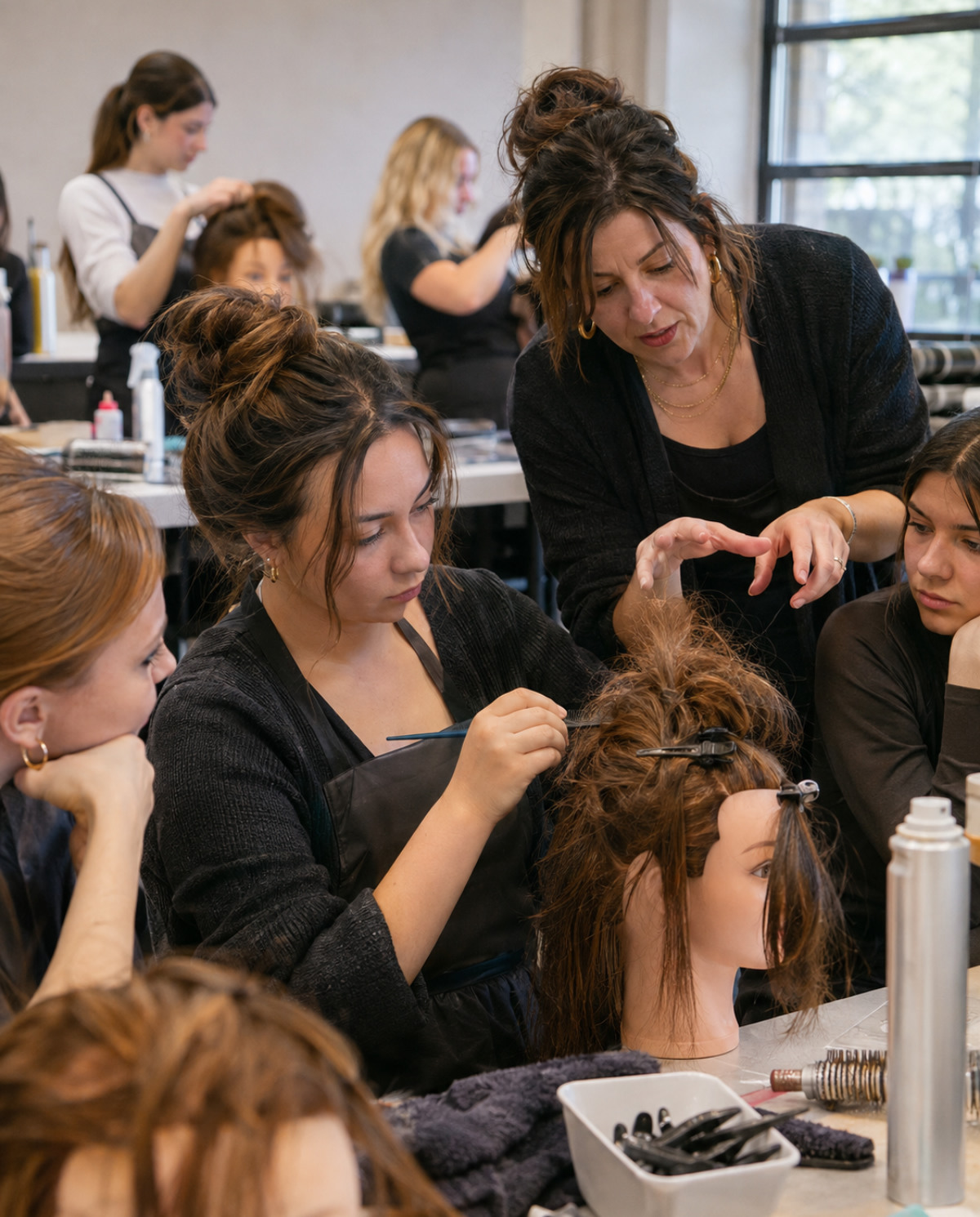
Once you realize a bachelor’s degree is unnecessary, the real challenge is narrowing down the best schools for cosmetology that fit your budget, learning style, and calendar. School categories give you a rough starting point, yet two campuses in the exact same category can operate very differently. I always recommend comparing individual cosmetology programs side by side rather than judging a school solely by its name.
Community Colleges with Cosmetology Programs
If keeping upfront tuition low is your top priority, checking out community colleges with cosmetology programs is a smart first step. State and local funding often keeps in-district tuition lower, and certain campuses let you pair your technical training with general education courses to earn an associate degree. That extra degree path can make sense if you want formal classes in business management or communication, though you should always separate what the state requires for licensing from what is only needed for the degree.
Do not automatically assume a community college track takes two full years, either. A standalone certificate program often runs on a completely different schedule than an associate degree, and enrollment windows vary. Ask admissions for the exact clock hours, weekly timetable, upcoming start dates, and projected graduation date.
Cosmetology Trade School Options
Enrolling in a cosmetology trade school or technical center usually means following a streamlined curriculum without general education classes like history or algebra. Because technical institutes can be publicly funded, nonprofit, or privately owned, tuition rates and daily schedules vary widely across the country.
Focus on the practical details of how the program runs: how many hours you train per week, how frequently new cohorts begin, whether night classes exist, and how much supervised clinic floor time you receive before graduating. A focused curriculum only helps if the schedule allows you to finish your state-mandated hours reliably.
Private Beauty Academies
Private beauty academies often appeal to students who want frequent start dates and flexible schedules without waiting for a traditional fall or spring semester. Many private campuses also weave salon consultations, retail product knowledge, client rebooking habits, and portfolio building into their everyday routine alongside state board prep. Still, never assume those perks come standard just because a school calls itself an academy—verify them in person.
During your visit, ask to sit in on a theory lesson and watch the student clinic floor in action. Pay attention to how instructors coach students, how steady the client traffic is, and whether tools and supplies are readily available. A trendy salon interior looks great on social media, but consistent, hands-on instruction is what actually builds your confidence.
To put average costs into perspective, Trade-Schools.net’s breakdown of NCES data notes that 2023–24 average annual tuition and required fees sat around $4,074 for in-district students at public two-year colleges compared to $16,524 at private for-profit two-year institutions. Keep in mind those numbers reflect broad national averages across many fields—not an exact price quote for a specific beauty program.
Build your own comparison sheet using written numbers from each campus. Factor in tuition, registration fees, textbooks, your tool kit, uniforms, state exam fees, commuting costs, and potential loan interest. Afterward, weigh the timelines: graduating earlier can get you earning behind the chair sooner, provided the school’s start date and weekly hours genuinely fit your life.
Does Cosmetology School Count as College, and Can You Get Financial Aid?
A question I hear all the time from future stylists is whether cosmetology school counts as college. In most cases, cosmetology training leads to a postsecondary certificate or career diploma rather than an academic degree, though select community colleges offer an associate degree option. Regardless of the credential title, the curriculum has to satisfy your state board’s licensing standards.
Instead of standard semester credits, beauty schools measure progress in clock hours—meaning documented, supervised hours spent in classrooms, practical workshops, and the student salon clinic. Exact hour minimums depend on your state and license category. Under Georgia’s cosmetology curriculum regulations, master cosmetology students must complete 1,500 hours of training. Their first 250 hours include theory, mannequin practice, skin and nail care, and supervised work on live models. Students must earn a minimum passing score of 75 percent before moving on to clinical services with patrons. Keep in mind that state-mandated training hours generally do not transfer as academic credits toward a traditional four-year university degree.
Financial aid availability comes down to the individual campus, the specific program, and your personal eligibility. If you enroll in a qualifying program at an accredited, participating school, you can submit the Free Application for Federal Student Aid (FAFSA) to see if you qualify for federal support like Pell Grants or student loans. Filing the FAFSA does not guarantee a set dollar amount, so reviewing a complete beauty school funding guide covering FAFSA, Pell Grants, and 529 plans can help you map out scholarships, savings, and remaining out-of-pocket expenses early on.
It also helps to look realistically at job growth and income expectations before taking on tuition debt. According to the U.S. Bureau of Labor Statistics, overall employment for barbers, hairstylists, and cosmetologists is projected to grow 7 percent between 2025 and 2035. BLS also projects roughly 80,300 job openings each year on average, many of them arising when workers retire or move into other occupations.
The BLS reports a 2025 median annual pay of $35,880 for that combined group, which factors in reported tips for employees but leaves out independent workers. Notably, BLS estimates that 48 percent of hairdressers, hairstylists, and cosmetologists were self-employed in 2025. Independent work covers everything from chair rental to running a private suite, and those figures do not reflect what a brand-new graduate takes home right away. If you dream of working for yourself, weigh projected service income against booth rent, backbar supplies, liability insurance, self-employment taxes, and the months it takes to build steady repeat clients.
How to Know If a Cosmetology School Is Accredited and State-Approved

Before you fall in love with a gorgeous student salon floor, verify the school’s legal standing. Many prospective students wonder if cosmetology schools are accredited—and the answer is that some hold accreditation, while others operate with state approval alone. Both credentials matter, and they serve two completely different roles. State approval grants a campus legal permission to teach hours that count toward your state licensing exam. Accreditation, on the other hand, is a quality review handled by an independent agency recognized by the U.S. Department of Education.
Understanding how to know if a cosmetology school is accredited is especially crucial if you plan to rely on federal grants or loans. Even at an accredited institution, you still need to confirm that your specific cosmetology course qualifies for the exact federal aid programs you want to use. Also, do not assume accreditation makes transferring hours effortless. Whether another beauty school accepts your completed hours depends on that school’s internal rules and state board regulations, so always request transfer policies in writing.
You can verify a campus yourself by looking up its exact name and address in the Department of Education’s Database of Accredited Postsecondary Institutions and Programs. Check the listed accreditor and current status, then ask admissions to show proof of state board approval and clarify which financial aid programs apply to your track. In Georgia, licensed cosmetology schools are also required to post their active school license and latest inspection report on campus.
Checking current accreditation standing matters more than ever right now. As Higher Ed Dive reported in October 2026, the U.S. Department of Education gave the National Accrediting Commission of Career Arts and Sciences (NACCAS) 12 months to resolve compliance issues and paused reviews for schools seeking new accreditation during that period—affecting roughly 300 pending applications as of July. While currently accredited NACCAS schools did not automatically lose their status, any campus claiming candidate status warrants extra questions about whether it currently qualifies for federal financial aid.
Before signing anything, read the entire enrollment agreement carefully. Find out what happens if illness or life emergencies push back your graduation date, whether extra hours trigger overtime fees, and how those charges are calculated. Reputable schools will gladly hand you an itemized cost breakdown and written attendance policy.
What Separates the Best Cosmetology Schools From Average Ones?
Earning a passing score on your state board exam proves you know safety rules and core techniques, which is a huge accomplishment. Still, passing a test does not automatically guarantee you will feel confident handling a thorough client consultation, pacing a two-hour color appointment, or working comfortably with every hair texture. When figuring out what are the best cosmetology schools for your goals, pay close attention to how students practice daily and how instructors track skill growth.
If you want a realistic preview of what you’ll really learn in cosmetology school, start by checking your state’s required subjects and then ask how the campus builds on those fundamentals. In Georgia, master cosmetology training covers haircutting, hair coloring and lightening, chemical texture services, scalp and hair care, basic facials, hair removal, and nail services. The first 250 hours combine theory, mannequin work, skin and nail instruction, and practice on live models. Students must reach a minimum passing score of 75 percent before they can perform clinical services on patrons.
During a campus tour, watch how theory turns into real-world practice. Ask whether students conduct full consultations before starting a service, receive direct instructor coaching during appointments, and work with guests across diverse hair textures and skin tones. Also ask how the curriculum covers sanitation protocols, product chemistry, and recognizing skin or scalp conditions that require a doctor rather than a salon service.
Practical business habits are just as important as technical skill. Find out whether instructors teach you how to explain service pricing transparently, estimate appointment timing, take well-lit portfolio photos with client permission, recommend at-home maintenance products, and rebook guests before they leave. Seeing those habits practiced on the clinic floor tells you a lot about how career-ready graduates actually are.
It is also smart to check whether the school’s tools and lesson materials reflect modern salon trends. New America’s reporting on beauty education highlights student frustration at some institutions over outdated textbooks and limited training in textured hair care and modern coloring techniques. That certainly does not apply to every academy, which is why inspecting current lesson plans, student kits, and live clinic work in person is so worthwhile.
Good Questions to Ask a Cosmetology School During Your Tour
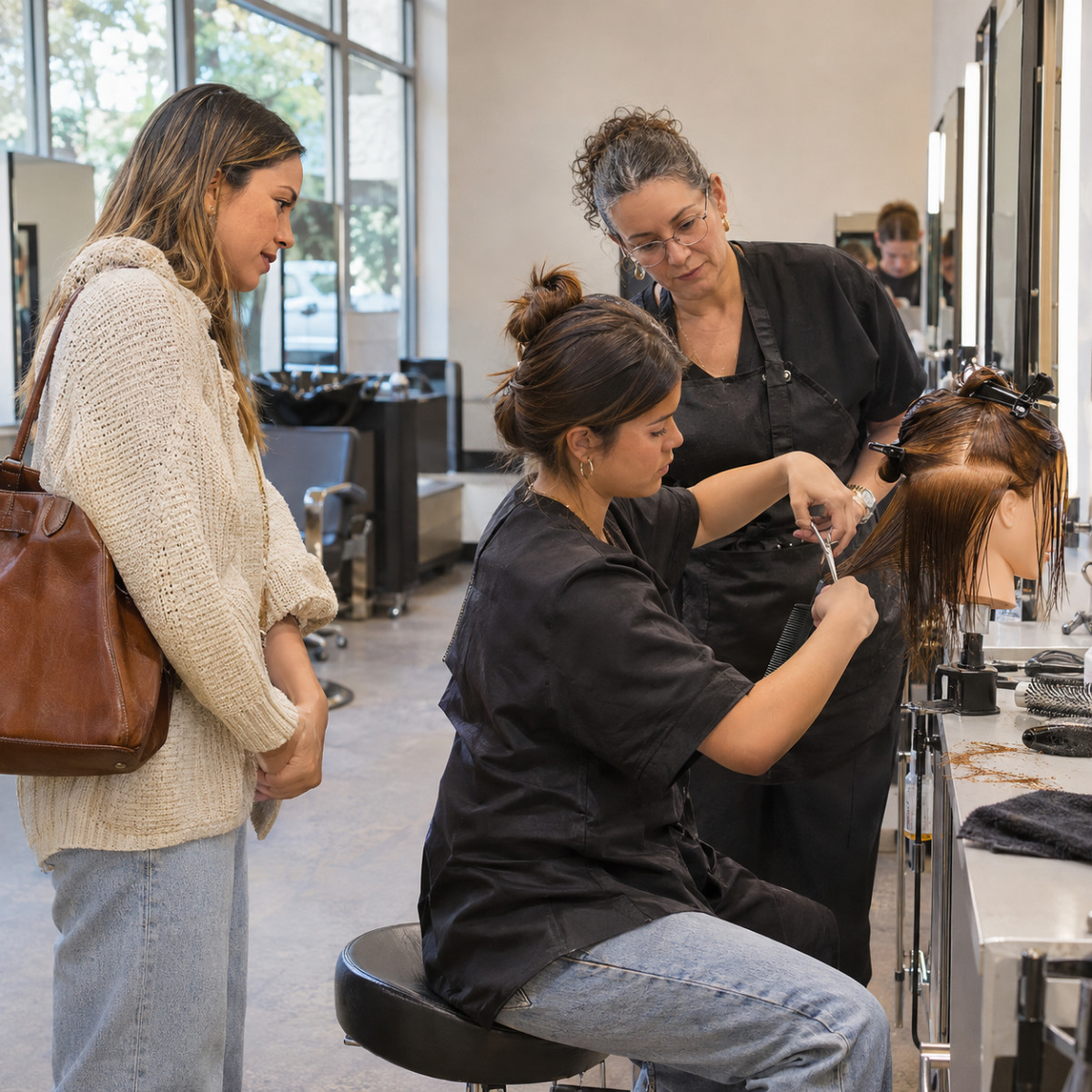
Stepping into an admissions meeting can feel intimidating when you are excited to get started. Bringing a checklist of good questions to ask a cosmetology school keeps the conversation practical and makes comparing multiple campuses much easier.
- What is the true all-in cost of the program? Ask for an itemized written quote covering tuition, application fees, textbooks, your student kit, uniforms, supplies, graduation fees, and state licensing exam costs.
- What will my exact weekly schedule look like? Confirm weekly attendance hours, upcoming start dates, your projected completion date, and how missed hours are made up.
- What happens if I need extra time beyond my contract end date? Review written policies regarding absences, leaves of absence, and any extra hourly fees.
- What are your latest graduation and state board pass rates? Ask which reporting year the numbers cover, how many students were tracked, and whether pass rates reflect first-time test takers.
- How soon do students start taking clinic clients? Find out how beginners prepare for the salon floor, how closely instructors supervise appointments, and how feedback is delivered.
- What practical skills are taught beyond state board requirements? Ask specifically about textured hair training, contemporary color formulation, client consultations, sanitation, pricing services, and building repeat clientele.
- Which financial aid options apply to my specific program? Verify federal aid eligibility, request a personalized financial aid estimate, and calculate your exact remaining balance.
- How does the school help students transition into salon jobs? Ask about salon guest speakers, career fairs, mock or working interview prep, and documented job placement outcomes.
While you are on campus, ask to inspect an actual student kit so you can see the quality of the shears, blow dryer, and mannequins—and ask what items students usually have to replace out of pocket. I also recommend cross-checking school data on the College Scorecard recommended by Federal Student Aid to compare typical borrowing amounts and graduate outcomes alongside the figures admissions hands you.
Frequently Asked Questions About Choosing a Cosmetology School
Can I transfer my cosmetology license if I move to another state?
Every state board sets its own rules for out-of-state stylists, so always check with the destination state’s licensing board before relocating. Many states offer licensure by endorsement or reciprocity if you already hold an active license in good standing. For instance, the Georgia State Board of Cosmetology and Barbers notes that actively licensed cosmetologists from other states may qualify for endorsement even if their original training required fewer hours than Georgia’s standard. Transferring mid-program as a student is much trickier, so ask both the new school and state board how partial hours are evaluated.
How do I decide between cosmetology, esthetics, and barbering?
Start by thinking about the services you want to perform every day behind the chair or treatment bed. Cosmetology covers broad haircutting, styling, coloring, and chemical services alongside foundational skin and nail care, whereas esthetics and barbering focus deeply on specialized scopes of practice. If your passion is strictly skincare and facials, a dedicated esthetics track is often a more direct route—in Georgia, esthetician training requires 1,000 clock hours compared to 1,500 hours for master cosmetology. Just be sure to compare full tuition quotes before assuming fewer hours automatically equals a dramatically lower bill.
What do salon owners actually look for when hiring new graduates?
Hiring standards vary depending on the salon’s culture, but most owners care far more about attitude, cleanliness, and basic technical readiness than perfection. Many salons use a working interview where you demonstrate sanitation habits, consult with a model, execute a foundational cut or color application, and show how well you take coaching. Ask admissions how they prepare students for working interviews and whether you can build a photo portfolio during clinic hours.
Can I work a job and attend cosmetology school part-time?
Plenty of students work while earning their hours, provided the campus offers evening or part-time schedules. Naturally, attending fewer hours per week extends your calendar timeline. For example, completing 1,500 hours at 20 hours per week takes at least 75 weeks, whereas a 35-hour full-time schedule takes roughly 43 weeks before factoring in holidays, school closures, or missed days. Checking out a detailed breakdown of how many months cosmetology school takes on full-time and part-time paths can help you pick a schedule you can realistically stick with.
Take the Next Step Toward Your Beauty Career
Finding the right school comes down to seeing the classrooms in person, asking direct questions about schedules and tuition, and making sure the training aligns with Georgia’s licensing standards. If you want to explore how USA Beauty and Barber Academy prepares students for real salon careers, you can find out more about admission requirements and campus tours over in Enrollment. Have questions about class schedules, financial aid, or getting started? Fill out the contact form at the end of this article and an advisor will reach out to help you plan your next move.