


Main Points to Know
- Licensing Depends on the State: The United States does not issue one national cosmetology license. Some states recognize regulated salon apprenticeships, while others require applicants to graduate from an approved school.
- Apprenticeships Often Take More Hours: On-the-job training routes frequently require substantially more hours than beauty school. Georgia requires 3,000 apprentice hours instead of 1,500 school hours, while California requires 3,200 on-the-job hours plus 220 hours of related training instead of 1,000 school hours.
- Exam Performance Is Not Consistent: In certain California reporting periods, cosmetology apprentices recorded lower written-exam pass rates than candidates educated in schools. These findings are not national averages and can change by year, examination, program, language, and candidate category.
- Online Courses Cannot Replace Practical Training: Some approved programs provide theory instruction online, but students must still complete the hands-on training recognized by their state for initial licensure.
- Moving a License Can Be Complicated: Completing an apprenticeship does not automatically prevent license transfer. However, the destination state may examine your training, testing history, professional experience, and current license status before approving you.
Building a career around hair, skin, and nail services can be rewarding for someone who enjoys creativity and helping clients feel more confident. However, traditional beauty programs can feel difficult to manage when tuition at some private schools exceeds $15,000 and training must be completed around work or family responsibilities.
That leads many future cosmetologists to consider workplace training instead of a conventional school program. This route is legally available in certain states, but it still involves regulated education, extensive supervised practice, and specific licensing requirements.
Is Beauty School Always Required for Licensure?
Each state establishes its own training hours, testing standards, approved educational formats, and licensing procedures. Because there is no nationwide cosmetology license, a training route accepted in one state might not qualify an applicant in another.
Before selecting a program, examine your state’s cosmetology requirements and confirm that the education you plan to complete will make you eligible for its licensing examination.
Graduating from a state-approved school remains the standard route in most states. Numerous jurisdictions also recognize formally organized apprenticeships supervised by licensed professionals. Availability, registration procedures, approved occupations, training hours, and supervision standards differ considerably.
Georgia and Arkansas illustrate how state policies can vary:
- Georgia: Under the Georgia State Board of Cosmetology and Barbers curriculum rules, a school-based Master Cosmetologist course must contain 1,500 hours completed over at least nine months. Georgia’s official apprenticeship regulations provide another option requiring 3,000 hours over a minimum of 18 months.
- Arkansas: The standard initial-license route requires 1,500 hours in a licensed cosmetology school. The current materials published by the Arkansas Department of Health Cosmetology Section do not identify a salon apprenticeship that substitutes for those school hours.
Learning how to obtain a cosmetology license without attending a conventional academy begins with reviewing the applicable state rules. Where apprenticeships are recognized, bypassing beauty school does not mean avoiding education. It means receiving that education through another regulated training system.
What Training as a Salon Apprentice Involves
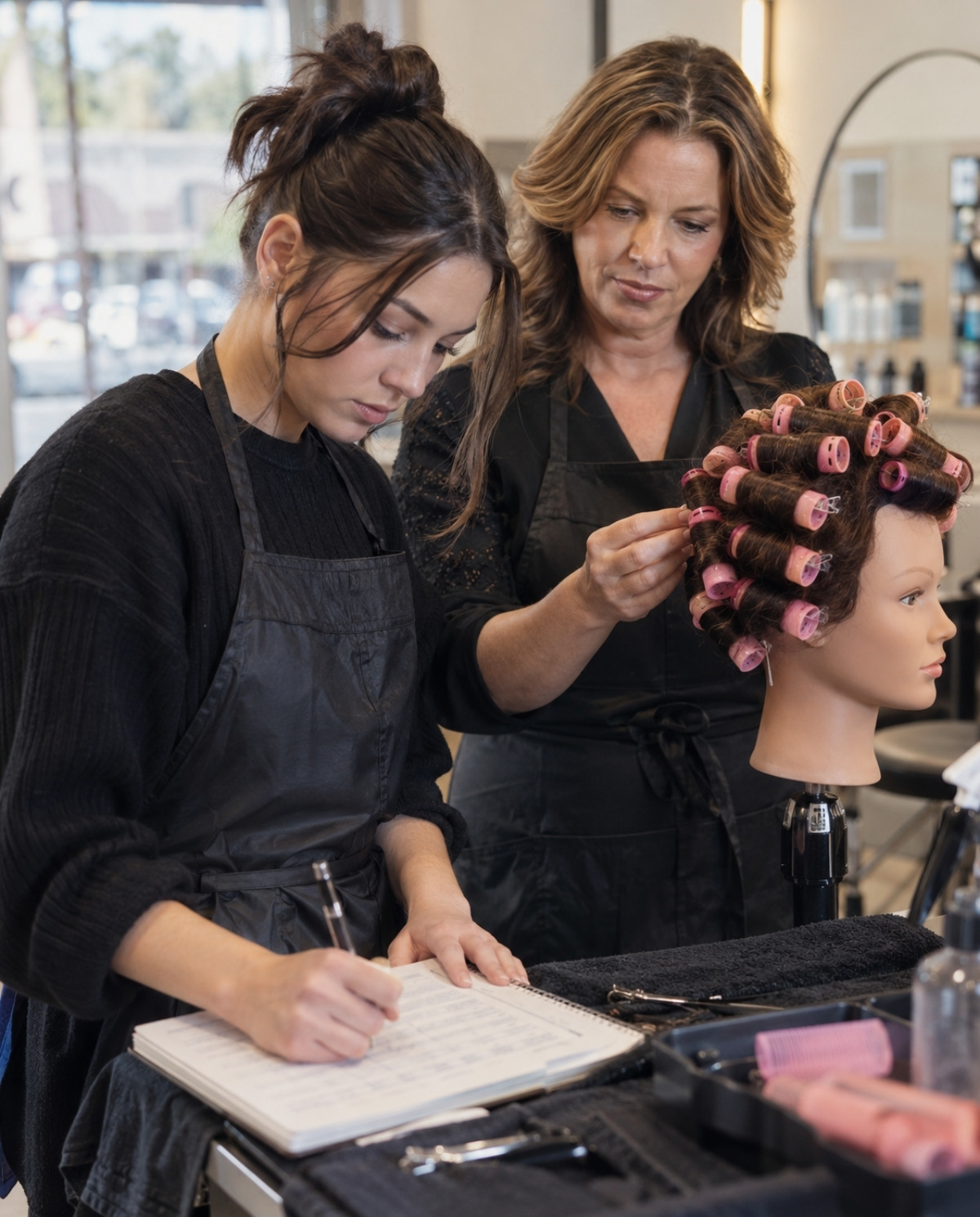
A salon apprenticeship is one of the main alternatives to a school-based cosmetology course. Rather than spending most training hours in classrooms and student clinics, an apprentice develops skills under supervision inside an approved working salon.
This arrangement is not the same as accepting an ordinary entry-level salon position. The apprentice, trainer, establishment, and program sponsor may need to be registered or approved before training begins. Work completed before the appropriate authorization is issued might not count toward licensing requirements.
Apprentices must also complete more than practical client services. The California Board of Barbering and Cosmetology, for example, requires a minimum of 3,200 on-the-job training hours over two years. Cosmetology apprentices must additionally complete at least 220 hours of related training supplied by the program sponsor.
Advantages of Training in an Active Salon
One significant benefit is regular exposure to the way a professional salon operates. Apprentices can learn how appointments are organized, consultations are conducted, products are discussed, and services are managed throughout a working day.
Interaction with paying clients may help apprentices strengthen their communication abilities and understand realistic service timing. Depending on the state and program, they may gradually perform approved services under the direct supervision of their assigned trainer.
A legitimate apprenticeship generally connects compensated employment with structured instruction and supervised experience. The U.S. Department of Labor describes apprenticeship as a model that combines paid on-the-job training with classroom instruction. Actual wages, schedules, benefits, and training expenses depend on the employer, program rules, and applicable employment laws.
For some learners, this structure reduces the need to leave the workforce completely while preparing for a license. It can also provide opportunities to develop professional relationships within the local beauty industry.
Possible Drawbacks and Training Gaps
The value of an apprenticeship depends greatly on its organization, sponsor, and supervising professional. Technical ability does not automatically make someone an effective instructor, and a busy salon may struggle to provide lessons as consistently as a school.
Apprentices also should not expect every salon duty to count toward approved training. Cleaning stations, preparing products, and watching services may be normal workplace responsibilities, but licensing authorities generally require documented education across particular subjects and practical operations.
Theory instruction is equally important. Cosmetologists must understand infection control, client safety, chemical services, product use, hair and scalp conditions, skin and nail fundamentals, and the laws regulating professional services.
Before entering a program, ask:
- Must the apprentice and establishment receive approval before any hours are recorded?
- Who maintains the hour records, and when are those records submitted?
- What happens to completed training if the supervisor leaves or the establishment closes?
- Can earned hours move to another approved salon or sponsor?
- How will theory, sanitation, chemical safety, and state regulations be taught?
- Are textbooks, formal classes, and examination-preparation resources included?
- What wages, instructional charges, registration fees, equipment costs, and testing fees apply?
- How much of the weekly schedule is assigned to recognized training activities?
These questions matter because state rules can restrict the way hours are transferred or combined. Georgia does not allow apprentice hours to be combined with school hours. The state also requires new paperwork whenever an apprentice changes the supervising professional or salon.
How to Interpret Apprentice Exam Statistics
Certain official reports indicate that apprentices can experience additional difficulty with written licensing examinations, but the data requires careful interpretation.
In a collection of California Board apprenticeship meeting materials, cosmetology apprenticeship candidates had lower written-exam pass rates than school-educated candidates during the periods reviewed. Results differed across reporting periods, license categories, examinations, programs, and languages.
The figures should not be presented as a permanent California rate or a national apprenticeship average. They document differences between candidate and training categories during particular reporting periods, but they do not establish why those differences occurred.
Prospective apprentices should request recent program-level results from the sponsor and ask whether the statistics cover first-time candidates or every examination attempt.
Can Online Classes Lead to a Cosmetology License?
Flexible education is especially attractive to people balancing training with employment or family responsibilities. Although online courses can make certain subjects more accessible, they should not be mistaken for a complete licensing route.

Subjects That May Be Available Remotely
Some state-approved schools operate hybrid programs that deliver a portion of the theory curriculum online. Depending on state regulations and program approval, these subjects might include anatomy, chemistry, infection control, product knowledge, business practices, and state law.
Distance education does not automatically count toward licensing requirements merely because a school offers it. The instruction must be part of a recognized program, and the institution may need to document attendance, assignments, examinations, participation, and completed hours.
Before enrolling, confirm directly with the school and licensing authority that:
- The institution is approved by the appropriate state authority.
- The particular cosmetology program makes graduates eligible for licensure.
- The state allows the advertised theory hours to be completed remotely.
- The course provides all required supervised practical training.
- The curriculum satisfies the rules of the state where you intend to seek a license.
Training That Must Be Completed in Person
Cosmetology is a practical occupation requiring supervised experience with sanitation, client protection, tools, haircutting, styling, chemical applications, and other services included within the applicable state scope of practice.
An online certificate alone is therefore not equivalent to a cosmetology license or proof of completing an approved licensing program. Practical experience must come through a school, apprenticeship, or another pathway formally accepted by the state.
Online beauty courses are not automatically illegitimate. Many provide useful continuing education, business instruction, product training, or examination review. The concern arises when a provider suggests that an inexpensive digital certificate by itself authorizes someone to perform regulated services.
Before paying a provider, ask the state board whether that exact course qualifies applicants for initial licensure. Promotional terms such as “accredited,” “board-ready,” or “professionally certified” do not override licensing regulations.
Comparing the Time Required by Each Route
People searching for the fastest licensing option may assume apprenticeship is quicker because they can begin working in a salon immediately. Starting as a registered apprentice, however, is not equivalent to becoming an independently licensed cosmetologist.
Full-time school is frequently the shorter path because its schedule is organized around accumulating approved education hours. Depending on the state requirement and weekly attendance schedule, completion may take approximately 8 to 15 months. Part-time attendance, missed classes, holidays, closures, and administrative delays can extend that timeline.
For a closer look at the relationship between required hours and completion dates, review this guide explaining how long full-time and part-time cosmetology programs may take.
Apprenticeships frequently involve more training hours and may include a mandatory calendar period. Georgia requires 3,000 hours over at least 18 months. California requires 3,200 on-the-job hours over two years in addition to 220 hours of related training.
Individual circumstances can still affect which option finishes sooner. A person attending school part time might take longer than someone completing a demanding apprenticeship schedule. For students able to attend school full time, however, the school pathway is often the more direct route to examination eligibility.
To learn more about written tests, practical testing policies, and preparation, review our cosmetology state board examination guide.
Will Apprentice Training Be Accepted in Another State?
Relocating can complicate cosmetology licensing because states use terms such as reciprocity, endorsement, and transfer differently. There is no single nationwide process that guarantees recognition of an existing license.
Training through an apprenticeship does not automatically prevent a cosmetologist from qualifying in a different state. The destination authority may examine:
- Whether the current license is active and free from disciplinary restrictions;
- The amount and type of education or training completed;
- Whether the applicant passed written or practical examinations;
- The applicant’s length of licensed professional experience;
- Whether the original licensing requirements are substantially equivalent;
- Whether additional education or a state-law examination is required.
Some states emphasize post-licensure work experience, while others compare the original training directly with their own educational standards. Apprentices should preserve their registration documents, curricula, hour reports, related-training records, examination results, employment history, and original license.
For more information about differences between jurisdictions, see our overview of state cosmetology hours, examinations, renewals, and licensing rules.
The Cosmetology Licensure Compact is designed to simplify professional practice across participating jurisdictions. However, the official Compact website confirms that multistate licenses are not yet being issued.
Once applications become available, eligibility is expected to require applicants to live in a Compact member state and hold an active, unencumbered single-state cosmetology license issued by that home state. Applicants will also need to pay the applicable fees and satisfy the Compact’s application conditions.
The Compact does not establish a universal number of training hours. Each member state continues to determine the education, training, and competency examination required for its original single-state license.
Anyone expecting to relocate should investigate the destination state’s licensing rules before committing to either an apprenticeship or school program. Neither route guarantees automatic approval in every jurisdiction.
Comparing the Complete Financial Commitment

Cost is one of the primary reasons people investigate alternatives to conventional beauty school. An apprenticeship can reduce tuition expenses and provide employment income during training, but it should not automatically be considered free.
Depending on the arrangement, apprentices may need to pay for:
- State applications, registrations, and permits;
- Required theory classes or related instruction;
- Textbooks and digital learning materials;
- Tools, products, uniforms, and safety equipment;
- Examinations and initial licensing fees;
- Transportation and childcare;
- Extra education following a program change or relocation.
Before signing an agreement, request a complete written explanation of wages, fees, required supplies, weekly hours, educational responsibilities, and refund conditions. Confirm whether the arrangement treats the apprentice as an employee and how compensation will be determined.
Standalone salon apprenticeships generally do not provide Pell Grants or federal student loans in the same way as eligible college or career-school programs. An apprenticeship connected with an eligible educational institution or separate approved program may have different funding arrangements. Depending on the circumstances, apprentices may also qualify for employer assistance, state workforce funding, veterans’ benefits, scholarships, or other program-specific support.
Beauty schools have expenses of their own, including tuition, kits, registration charges, and living costs during training. Students attending eligible programs at participating institutions may qualify for federal student aid.
Accreditation alone does not guarantee access to Pell Grants or federal loans. The institution and program must satisfy federal eligibility requirements, the school must participate in the relevant aid programs, and the student must qualify individually.
Prospective students can use the official Federal Student Aid school search to look for a federal school code and review available information. They should also confirm program eligibility with the institution’s financial-aid office.
When comparing the two routes, consider:
- Tuition or related-instruction charges;
- Books, tools, uniforms, registrations, examinations, and license fees;
- Expected earnings during apprenticeship training;
- Transportation and childcare costs;
- The estimated time required to qualify for a license;
- Available grants, scholarships, workforce programs, and employer assistance;
- Possible additional-training costs after relocating.
Deciding Which Option Fits Your Situation
School and apprenticeship training can both lead toward licensure where state law recognizes them, but neither option is automatically suitable for every student.
A state-approved school may suit learners who want an organized curriculum, scheduled theory classes, regular instructor access, examination preparation, and a potentially shorter full-time route.
An apprenticeship may suit someone whose state permits it, who has identified a reputable program and supervisor, who needs employment income, and who learns effectively in an active salon. Before choosing this route, understand the additional hours, reporting obligations, related education, and consequences of changing supervisors or moving.
Regardless of the option selected, verify the exact program with the state licensing authority before paying fees or beginning training.
Common Questions About Alternative Licensing Routes
May Applicants Use an ITIN on a License Application?
Requirements depend on the jurisdiction. The California Board of Barbering and Cosmetology, for example, accepts a valid Individual Taxpayer Identification Number instead of a Social Security Number on licensing applications.
An ITIN is issued for federal tax purposes. It does not grant immigration status or employment authorization. Applicants should separately confirm their legal authorization to work and their state board’s current identification requirements.
Will a Criminal Conviction Prevent Licensing?
Not automatically. The rules depend on the state, the offense, and the applicant’s circumstances. The Texas Department of Licensing and Regulation, for example, evaluates relevant criminal history individually rather than treating every conviction as an automatic disqualification.
Prospective Texas applicants may request a criminal history evaluation letter before investing in training. Applicants elsewhere should ask whether their licensing authority offers a comparable pre-application review.
Can an Apprenticeship-Based License Move Across State Lines?
Possibly. An apprenticeship does not automatically prevent a cosmetologist from becoming licensed elsewhere. The destination state may review the existing license, education and training records, examination history, professional experience, and disciplinary status.
If the qualifications are not considered equivalent, additional education, experience, or testing may be necessary.
Is Federal Student Aid Available to Salon Apprentices?
A standalone salon apprenticeship generally does not offer Pell Grants or federal loans in the same way as an eligible postsecondary program. Funding might still be available through an employer, workforce agency, veterans’ program, scholarship, or separate eligible educational provider.
Beauty-school students should also verify both institutional and program eligibility because not every school or program participates in federal student aid.
Are Apprentices Allowed to Provide Client Services?
Where cosmetology apprenticeships are permitted, registered apprentices may usually provide authorized services under the supervision specified by the state and program.
California allows apprentices to work on paying clients when the services are performed under the direct supervision of the designated trainer in the approved establishment named on the apprentice license. Apprentices cannot work independently or count unregistered employment toward future licensing requirements.
What Happens When an Apprentice Moves to Another Salon?
The process depends on the state’s regulations. Changing salons or trainers may require ending the existing arrangement, obtaining an official record of completed hours, registering the new supervisor or establishment, and receiving approval before earning additional credit.
Georgia specifically requires a new application each time an apprentice changes the supervising licensee or salon. Apprentices should contact the licensing authority and secure official training records before leaving the original arrangement.
Begin Your Professional Beauty Training
If you prefer organized theory instruction, supervised practical experience, and structured preparation for the licensing process, an approved beauty program may be a suitable next step.
USA Beauty and Barber Academy offers cosmetology among its listed training options. Prospective students can visit the academy’s Enrollment page to request information, learn about the enrollment process, arrange a campus tour, and discuss programs and scheduling.
For additional assistance, submit your information through the contact form at the end of this page.