

Barber License Requirements: Everything You Need to Know & Prepare
Starting a career in the grooming industry is an exciting move, but it often comes with a side of confusion when it's time to deal with state regulations. If I had a dollar for every time a talented barber felt overwhelmed by a state board website, I could probably open a whole new shop. It is a common feeling to worry that the artistic side of the job might get buried under a pile of legal requirements, but making that transition is actually the best thing you can do for your long-term success.
The modern industry in 2026 demands more than just skill with a pair of shears; it requires a level of legitimacy that only a formal license can provide. By stepping up and meeting these standards, you are essentially upgrading your business from a hobby to a high-level career. Before we get into the details, if you are looking for a clear path forward, I highly recommend reading through our guide on Steps To Becoming A Barber: Everything You Need To Know About Barbering to get the full picture.
Why Barber License Requirements Help You Win
It is easy to see barbering license requirements as just another obstacle, but I prefer to think of them as a way to protect your livelihood. Looking at the 2026 updates from the IDFPR, you can see that these rules now include vital training in areas like abnormal skin growth education and on different hair types and texture.
When you follow the rules set by the board of barbering and cosmetology, you are doing more than just checking a box. You are building a professional reputation that customers and insurance companies can trust. In an era where anyone can post a tutorial online, having the backing of the barbering and cosmetology board shows that you are a pro who knows how to keep clients safe and healthy.
The Standard Licensing Checklist
While every state has its own flavor of red tape, the journey toward getting a barber license usually follows a very similar pattern across the country. Here is what you can generally expect:
- Proving eligibility with basic ID and meeting age requirements.
- Completing the required training hours at a school approved by the state.
- Finishing specific safety and sanitation coursework required by the board.
- Submitting a full application package along with the necessary fees.
- Passing the required exams, which typically include a theory portion.
- Managing your barbering and cosmetology license renewal to stay active.
For a few specific examples, you can check out the Florida DBPR checklist which outlines the school-to-license route, or the New York barbering page which mentions specific health certifications needed from a doctor. If you happen to be in California, you should note that they have moved to a written-only system for licensure lately.
Navigating the State Board Exam for Barbering
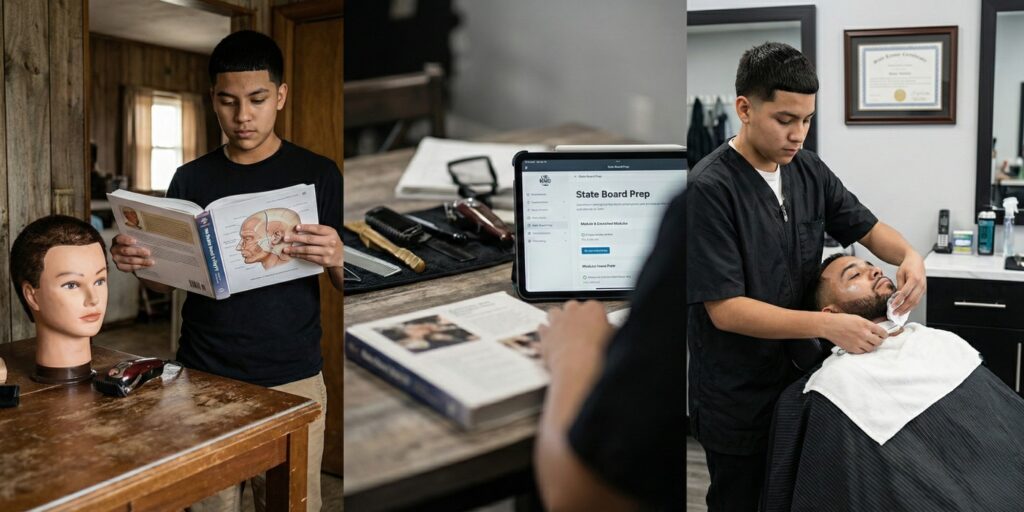
One of the biggest stress points I see is the state board exam for barbering. It is natural to feel some nerves about a written test, but the barbering exam in 2026 is really just there to prove you can handle the responsibility of the job.
If you are curious about how many questions are on the barber exam, current Board of Barbering and Cosmetology guidelines suggest a written test of about 85 scored questions plus 10 pre-test items. You usually get around two hours to finish, which is plenty of time for most people.
The focus is largely on safety and sanitation. As the 2026 Sunset Review Report points out, the main goal is to prevent consumer harm. Knowing your stuff here means you won't have to worry about the kind of mistakes that lead to legal trouble down the road.
The Real Value of Being Licensed
When you look at the barbering license cost, it helps to view it as an investment in your earning potential. While you might wonder how long it takes to get a barber license, keep in mind that being licensed allows you to offer higher-margin services. According to the BusinessDojo 2026 Industry Report, specialized services like beard sculpting and hot shaves can have profit margins exceeding 80 percent.
Beyond the money, being legitimate opens up:
- Opportunities for commercial leases and shop ownership.
- Eligibility for business and liability insurance.
- Access to professional-grade tools and vendor pricing.
- The ability to use top-tier digital booking platforms.
The Risks of Barbering Without a License
I have seen people try to fly under the radar by cutting hair in a garage, but that is a dangerous game to play in 2026. Practicing barbering without an active license carries heavy risks that just aren't worth it.
First, you could face criminal charges. In Florida, the DBPR reports unlicensed activity to prosecutors as a misdemeanor. In New York, you could even face jail time or significant fines. Furthermore, agencies like the Texas Department of Licensing and Regulation may permanently ban you from ever getting a license.
Perhaps the biggest risk is financial. Without a license, no insurance company will cover you. If a client has a bad reaction to a product, you are on the hook for everything. Plus, you’ll be locked out of the modern industry; Boulevard’s 2025 Trend Benchmarks show that nearly half of all bookings are now handled through digital systems after hours that require professional credentials.
Starting Your Journey the Right Way
Before you can hold that license in your hand, you need to log the hours and learn the trade. This is where you build the foundation for your entire career. It isn't just about passing a test; it is about developing the habits that make you a professional.
At USA Beauty Academy, we are dedicated to helping you become salon ready. We provide a real-world training environment where you can master your craft and prepare for a successful career. We have spent years helping students turn their passion for grooming into a legitimate, thriving business.
If you are ready to take the next step and learn more about our process, I invite you to visit our Enrollment page. You can also use the contact form at the bottom of this page to get in touch with us directly. We would love to help you get started on the path to becoming a licensed professional.